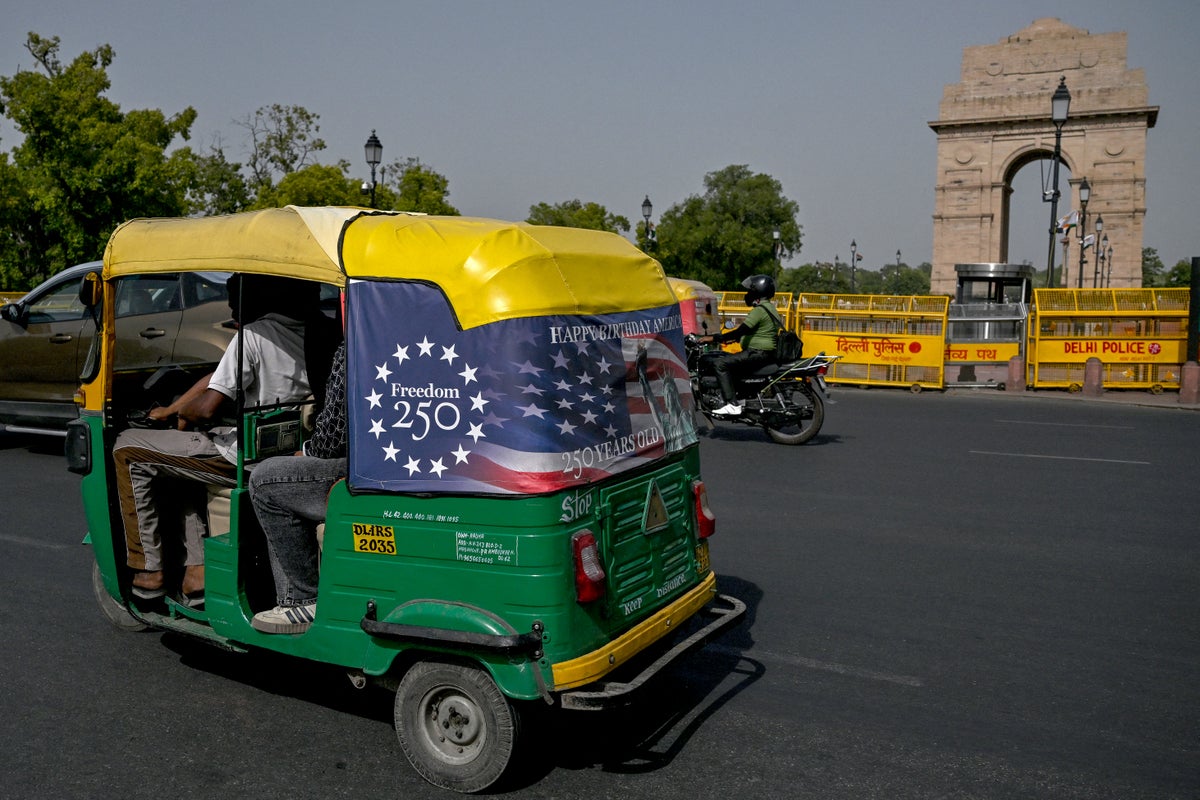
If you find yourself stuck in a sweltering rush hour jam in New Delhi right now, look ahead. You might just see Donald Trump staring straight back at you from the rear flap of a green and yellow auto-rickshaw.
It is a bizarre sight. Next to his face, a bold graphic proclaims, "Happy Birthday America! 250 Years Old." Some vehicles feature the Statue of Liberty instead, but it is the image of the American president that is stopping traffic.
This isn't a grassroots fan club. It is a calculated, aggressive public diplomacy campaign cooked up by the United States embassy in India. They call it the "Freedom Fleet." The diplomatic push marks the upcoming 250th anniversary of American independence. It also perfectly timed with a multi-city tour by US Secretary of State Marco Rubio.
But while diplomats in Washington view this as a brilliant piece of cross-cultural soft power, the reality on the ground is a lot more transactional. For the local drivers navigating Delhi's punishing heat and rising fuel costs, the American president is essentially free maintenance and a packet of loose tea leaves.
Inside the Freedom Fleet initiative
The brains behind this mobile advertising blitz belong to Sergio Gor, the US Ambassador to India. Known for his close ties to the administration, Gor launched the initiative to plant iconic American imagery directly into the daily lives of ordinary Indian citizens.
Auto-rickshaws, or tuk-tuks, are the lifeblood of Delhi's transport network. Thousands of them crisscross the sprawling megacity daily. They are moving billboards. Usually, their vinyl back covers advertise local fertility clinics, quick loan apps, or English language coaching centers. The US embassy decided to buy out that real estate.
The embassy announced that thousands of circulating tuk-tuks would receive these sponsored messages. On social media, officials gleefully declared that freedom was literally on the move. They urged locals to spot them across the capital.
The campaign coincided with intense diplomatic activity. Marco Rubio arrived for high-level bilateral talks, hitting key regional hubs like Kolkata before landing in New Delhi for an independence anniversary gala. The rickshaws were meant to provide a vibrant, populist backdrop to these state meetings. They certainly succeeded in getting noticed, though perhaps not for the reasons the state department intended.
What the drivers actually think
To understand how this campaign works, you have to look at the fuel stations where rickshaws queue for Compressed Natural Gas. That is where the actual distribution happens.
Wielding a hammer and a stack of vinyl covers, local installers work the long vehicle lines in 111-degree heat. They bribe and persuade weary drivers to let them swap out their old, worn-out canopies for the new Trump-branded ones. The incentive structure is remarkably simple.
First, the canopy itself is free. A standard, plain replacement cover costs about 700 rupees, which is roughly nine US dollars. For a driver earning a tight daily wage, saving that money is a big deal. Second, the promoters sweeten the arrangement with small physical gifts. They hand over a packet of tea bags. Sometimes it is a jar of pickles. The gifts change constantly to keep the drivers interested.
Most operators have zero stake in American politics. Take Murari Lal, a veteran driver who happily accepted the makeover. He admitted he knew the face belonged to Trump, but his logic was purely financial. He got a brand-new roof cover without spending a single paisa.
Others agreed out of sheer necessity. A driver named Pradeep Kumar had a torn canopy that let in the blistering sun and the monsoon rains. The embassy workers fixed his roof for free. When asked what he knew about the design, his answer was brief. He knew it was Trump, but nothing else mattered. It kept the sun off his neck.
Geopolitics meets the local gas pump
Not every driver is willing to play along. The campaign rolled out during a tense economic moment for India's commercial transport workers. Prime Minister Narendra Modi recently called for nationwide fuel conservation measures, leading to government work-from-home days. Shortly after, domestic fuel prices jumped twice in a single week.
Commercial drivers bore the brunt of those hikes. Because of that, a political icon from the West can provoke intense anger.
Tushar, a young worker hired to install the covers, revealed that convincing some drivers is an uphill battle. The ones who read the daily newspapers are highly aware of global conflicts. They blame western foreign policy for driving up global energy markets and causing local fuel inflation. Some look at Trump's face and refuse the cover immediately, ignoring the free tea and the cost savings.
Another anonymous driver expressed deep resentment, stating flatly that he would not put the poster on his vehicle even if they paid him. In his eyes, western policies have complicated the economic survival of working-class people half a world away.
Yet, a fascinating undercurrent of admiration exists among some operators. A driver named Santosh Chauhan offered a different perspective. He described Trump using the Hindi term for a king, calling him arrogant and transactional. While he acknowledged those are generally negative traits, he argued that India needed that exact brand of tough leadership to handle its regional rivals.
For these drivers, the image represents a raw, unyielding version of state power that they find appealing, regardless of the official diplomatic messaging about shared democratic values.
The soft power reality check
This entire corporate-style rollout exposes the deep friction between high-level diplomatic strategies and street-level realities. The US embassy treats the project like a major marketing victory, complete with a launch event and a steady stream of social media content. They are incredibly proud to display their head of state on the streets of a key global ally.
But on the asphalt of New Delhi, the symbolism completely detaches from its original meaning.
To the average commuter, it is a surreal piece of visual clutter. To the driver, it is a practical tool for survival. A shield against the sun. A way to bypass a minor repair bill. The grand ideas of international cooperation and shared history are secondary to a dry roof and a warm cup of tea at the end of a shift.
It proves that international soft power campaigns rarely land the way strategists plan them. They get absorbed, reinterpreted, and commodified by the people on the ground. The US government wanted to project a message of global friendship and democratic strength. What they actually did was fund a highly effective, unexpected utility program for Delhi's hardest working taxi drivers.
How to track international marketing trends
If you are analyzing global public relations or managing cross-cultural communication campaigns, you can learn a lot from this embassy experiment. Avoid the common mistakes made by western organizations when exporting ideas to South Asian markets.
- Assess local economic pain points before launching public stunts. If your target audience is struggling with inflation or utility costs, tying your brand to high-profile political figures can backfire.
- Offer immediate tangible utility rather than abstract messaging. The only reason this campaign achieved scale is because it solved a real problem for the drivers by replacing their damaged roofs.
- Monitor grassroots sentiment through local fixers and installers. Relying strictly on official press releases will give you an inaccurate picture of how your brand is perceived on the ground.