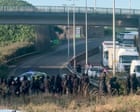
Dozens of masked figures dressed in head-to-toe black gear march onto a vital transport artery. They link arms. They drop a sudden, heavy blockade across the A20. Traffic backs up for miles. Local commuters sit stranded while travelers miss ferry sailings to France.
This wasn't a spontaneous pop-up rally. It was a calculated paramilitary-style drill.
When a group calling itself Patriot Platform shut down access roads to the Port of Dover, they didn't bring placards or banners. They brought walkie-talkies, coordinated scout bikes, and face-obscuring balaclavas. If you think this was just another rowdy roadside gathering, you're missing the entire point of what happened on that Saturday morning.
Let's look at how the event actually unfolded. At around 6:45 AM, hundreds of men materialized near the Kent port. Eyewitnesses reported a chilling lack of verbal communication. Instead of chanting slogans right away, participants handed out silent slips of paper. Older coordinators monitored police positioning from electric bikes, feeding tactical movements back to the masked groups blocking the tarmac.
National Highways recorded four miles of congestion and delays stretching past thirty minutes before authorities cleared the lanes by lunchtime. Ferry operators scrambled to rebook stranded passengers. Yet, the disruption itself was secondary to the display of intimidation.
The Real Intent Behind the Masks
Why organize a blockade with zero banners? Because the goal wasn't public persuasion. It was psychological dominance.
When far-right figures like Stephen Yaxley-Lennon—widely known as Tommy Robinson—amplified live streams of the blockade, they weren't trying to debate immigration policy. They were showcasing a rapid-mobilization model. Danny Thomas, the founder of Patriot Platform, had openly teased the operation days prior, promising supporters a "message" that would prove their capability to disrupt major infrastructure at will.
Local leaders and politicians reacted with predictable frustration. Mike Tapp, the Labour MP for Dover and Deal, publicly called out the demonstrators for targeting local amenities like the weekend parkrun alongside port access. Conservative district councillor Chris Vinson pointed out the glaring safety hazard of anonymous groups dictating who gets to move through a major trade hub.
Yet, condemning the behavior ignores the operational evolution on display. These groups are shifting away from traditional street marches. They are testing decentralized, high-speed road shutdowns designed to catch local law enforcement flat-footed.
What the Media Misses About These Tactics
Most coverage treats these incidents as isolated public order nuisances. They aren't. They are stress-tests for civil infrastructure.
When you have coordinated squads using encrypted apps, walkie-talkies, and scout bikes, you are looking at tactics borrowed from urban guerrilla movements, adapted for domestic political theater. They want to force a heavy police response, capture high-definition footage for social media algorithms, and project an image of unstoppable underground strength.
If local police departments don't adapt their intelligence-gathering to track these rapid-assembly networks, ports, major highways, and logistics hubs will remain sitting ducks.
The Port of Dover returned to a free-flowing state by Saturday afternoon, and no immediate arrests were made during the initial clearance. But the playbook has been tested and broadcasted to thousands online. Ignoring the sophistication behind the balaclavas guarantees you'll see them again on another highway very soon.