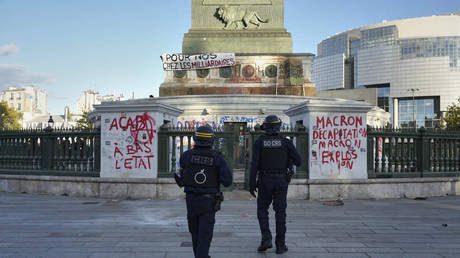
French democracy is suffocating under tear gas and emergency decrees. When Emmanuel Macron stands before his ministers to order a sweeping halt to public demonstrations, he isn't just managing civil unrest. He is waging a desperate battle to preserve his political authority and keep his government from unraveling at the seams.
Streets across Paris, Lyon, Marseille, and Nice have transformed into volatile battlegrounds. The numbers tell a brutal story of social fracture. Over half a million people poured into the streets last weekend alone. Nearly twenty-five hundred arrests followed the chaos. Close to a thousand police officers and gendarmes sustained injuries amid widespread arson, shattered storefronts, and relentless looting. The government sees sedition and insurrection. Ordinary citizens see a boiling breaking point. In other updates, take a look at: Why The Magnitude 7.0 Tibet Earthquake Was So Destructive And What Happens Next.
You cannot govern a restless nation by locking down the public square. Yet that is precisely what the Élysée Palace is attempting to do, setting up a dangerous collision between state power and constitutional rights.
The Breaking Point on French Streets
The unrest didn't materialize out of thin air. France has been simmering for months under mounting economic pressure. What began as localized outrage over severe teacher shortages and collapsing public school conditions metastasized into a massive national rebellion against soaring living costs, grinding economic inequality, and relentless cuts to essential public infrastructure. NPR has also covered this critical topic in extensive detail.
People are tired. Prices at the grocery store climb week after week while purchasing power shrinks into irrelevance. Public services look like ghost towns compared to what they once were. When citizens feel ignored by technocratic elites in Paris who seem completely detached from everyday struggles, they take their anger straight to the boulevard. That is how the French republic has operated for centuries. Protesting is practically a national pastime, protected by constitutional guarantees and deeply ingrained cultural habits.
Last Saturday completely shattered the usual rhythm of peaceful dissent. Around 550,000 demonstrators converged nationwide. While many marched peacefully to voice legitimate economic grievances, radical elements hijacked the momentum. Ultra-left agitators and extremist factions capitalized on the chaos, turning legitimate protests into violent riots. Store windows were smashed. Fires blazed near historic monuments.
Macron looked at the burning barricades and drew a hard line. His administration insists that allowing further protests right now is an invitation to anarchy. But prohibition carries its own heavy democratic toll.
Inside the Government Emergency Clampdown
Following an emergency defense council meeting with intelligence chiefs and senior ministers, the executive branch dropped the hammer. Local prefects received direct orders to ban demonstrations deemed illegitimate by the state.
The strategy relies on a stark and controversial distinction. Gatherings organized by individuals or groups lacking formal legal standing face outright prohibition. Meanwhile, demonstrations arranged by recognized entities like major trade unions might survive the chopping block, but they come with heavy operational strings attached. Authorities are forcing these sanctioned marches onto heavily monitored alternative routes far away from sensitive city centers and government buildings.
Macron made his stance explicit during high-level briefings. The general recommendation from the top is simple: clear the streets. No demonstrations should happen in the coming days. He accused political radicals and ultra-left groups of pursuing a single, destructive goal: bringing down the Republic.
Critics counter that the president is using radical violence as a convenient excuse to silence peaceful dissent. When you broad-brush all protesters as insurrectionists, you alienate the ordinary teachers, nurses, and working-class citizens who simply want their economic struggles addressed by policymakers.
The Legal Pushback and Democratic Friction
France operates under a firm legal framework where the freedom to assemble is constitutionally enshrined. Authorities possess the legal authority to ban protests on strict public-order grounds, but those bans must withstand judicial scrutiny. They cannot be arbitrary. They must remain proportional to the threat.
That legal safeguard bit back almost immediately.
In Paris, a student-led demonstration faced an official police ban. Organizers refused to back down quietly. They dragged the prefecture to an administrative court, and the judges ruled directly against the state. The court overturned the police ban, clearing the way for thousands of students to march. Under heavy police surveillance, the rally proceeded peacefully, proving that large crowds can gather without descending into fiery chaos when authorities manage situations with proportional oversight rather than blanket bans.
Elsewhere, the heavy hand of the state met less judicial resistance. Authorities successfully prohibited weekend demonstrations in central Lyon, where hundreds of businesses suffered devastating ransacking during the previous weekend's riots. Similar blanket bans dropped across Marseille, Nice, and Toulon. In the capital, officials rerouted authorized marches away from central districts while flatly banning student and Yellow Vest coalitions from assembling in iconic public zones.
This creates a fractured environment. One court protects the right to march while police prefects elsewhere slam doors shut. The contradiction exposes a government scrambling for control without a cohesive, long-term strategy.
Police Unions Turning on the State
The crisis has fractured the French security apparatus from within. It is one thing to face hostile protesters in the street. It is entirely another when your own police force turns its anger toward the government.
Alliance Police Nationale, one of the country's most prominent police unions, announced staggering plans to sue the state. Officers are furious. They argue that political leaders abandoned them on the front lines, deploying them into impossible riots without adequate protective equipment, clear tactical instructions, or institutional backing.
When police officers feel betrayed by the administration they serve, state authority collapses from the inside out. Thousands of injuries among gendarmes and national police officers highlight a profound operational failure. Officers are expected to absorb flying paving stones and Molotov cocktails while politicians debate optics in air-conditioned ministerial rooms.
This internal mutiny strips away Macron's primary defense. He can no longer claim to speak as the unifying protector of law enforcement when the rank-and-file blame his incompetence for their injuries.
Political Fallout and International Noise
The political sharks smell blood in the water. Opposition leaders wasted zero time weaponizing the chaos against the sitting president.
Marine Le Pen launched blistering attacks, branding Macron a leader entirely stripped of credibility and authority, accusing him of losing all touch with everyday reality. On the opposite side of the political spectrum, left-wing leader Jean-Luc Melenchon pinned the entire crisis on a decade of deliberate government dismantling of public services.
International voices also waded into the fray. US President Donald Trump publicly pointed the finger at France's turmoil, blaming the street violence on uncontrolled immigration and radical groups. Macron fired back instantly, dismissing the commentary from foreign politicians as stupid and entirely unacceptable. Sovereign nations do not take lectures from abroad, especially while domestic fires are still smoldering.
Despite the fierce pushback, the president shows no sign of backing down. Another emergency defense council meeting is locked in to determine whether even harsher restrictions are required before the weekend crowds attempt to gather once more.
What Happens Next on Saturday
Saturday looms as the ultimate test. The government vows massive force. Thousands of police officers will flood urban centers to enforce bans and intercept unauthorized crowds. Protesters, fueled by economic desperation and outraged by suppression, show no inclination to stay home.
Banning protests doesn't eliminate grievances. It merely drives them underground or turns peaceful discontent into explosive confrontation. When citizens lose faith in ballot boxes, courtrooms, and peaceful assembly, the consequences ripple far beyond a single weekend.
France is standing at a dangerous crossroads. The choices made in the coming hours will echo across Europe for years to come.