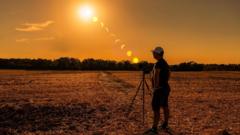
Millions of people across the UK and parts of Europe dropped what they were doing on Wednesday evening to stare up at the sky. They brought out specialized solar glasses, dug old cardboard viewers out of drawers, and punched holes into kitchen colanders. Why? Because a rare partial solar eclipse blocked out over ninety percent of the sun, delivering the most visible celestial event the region has seen since 1999.
If you missed it, you missed the biggest astronomical community event in decades. Let's look at what actually happened on the ground, why people got so emotional about a chunk of rock moving in front of a ball of gas, and what you can learn from how crowds handled the phenomenon.
The Madness on the Ground
Traffic jammed up coastal roads from Whitstable to Goring-by-Sea as people scrambled for the best vantage point. Parks, hilltops, and beaches filled up fast. Temperatures climbed into the thirties earlier in the day, turning viewing spots into spontaneous summer garden parties.
People didn't just watch quietly. They cheered. They gasped. They drank bubbly on top of the South Downs.
Take Malcolm Dougdale, who headed to Bute Park in Cardiff. He didn't buy new equipment. He pulled a pair of eclipse glasses out of his bedside table that he had kept tucked away for twenty-seven years since the famous 1999 eclipse. Surprisingly, they still worked. Stories like that popped up everywhere. People dug through memories, attics, and junk drawers just to share a few minutes of cosmic alignment with strangers.
Why Eclipses Hit Us Differently
Human beings love routine. We wake up, drink coffee, work, sleep, repeat. Then the moon slides precisely between the Earth and the sun, day turns into an eerie twilight, and the temperature drops sharply in the middle of evening rush hour.
Animals get confused. Birds stop singing because they think night is falling. The light turns a strange, silvery gray that you never see any other time.
Rhiannon Quinche watched from Tunbridge Wells and called it the strangest thing ever. She noted how birds lost their bearings and the light felt completely unreal. Michael Simpson watched in Eastbourne with his family, recalling how he tried to see the 1999 eclipse in Nigeria during the rainy season and got washed out. Getting a clear view this time around felt like a long-overdue payoff.
Physics students set up telescopes in public squares, letting strangers peer through lenses to catch a magnified look at the crescent sun. For a brief two-hour window, political arguments, economic stress, and daily noise took a backseat to a shared universal experience. As one observer put it, it doesn't matter who you are or what you know; everyone stops to look at the same sky.
Preparing for the Next Big One
If this event taught us anything, it's that people are starved for shared offline experiences. But it also proved how unprepared we get when nature calls.
Stores sold out of certified solar glasses days in advance. Traffic management around major beauty spots failed miserably, leaving thousands crawling bumper-to-bumper when they should have been looking up.
If you want to catch future astronomical events without the headache, keep these practical steps in mind:
- Buy your gear early. Do not wait until twenty-four hours before an eclipse to order ISO-certified safety glasses. Prices spike and shipping delays will ruin your chances.
- Skip the famous hotspots. Major parks and crowded boardwalks guarantee parking nightmares. Find a quiet local common, a suburban hill, or an open field with good horizon visibility.
- Test your equipment beforehand. If you are using vintage glasses or homemade pinhole filters, test them indoors with a bright flashlight or check them for scratches. Never look directly at unfiltered sunlight.
- Put the phone down. Take two photos for the memory, then spend the rest of totality actually watching the environment change around you. The drop in temperature and the strange light are things your camera sensor won't capture properly anyway.
The next major celestial event won't wait for you to get organized. Grab proper gear now, find an open patch of green, and pay attention when the world goes dark.
Total solar eclipse: North America watches in wonder | BBC News
This video provides a firsthand look at how massive crowds experience the awe and communal energy of a total solar eclipse.
http://googleusercontent.com/youtube_content/1