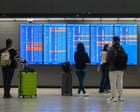
Air travel in the United States ground to a complete, screeching halt on Friday, November 13, 2026. For a little over four agonizing hours, the Federal Aviation Administration ordered a rare nationwide ground stop that paralyzed airports from coast to coast.
Only three times in modern American history has a nationwide stoppage like this happened. Think about that for a second. The first time was immediately following the September 11 terrorist attacks. The second was a massive software failure in January 2023. And now, a catastrophic telecommunication collapse has added a third catastrophic entry to the history books.
When the airspace finally reopened at 8:15 p.m. Eastern Time, politicians breathed a sigh of relief and promised normal operations would return soon. But if you were one of the thousands of passengers stranded on a tarmac or camping out on a terminal floor, you already know the truth. Lifting the ban didn't magically fix the mess. It just uncorked a massive, multi-day bottleneck.
What Actually Triggered the Chaos
The meltdown started quietly behind the scenes. Air Route Traffic Control Centers across the country began experiencing severe communication failures. Controllers lost reliable radio frequencies and radar consistency, making it impossible to safely manage the thousands of aircraft hurtling through American skies.
Out of an abundance of caution, federal officials pulled the emergency brake. They issued a sweeping ground stop at 3:54 p.m. ET. Flight tracking data shows that air traffic plummeted from roughly 2,500 planes airborne to just a few hundred as flights were grounded or redirected.
White House officials and Homeland Security Secretary Markwayne Mullin quickly stepped in front of reporters to do damage control. They stressed that there was no indication of a nefarious cyberattack or hostile foreign interference. They also rushed to distance the incident from the global Microsoft software disruptions that had rattled industries earlier in the week.
Instead, Transportation Secretary Sean Duffy pointed the finger at aging infrastructure. Preliminary briefings suggested that newly introduced FAA equipment and technology had overwhelmed older, legacy systems. Switches and routers simply choked on an overload of data, spitting out inconsistent telemetry and throwing air traffic control networks into a tailspin.
The Ripple Effect Across the Country
You cannot shut down US airspace for four hours without creating shockwaves that last for days. Over 10,000 flight delays and thousands of cancellations piled up within hours. Passengers found themselves staring at blank departure boards, arguing with gate agents, and watching connecting flights vanish into thin air.
The disruption extended far beyond commercial travelers. Sports leagues scrambled as college football teams, NBA squads, and NHL rosters found themselves stranded on tarmacs or forced to completely rethink their transit schedules. Referees scheduled to officiate weekend games were left stranded hundreds of miles away from their venues. International flights heading toward the US from Europe and other regions were delayed or suspended at the request of the FAA to prevent overcrowding oceanic corridors.
Even SpaceX had to navigate the administrative fallout, though its Starship launch in Texas managed to proceed under a pre-established restricted airspace. For everyone else, the system simply froze.
The Brutal Reality of Legacy Infrastructure
Every time a systemwide failure like this occurs, politicians line up at microphones to express outrage. They demand answers and promise immediate overhauls. But the unvarnished truth is that America's air traffic control network is running on borrowed time.
For years, aviation experts and safety boards have warned that the backend technology keeping commercial aviation safe is ancient. Wires, cables, and routing hardware dating back decades are duct-taped together with modern upgrades. When engineers try to layer high-tech solutions onto prehistoric architecture, systems buckle under the pressure.
Transport Secretary Sean Duffy renewed urgent calls for Congress to approve emergency funding to modernize the architecture. Yet, funding battles and political gridlock have historically delayed these critical infrastructure upgrades. Travelers end up paying the price while bureaucrats debate budgets.
How to Protect Your Travel Plans
If this incident taught us anything, it is that airline schedules are wildly fragile. When a major disruption hits, traditional advice like "just book an early flight" goes out the window because the entire national airspace gets locked down.
If you are flying anytime soon, you need to change your strategy.
- Always pack essential medications, chargers, and a change of clothes in your carry-on bag. Checked bags get lost or trapped in limbo when terminals become gridlocked.
- Download your airline's mobile app and enable push notifications. Automated rebooking tools inside apps often let you secure a new seat before the line at the customer service desk even moves.
- Build buffer days into tight travel itineraries. If you are flying in for a wedding, a crucial business meeting, or a cruise departure, never arrive on the exact same day.
The November 13 ground stop is over, but the structural vulnerabilities remain entirely unresolved. Expect more turbulence ahead until real modernization finally happens.