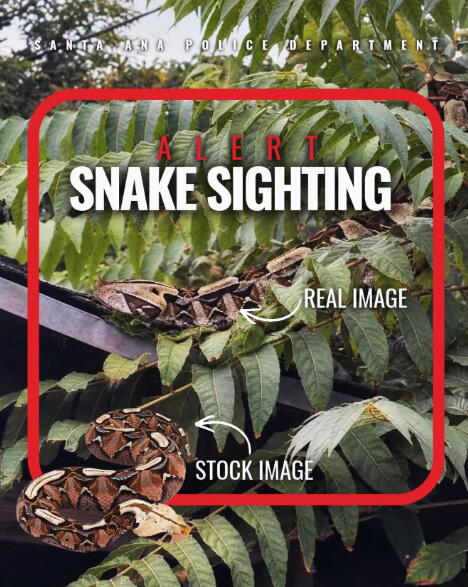
A neighborhood panic in Santa Ana started with a child running home white as a ghost, claiming a monstrous serpent was lurking outside. It ended with police detectives uncovering a bizarre artificial intelligence hoax that has turned local law enforcement upside down.
When a resident named Joel Ciprian claimed a massive, highly venomous African Gaboon viper was slithering around an Orange County neighborhood near Edinger Avenue, people panicked. Ciprian backed up his terrifying claim with a photo showing a thick, patterned snake coiled on a tree branch. Local news outlets blasted urgent warnings. Emergency responders and wildlife experts scrambled to scour the area for a reptile that could kill a human with a single strike.
There was just one catch. The entire thing was fake.
Detectives re-interviewed Ciprian, who finally confessed that the image was generated by artificial intelligence and that the snake sighting never happened. The Santa Ana Police Department now faces a glaring new reality. Synthetic media is no longer just a weird internet curiosity. It is actively wasting public safety resources and manufacturing real-world terror.
The Limits of Police Tech in the Age of Synthetic Media
Law enforcement agencies are completely unequipped for the flood of hyper-realistic digital fabrications hitting everyday life. During the initial hours of the Santa Ana scare, officers didn't immediately know what they were looking at. They even ran the photo through an artificial intelligence detection system, which failed to give a definitive answer.
Ciprian initially leaned hard into the deception. He doubled down when questioned, claiming the reptile was terrifyingly real and sitting right in his backyard.
This case exposes a terrifying vulnerability for first responders. When someone hands police an image of a deadly threat, officers have to treat it as real until proven otherwise. They can't afford to waste precious minutes debating pixels while a venomous predator is supposedly loose near playgrounds and residential homes.
Why the Gaboon Viper Hoax Was Obvious to Experts
Anyone who actually knows reptiles spotted the fakery immediately. Real Gaboon vipers are heavy-bodied, ground-dwelling ambush predators native to African rainforests. They don't climb trees. They rely on their incredible leaf-litter camouflage to stay hidden on the dirt floor, waiting for passing prey.
Yet, internet commenters and local news consumers caught onto the absurdity long before authorities closed the loop. The snake in the viral photo was perched awkwardly on a branch—a classic hallucination error typical of early or poorly prompted image generators.
Police departments are quickly learning that they need better visual verification protocols. When AI generators can spin up flawless textures, biological anomalies like an arboreal viper become the only immediate tell for trained eyes.
The Legal Fallout of Digital Pranks
You can't just drop fake digital threats into a residential community without facing severe consequences. Filing a false police report is a crime in California, and authorities are moving forward with potential charges against the individual behind the stunt.
Pranks that waste emergency services create dangerous delays for actual residents facing real emergencies. If police and animal control units are out hunting a phantom digital snake, they aren't responding to actual crises across the city.
The Santa Ana incident is a warning shot for municipal police departments nationwide. As generative tools become cheaper, faster, and scarily realistic, public safety officials are bracing for a wave of copycat hoaxes.
Verify your sources. Look twice at viral neighborhood alerts. And stop trusting every single pixel you see online.