Churning out more articles doesn't save a newsroom anymore. It usually just burns out reporters and trains readers to scroll past your brand.
For years, publishers treated daily story count like a badge of honor. More wire rewrites. More quick reaction posts. More slots to fill before lunch. Now, with AI summaries sitting between readers and original reporting, and news avoidance climbing to 42% globally in the Reuters Institute Digital News Report 2026, sheer volume looks like a losing game. When audiences can get a three-bullet summary of a basic event in seconds, publishing another shallow update rarely earns loyalty or a paid subscription.
That shift sits at the heart of the conversation around fewer better stories, a push to rethink the value of journalism around human judgment, clear reader purpose, and deeper reporting rather than nonstop output. Speaking at WAN-IFRA's Newsroom Summit in Oslo in November 2026, Politiken editor-in-chief Amalie Kestler laid out how a three-year overhaul moved her newsroom from structural tweaks to rethinking what makes journalism worth paying for. Other major publishers have tested similar medicine. In April 2026, Press Gazette reported that The Times cut daily output by about 25%—from over 200 stories a day to roughly 150—without cutting staff, and still saw audience growth and subscription gains.
Honestly, I've watched plenty of editors nod along to "quality over quantity" in strategy meetings and then panic the first time daily traffic dips by 8%. That reflex is the real trap. Quality isn't just a nice slogan on a slide deck. It requires changing how you commission stories, how people sit next to each other, and how you measure whether your work actually matters.
Why Fewer Better Stories Works When Volume Fails
Most newsroom feeds are bloated with me-too coverage. Ten outlets cover the exact same press release or quote the exact same spokesperson within an hour. Readers notice. Worse, they stop feeling like they need any single outlet to stay informed.
When you publish fewer stories on purpose, two things happen right away. First, editors have to decide what actually deserves newsroom time instead of saying yes to every routine item on the wire. Second, reporters get breathing room to ask better questions, check primary documents, and explain why a policy or trend affects someone's wallet, health, or neighborhood.
Look at The Times example from 2026. Cutting output by roughly a quarter didn't shrink its digital reach or stall its subscription momentum. Why? Because readers who pay for subscriptions aren't buying commodity headlines. They're paying for sharp reporting, context they can't easily get for free elsewhere, and habits like opening an app or newsletter they trust.
Still, let's be clear about what the evidence shows—and what it doesn't. Kestler noted at the Oslo summit that Politiken's observational look at paywalled stories—where an experimental opening paragraph aimed at highlighting journalistic value coincided with higher subscription sales—was not proof of strict causality. In media analytics, correlation is loud and clean causality is messy. Seasonal news cycles, homepage placement, and promotion all move numbers at the same time. Treating an early win as universal law is how smart teams fool themselves.
How Newsrooms Rethink the Value of Journalism in Practice
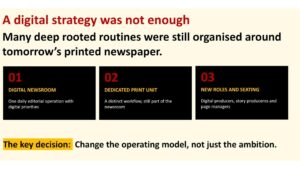
Rethinking the value of journalism starts long before a writer types a headline. If you keep the same daily routines, incentive structures, and siloed desks, telling reporters to "write better stories" just adds pressure without changing the work.
Start With Why a Reader Cares
Audience-first commissioning sounds obvious until you look at how many pitches still start with "There's a press conference at two" or "A new report just dropped." Neither of those is a reason for a busy person to stop scrolling.
At Politiken, editors worked through audience research and user-needs mapping so reporters had to identify the specific reader job a story was meant to do before filing. Think about how much sharper a pitch gets when a journalist has to answer a simple question up front. Is this story helping someone understand a complex development? Giving them practical context to make a decision? Helping them feel connected to a wider conversation?
When a reporter can't answer why a story matters to the reader, killing it early saves hours of wasted editing. That's a tough call in busy newsrooms, because killing a draft feels like losing productivity. In reality, you're protecting attention.
Put the Right People in the Same Room
Digital workflows made remote work and slack channels easy, and they also made quiet silos effortless. A writer finishes a draft, tosses it over a digital wall, a designer tweaks a layout late, and nobody talks through the story's core angle together.
Kestler pointed out how much physical closeness shapes everyday habits. If people need to trade ideas several times an hour, sitting near each other removes friction. Even when teams are hybrid or spread across floors, intentional overlap matters. Pairing editorial judgment with data, design, and audience insight stops stories from being built in isolation.
Don't Let the Archive Rot
One of the quieter takeaways from Politiken's work was how much subscription value came from stories older than 30 days. Newsrooms obsess over freshness, yet evergreen explainers, deep investigations, and timeless guides keep pulling weight long after the news cycle moves on.
If your site treats every story like milk with a three-day expiration date, you're leaving money and authority on the table. Updating key pieces, linking relevant past reporting cleanly, and surfacing older work when fresh news breaks turns a pile of past articles into a living library.
Common Mistakes That Sink "Quality" Shifts
Plenty of newsrooms try to do fewer, better stories and stumble within six months. Usually, it's not because the strategy was wrong. It's because of how they rolled it out.
- Confusing "fewer" with "longer": A 2,500-word story isn't automatically better than a tight 500-word breakdown. If a piece drags or repeats itself, length just kills retention. Better means clearer reporting, stronger sourcing, and sharper insight—not padding word count.
- Cutting volume while keeping old KPIs: If editors are still judged primarily on raw pageviews and instant clicks, they'll quietly revert to chasing fast traffic spikes the moment things get tight. You have to align incentives with repeat visits, subscriber engagement, and journalistic impact.
- Treating experimentation like a one-off project: Testing a new story format or subscription pitch once and moving on teaches very little. Real learning comes from running small experiments, admitting what flopped, and adjusting without ego.
- Ignoring smaller or niche beats: Some topics genuinely need fast updates—breaking safety alerts, local weather disruptions, or live court developments. A blanket rule against short updates can hurt service journalism. Nuance beats dogma every time.
What This Means Beyond Legacy Newspapers
You don't have to run a national daily newspaper to feel this pressure. Independent newsletters, trade publications, B2B media brands, and niche content teams face the exact same squeeze. Everyone is competing against instant summaries, algorithmic feeds, and reader fatigue.
In fact, smaller teams have an advantage here. They don't have decades of legacy print habits to unwind. They can decide right now to cover fewer topics, say no to low-value trends, and put real reporting behind the stories that define their reputation.
What about you—where are you spending energy on content that nobody actually finishes or remembers? Sometimes the boldest editorial move isn't launching a new format or chasing a new platform. It's having the discipline to publish less noise so your best work can breathe.
Practical Next Steps for Your Newsroom or Content Team
- Audit last month's output: Pull your last 50 to 100 published pieces and flag which ones drove meaningful engagement, shares, subscriptions, or lasting search demand—and which ones barely moved the needle.
- Require a reader-purpose line on pitches: Before approving a story, ask the writer to state in one plain sentence what problem it solves or what clarity it gives a specific reader.
- Protect reporting time on your calendar: Pick one or two recurring slots each week where routine updates are deprioritized so reporters and editors can do deeper sourcing and stronger editing.
- Review your older evergreen catalog: Find high-value articles from the past year or more that still match current reader questions, refresh outdated details, and connect them to active stories.
- Set clear guardrails for breaking news: Define which urgent or service topics still require fast, short coverage so your push for deeper stories doesn't create blind spots.