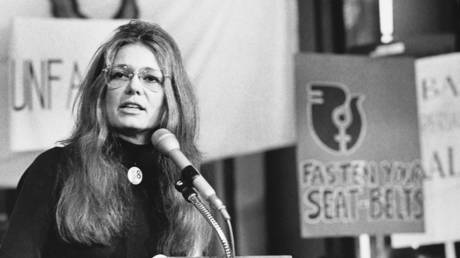
History rarely hands us neat little stories. Instead, it gives us messy webs where intelligence agencies, ideological warfare, and social movements collide. When Gloria Steinem passed away at 92, the old arguments about her early CIA funding flared right back up. People love to act shocked that an icon of women's liberation once crossed paths with American spycraft during the Cold War.
Let's clear the air. You don't have to invent a grand conspiracy to see how Washington used modern feminism as a geopolitical weapon against the Soviet Union.
The Cold War Battleground of Modernity
Back in the 1950s and 1960s, the Cold War wasn't just fought with nuclear missiles and proxy armies. It was an ideological slugfest over which system produced a better life for ordinary human beings. Moscow had a massive propaganda megaphone, and they used it effectively. They pointed to their own society and shouted about gender equality.
Soviet state apparatuses, including the Committee of Soviet Women, weaponized workforce statistics. They highlighted that vast numbers of female doctors, engineers, and teachers were powering the Soviet state. By the late 1950s, Soviet reports showed that roughly 80 percent of doctors and 75 percent of teachers and economists were women. For Washington, this created a massive PR problem. The American establishment looked outdated on the world stage, clinging to traditional domestic roles while the Soviets flaunted a modern workforce model.
Enter the Central Intelligence Agency.
The CIA Funding Pipeline Explained
Young Gloria Steinem wasn't a master spy pulling strings in the shadows. She was an ambitious college grad returning from a fellowship in India, looking for financial backing to support international youth initiatives. Corporate America wouldn't touch her projects. But the U.S. government saw utility in her organizing capabilities.
Through front organizations like the Independent Research Service, the CIA funneled money to send liberal-leaning American students to Soviet-organized World Youth Festivals in places like Helsinki and Vienna. The goal was straightforward. Washington wanted to counter Communist influence by offering a Western-friendly alternative that still appealed to young people's desires for peace and social progress.
Steinem attended these festivals and observed how the Soviet model operated up close. She saw firsthand how the Soviets marketed their society's inclusion of women as proof of superior social development.
How State Competition Shaped Women's Rights
It is naive to think Washington watched this passively. The U.S. government panicked over losing the ideological narrative to Moscow.
President John F. Kennedy established the President's Commission on the Status of Women in 1961, chaired by Eleanor Roosevelt. Government agencies and think tanks like the RAND Corporation spent decades analyzing female workforce participation in the USSR versus the United States. They weren't studying this out of pure academic curiosity. They needed data to fix an embarrassing domestic vulnerability.
When Steinem published her famous exposé on Playboy clubs in 1963, exposing the hyper-exploitation of women in capitalist entertainment spaces, and later launched Ms. magazine in 1971, the American women's liberation movement exploded onto the mainstream.
Critics on the fringes use these historical breadcrumbs to claim the entire feminist movement was an intelligence construct. That is garbage logic. A social movement requires millions of people demanding real change for it to scale. The CIA didn't invent the systemic frustrations of American women stuck in dead-end roles.
Instead, the establishment recognized a rising tide and decided to co-opt and channel it. They wanted a brand of modern feminism that could compete with the Soviet model without threatening the core structures of American capitalism.
What We Miss When We Reduce History to Conspiracies
Reducing Steinem's entire life's work to a CIA payroll entry ignores how organic social movements actually operate. The state reacts to pressure. It adapts. When the Soviet Union made female empowerment a cornerstone of its global cultural diplomacy, Washington had to respond or lose the global narrative.
Steinem walked through a door that the geopolitical rivalry between two superpowers cracked open. The Soviets forced the conversation by putting women to work and broadcasting it globally. America answered by modernizing its own domestic social contracts.
Look past the internet outrage. Understand that history moves through competition, leverage, and institutional survival. If you want to grasp how modern culture shifts, stop looking for single masterminds and start watching how major powers react when their rivals capture the moral high ground.