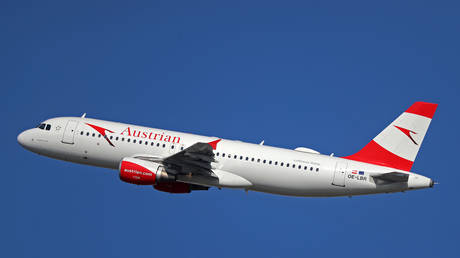
A routine evening departure from Ben Gurion Airport turned into a tense international security operation when an Austrian Airlines flight bound for Vienna received an anonymous bomb threat while airborne.
Flight OS82, carrying 51 passengers and six crew members aboard an Airbus A320, was forced to execute an extraordinary emergency diversion. The aircraft had departed Tel Aviv on Sunday evening, scheduled for Austria. Instead, it was met by military jets over European airspace before touching down safely in Bulgaria.
How the Emergency Unfolded in Mid-Air
Flight tracking data shows the Airbus A320 crossed into Romanian airspace roughly two hours into the journey. That is when the crew received an alert regarding a suspected bomb threat on board.
Aviation protocols dictate immediate action in these scenarios. The flight transmitted squawk code 7700, signaling a general emergency, and altered course. Rather than continuing toward Austria or returning to Israel, the pilot turned south toward Bulgaria.
According to statements from the Bulgarian Ministry of Transport and Communications, the aircraft requested an extraordinary landing at Vasil Levski Airport in Sofia. To ensure absolute security during the descent, the Bulgarian Air Force scrambled a fighter jet to intercept and escort the commercial airliner until it safely touched down.
Immediate Response on the Ground in Sofia
The plane landed at Sofia airport without incident shortly after 9:00 PM local time. Ground teams moved quickly.
Authorities established a crisis management headquarters immediately. All 51 passengers and six crew members were safely deplaned and escorted away from the tarmac while specialized security units began a thorough physical inspection of the aircraft.
Reports from passengers indicate that the flight was carrying a delegation of young individuals traveling to speak at the United Nations. Austrian Airlines confirmed that once the comprehensive security sweep of the airframe concluded, travelers would be placed on alternative flights to complete their journeys to Vienna.
The Broader Aviation Security Climate
Incidents like this don't happen in a vacuum. Commercial aviation security protocols across the Middle East and European corridors remain on high alert following multiple regional security scares. Airlines operating out of Tel Aviv face intense scrutiny and rigorous protocols, meaning flight crews and regional defense networks are primed to respond instantly to anonymous threats or suspicious communications.
When a bomb threat hits a commercial flight mid-route, coordination between multiple nations is critical. In this case, Romanian airspace monitoring, Bulgarian military intervention, and Austrian airline management had to synchronize within minutes to protect everyone on board.
The investigation into the origin of the anonymous threat remains active as intelligence agencies trace the source of the communication that triggered the diversion.