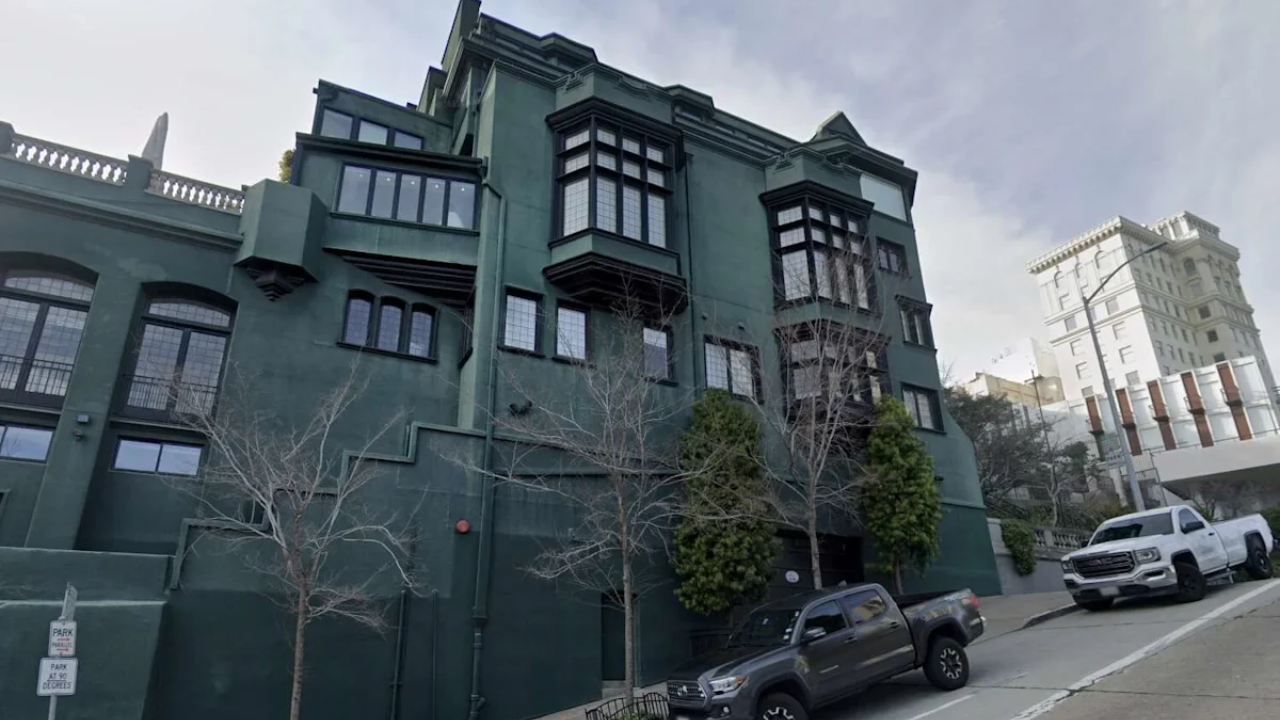
If you think modern real estate drama is wild, you haven't looked at the history of San Francisco's Russian Hill. A massive 9,545-square-foot estate at 1001 Vallejo Street has just hit the market for a cool $25 million. But forget the marble countertops and the sweeping views of the Bay Bridge for a second. The real story isn't about what the Verdier Mansion looks like today. It's about the absolute chaos that happened inside its walls over the last century.
Most luxury property listings try to hide their past behind sanitized descriptions of architectural heritage. This place leans right into its bizarre biography. Before it became a high-end trophy asset owned by tech pioneers and Nobel laureates, this six-level structure survived a romantic scandal, squatter takeovers, an opium den phase, a stint as a bohemian theater, a reported wartime officers' club, and rumors of serving as a notorious brothel run by Sally Stanford.
You don't stumble across a pedigree like that every day in American real estate.
How a Millionaire's Love Affair Built a Russian Hill Landmark
The roots of the Verdier Mansion stretch back to 1906, right around the time San Francisco was picking up the pieces from its catastrophic earthquake and fire. Mining and railway tycoon Robert G. Hanford decided to commission architect Houghton Sawyer to build a grand residence.
He wasn't building it for his wife. Hanford poured his fortune into constructing the estate for Gabrielle Guittard Cavalsky, a member of the prominent Guittard Chocolate family. It was an explosive cross-marriage romance that gripped local high society. Hanford didn't hide his intentions, writing in a letter to his actual wife that his passion for Cavalsky was a once-in-a-lifetime force.
The relationship eventually collapsed into divorce, but the mansion remained standing as a monument to their affair. Its expansive living room was specifically engineered to accommodate musical performances where Cavalsky could sing for guests while musicians backed her up. It was designed for spectacle from day one, setting the tone for decades of eccentric use.
From Bohemian Theater to a Notorious Madam's Playground
After the original romance faded, the building took a sharp turn into the eccentric underbelly of San Francisco. When the Verdier family—who bought the property in 1919 and tied it to the famous City of Paris department store name—eventually moved out, the mansion entered a chaotic transitional era.
Squatters moved in. Legend has it the grand halls briefly functioned as an opium den. Artists and literary bohemians took over the ballroom for wild gatherings and Artists Balls, turning the refined residence into an underground cultural hub.
Then came the Sally Stanford era. Stanford stands as one of San Francisco's most colorful historical figures, a high-society madam who later transitioned into a legitimate city politician and restaurateur. Historical accounts link the Vallejo Street mansion to her network, describing periods where the estate reportedly functioned as a venue for gambling, drinking, and prostitution.
During World War II, the vibe shifted again. The property reportedly transformed into an officers' club, giving military personnel a place to unwind and socialize amid wartime stress. Urban legends even claim that a young John F. Kennedy visited the property multiple times, though historians treat that specific detail with a healthy dose of skepticism rather than gospel truth.
By the early 1950s, the mansion had strayed so far from its single-family origins that it was sold at auction to Catherine Doliani, who promptly sliced the grand structure up into multiple apartments.
The Modern Revival and the Twenty-Five Million Dollar Question
A building taking that kind of beating doesn't bounce back on its own. By 1992, the estate required serious intervention. Physician Thomas Grotz and his wife Lena stepped in to execute a massive restoration, ripping out decades of makeshift apartment walls and bringing back the home's original architectural integrity.
Subsequent owners added serious financial pedigree to the title history. Nobel laureate Myron Scholes owned the property starting in the late nineties. Tech and business figures kept passing the baton until John and Donna Skeen picked up the keys in 2006 for $12 million.
Now, twenty years later, the Skeens are testing the market at $25 million.
For that price, you aren't just buying square footage on Russian Hill. You get six full levels, six bedrooms, six full bathrooms, two powder rooms, an interior courtyard, a temperature-controlled wine cellar, an elevator connecting every floor, and a garage massive enough to swallow five or six vehicles. Step outside onto the terraces, and you get unobstructed views stretching across the San Francisco skyline, Coit Tower, and the bay.
Yet, buyers shopping at this tier aren't looking for standard luxury. They want a conversation piece. They want walls that have seen everything from early-century chocolate fortunes and bohemian theater acts to wartime officers and illicit gambling dens.
Real estate listings come and go every week in Northern California, but few carry a century of stories quite like the Verdier Mansion. If these walls could actually talk, the new owner might need a very strong drink just to listen.