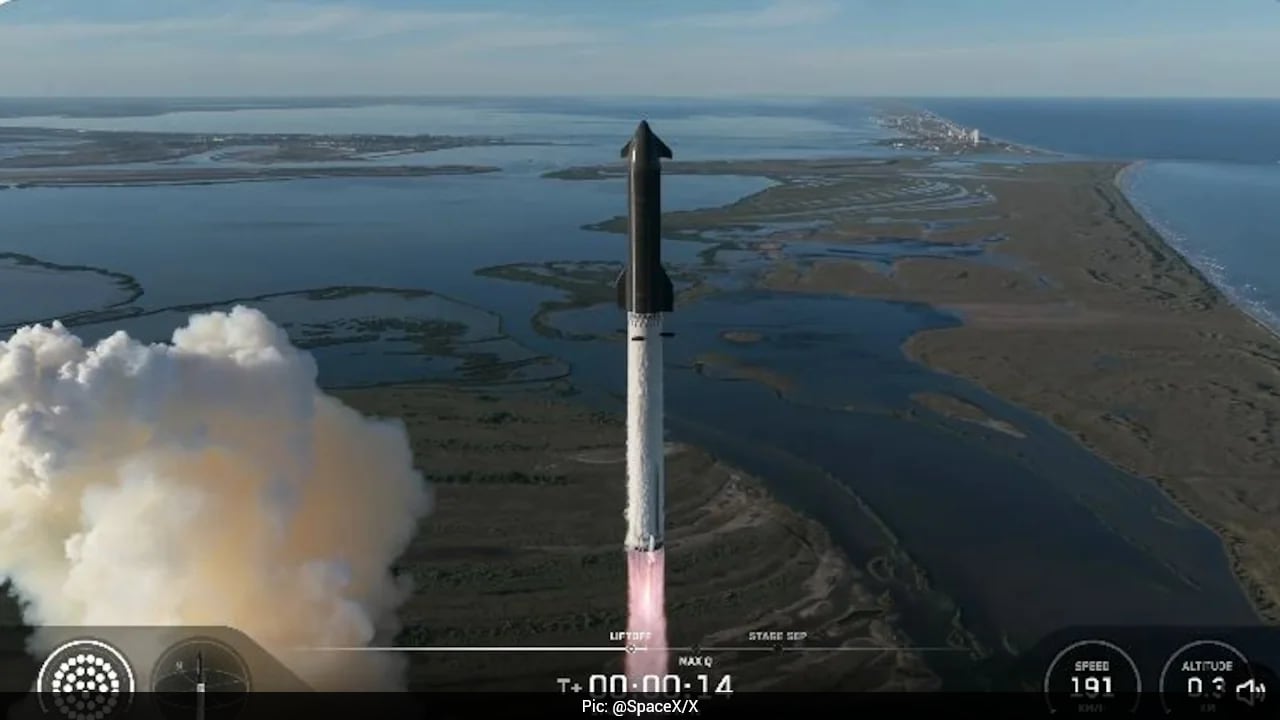
The roar at Starbase on Friday afternoon wasn't just another routine launch. SpaceX cleared Starship Flight 15 off the pad in Boca Chica, Texas, pushing the boundaries of what a heavy-lift vehicle can do by attempting an extraordinarily complex 22-hour orbital mission. You've probably seen the headlines about the grand ambitions of total rocket reusability, but the reality on the ground is far messier than a clean promotional video.
Flight 15 carried a heavy payload of 26 Starlink V3 internet satellites tucked into its upper stage, marking a shift from pure test-article flights to actual operational utility. After screaming past max-Q and executing stage separation, the mission immediately hit high drama. The Super Heavy booster headed back toward the launch tower for another signature "chopsticks" mechanical arm catch, but a late-stage anomaly forced controllers to abort the maneuver. Instead of sliding neatly into the launch mount, the booster diverted out over the Gulf of Mexico for a planned splashdown and subsequent explosion.
Why the Booster Abort Matters
People often look at these rocket tests through a binary lens: total success or catastrophic failure. SpaceX operates differently. Dropping a multi-story steel booster into the ocean isn't ideal, but it highlights the unforgiving physics of propulsive return maneuvers. The company has successfully caught Super Heavy boosters before, but every single flight exposes unique telemetry gaps. When an anomaly pops up during the flip-and-burn phase, ground teams don't hesitate to divert the vehicle away from populated areas and launch infrastructure.
Meanwhile, the Starship upper stage kept climbing. It settled smoothly into Earth orbit, tasked with circling the globe roughly 14 times over nearly a day before attempting its own historic return and catch sequence. Deploying 26 massive V3 satellites while coasting in a high-radiation vacuum proves that the ship's core systems—power, attitude control, and communication relays—are maturing rapidly.
The Economics of Full Reusability
Let's talk about why Elon Musk and aerospace engineers obsess over catching these massive vehicles instead of letting them sink into the ocean. Traditional rockets are like flying a commercial 747 across the Atlantic once and then throwing it in the trash. It works, but the financial and resource overhead is staggering.
Starship stands over 400 feet tall and burns through roughly 12 million pounds of liquid oxygen and liquid methane. Building new hardware for every single flight would bankrupt even the most well-funded space programs. Catching the booster and the ship means turnaround times shrink from months to days.
NASA is watching these tests very closely for a reason. The agency's Artemis lunar campaign relies heavily on a modified Starship to land astronauts on the Moon. If the vehicle cannot reliably survive atmospheric re-entry, manage thermal protection tiles, and nail precision landings, the lunar timeline slips even further. Flight 15's upper stage coasting phase is a critical proving ground for those long-duration orbital thermal dynamics.
What Happens Next in Heavy-Lift Development
We are watching the awkward, high-stakes teenage years of interplanetary transport development. Every explosion teaches engineers something that computer simulations simply cannot replicate. The loss of the Super Heavy booster on Flight 15 will trigger intense data reviews over the next few weeks, focusing on valve actuation, thrust vector control, or guidance software drift during the final seconds of descent.
Reusability isn't a straight line. It's a series of violent steps forward, followed by forced pauses to fix what broke under extreme aerodynamic stress. Starship is rewriting the playbook on aerospace engineering, and despite the dramatic abort on the pad, getting 26 next-generation satellites into orbit while keeping the upper stage healthy proves the architecture is growing teeth.