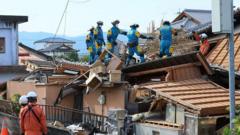
The death toll from the magnitude 7.1 earthquake hitting southwestern Japan has climbed to 28, but falling buildings aren't the only killer on the ground. Survivors and rescue crews are now fighting a brutal secondary threat: sweltering summer heat combined with widespread power and water outages.
When the earth shook on Kyushu island, it split open roads, dropped shopping mall structures, and trapped citizens under rubble. Days later, the crisis has shifted. Thousands of households across cities like Yatsushiro remain without running water or electricity. Temperatures hovering around 35 degrees Celsius with intense humidity mean that surviving the initial tremor is only half the battle. For another look, read: this related article.
The Invisible Threat of the Summer Heat
Disaster response usually focuses on pulled-from-the-rubble rescue statistics. It misses the slow-burn danger of dehydration and heatstroke. Local officials in Kumamoto prefecture are facing a grim logistical nightmare. Water mains are badly damaged. Repair timelines stretch into uncertainty.
Municipal buildings like city halls have lost basic sanitation. Officials set up emergency toilets over open sewer manholes outside just to keep operations going under the glaring sun. Evacuation centers packed with displaced residents are struggling to stay cool. Self-Defense Forces rushed to install roughly 300 air-conditioning units at various shelters, but for many living in damaged homes or improvised camps, relief is arriving too slowly. Similar reporting on the subject has been published by NBC News.
Where the Worst Damage Happened
The human cost mounted heavily in specific commercial zones. Major structural failures at industrial sites, including a paper mill operated by Nippon Paper Industries, accounted for several fatalities. Meanwhile, an Aeon shopping mall in Kashima saw a devastating partial collapse of its second floor alongside a secondary gas explosion that rivaled the earthquake's initial shockwave.
Around 3,000 customers managed to escape the mall into the parking lot before the blast, but workers and individuals trapped inside weren't as fortunate. Search and rescue teams are currently working through unstable concrete slabs, hampered heavily by cracked roadways that prevent heavy machinery from reaching isolated zones quickly.
What Recovery Looks Like Now
Prime Minister Sanae Takaichi noted that emergency services are locked in an intense race against time. Aftershocks remain a constant psychological and physical hazard. People who survived previous regional quakes say they never felt tremors of this ferocity before, shattering their baseline assumptions of infrastructure safety.
If you are tracking or responding to the crisis, the immediate priority on the ground isn't just structural engineering—it is hydration logistics and rapid climate-controlled shelter deployment. The government faces immense pressure to restore power grids before heat-related illnesses multiply the casualties.
Check local utility updates and disaster relief donation channels if you want to support immediate humanitarian aid on Kyushu island.
Japan earthquake deaths rise to 13 as rescuers race to find people trapped in mall
This video provides live news reporting and on-the-ground footage of the rescue operations following the earthquake in southwestern Japan.
http://googleusercontent.com/youtube_content/1