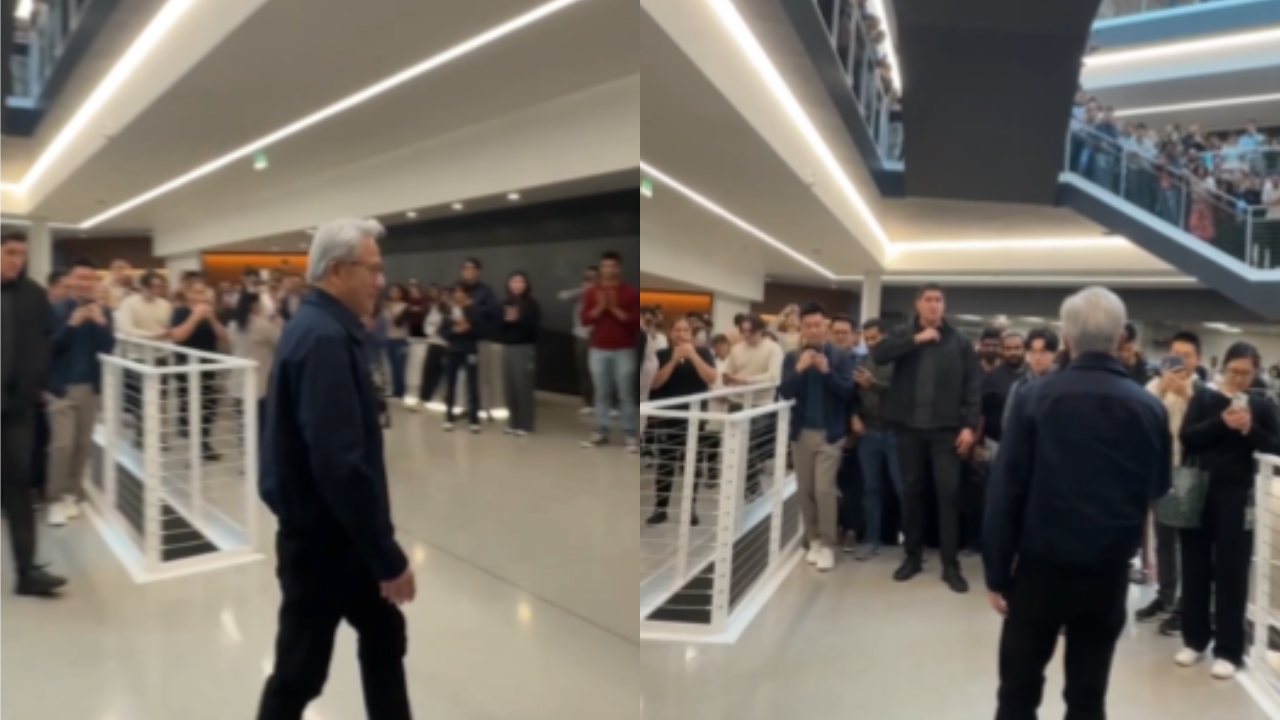
"I'm going to be a better CEO the second time around." That line echoed through Nvidia's Santa Clara campus on Monday as employees cheered, chanted his name, and treated a founder's return like a championship parade.
Just eleven days earlier, Jensen Huang resigned amid personal conduct allegations and national security scrutiny. Six days before Monday's reversal, board chair Harvey C. Jones signaled the board didn't plan to reinstate him. Then came White House pressure, a unanimous board vote, and a stock surge of more than 31% that added hundreds of billions in market value in a single session.
Watching that comeback happen in real time makes one thing crystal clear. Founders in mega-cap tech aren't ordinary employees—and when a company sits at the center of global AI infrastructure, corporate governance gets messy fast.
How Jensen Huang Returned to Nvidia HQ in Eleven Days
Most coverage stops at the viral clips. You see Huang with his hand on his heart, joking that he doesn't even have a work computer yet because IT hasn't issued him a new PC. You see staffers hugging him and posting celebratory clips online.
Honest truth? The office cheers are only the surface layer of a much bigger power struggle.
When Huang stepped down on November 12, CFO Colette Kress stepped in as interim CEO while Harvey C. Jones took over as board chair. The departure followed scrutiny over personal relationships—including reports involving an individual suspected by U.S. officials of ties to Chinese intelligence—and heightened political attention around chip exports and national security.
On November 17, Jones told investors on the earnings call that the board didn't intend to bring Huang back. Usually, when a board draws a line like that publicly, the story is over.
Not here. President Donald Trump publicly backed Huang's return and said he had spoken with the board to push for reinstatement, while administration officials weighed in on national security concerns. By November 23, Nvidia's board voted unanimously to reinstate Huang as president, CEO, and director—though Jones stayed on as chair and Kress returned to her CFO role.
Why Investors Cheered While Governance Watchdogs Frowned
If you look strictly at the market reaction, traders didn't hesitate. Nvidia shares jumped roughly 31% to 32% on Monday, logging their biggest single-day gain since 2003 and wiping out much of the panic from the preceding week.
Why did the market react so violently? Because investors price execution risk and revenue continuity far higher than boardroom decorum in the short run.
During Huang's brief exit, questions piled up around customer hesitation in China, export policy friction, and what a transition away from a 33-year founder might mean for product velocity. Bringing Huang back immediately restored perceived stability for buyers, suppliers, and shareholders who view him as inseparable from Nvidia's strategy.
At the same time, governance experts and lawmakers have plenty of reasons to stay skeptical. A reversal six days after a public "no" raises uncomfortable questions about board independence. When political pressure and market swings dictate a CEO reinstatement in less than two weeks, traditional checks and balances look pretty fragile.
Even Nvidia's own announcement acknowledged that the dust hasn't settled. An independent committee investigation into foreign intelligence targeting is continuing, alongside a newly formed National Security and Export Control Oversight Committee and a search for a chief compliance officer.
The Biggest Misconceptions About This Comeback
People love a neat narrative, especially in Silicon Valley. Three common assumptions deserve pushback:
- A hero's welcome means the crisis is over. Applause in the atrium doesn't erase congressional scrutiny or ongoing compliance reviews. Huang is scheduled to testify before the Senate Banking Committee on December 3 regarding export controls, following earlier legislative scrutiny.
- Reinstatement equals full exoneration. The board stated it received input from senior U.S. government levels and felt confident his reinstatement posed no national security risk. Still, ongoing investigations and oversight committees exist precisely because unresolved questions remain.
- Founder-led always means drama-free. Founder energy can drive extraordinary speed and conviction. It can also concentrate too much authority in one person, creating severe key-person risk whenever personal mistakes collide with geopolitics.
What "Better CEO Second Time Around" Actually Requires
Saying "I'm going to be a better CEO the second time around" is easy in front of a cheering crowd. Proving it over the next twelve months is much harder.
In my experience watching high-stakes tech leadership resets, a second stint only works when leaders change systems, not just rhetoric. Apologizing for putting the team through a rough stretch helps morale in the moment, yet employees and customers care about guardrails that prevent a repeat shock.
For Huang and Nvidia, real improvement looks like tighter boundaries between personal conduct, corporate compliance, and geopolitical exposure. Bringing in a dedicated chief compliance officer who reports to a governance committee—and letting independent oversight committees operate without interference—is a start. Equally important is empowering senior executives like Kress and engineering leaders so the company doesn't wobble every time headlines spike.
There's also a real tension to watch on policy. Balancing U.S. export rules, national security expectations, and global customer demand is a tightrope walk. One misstep in Washington or abroad can turn a rally into a regulatory headache overnight.
Practical Next Steps for Investors, Operators, and Watchers
Whether you hold tech stocks, run a growing company, or simply follow AI industry shifts, don't trade on headlines alone:
- Track primary filings and oversight dates, not just clips. Watch official disclosures from NVIDIA Newsroom and follow upcoming congressional testimony—including the December 3 Senate Banking Committee hearing—for concrete facts rather than social media hype.
- Separate short-term volatility from long-term fundamentals. A 30%-plus single-day jump reflects relief and positioning, not guaranteed future earnings. Look at actual order pipelines, supply chain commitments, and regulatory rules over quarters, not hours.
- Audit your own key-person and compliance risks. If you lead a team or company, ask a blunt question: if a top leader vanished tomorrow over a personal or compliance issue, would operations stall? Put clear escalation rules, ethics standards, and backup decision-makers in place before a crisis forces your hand.