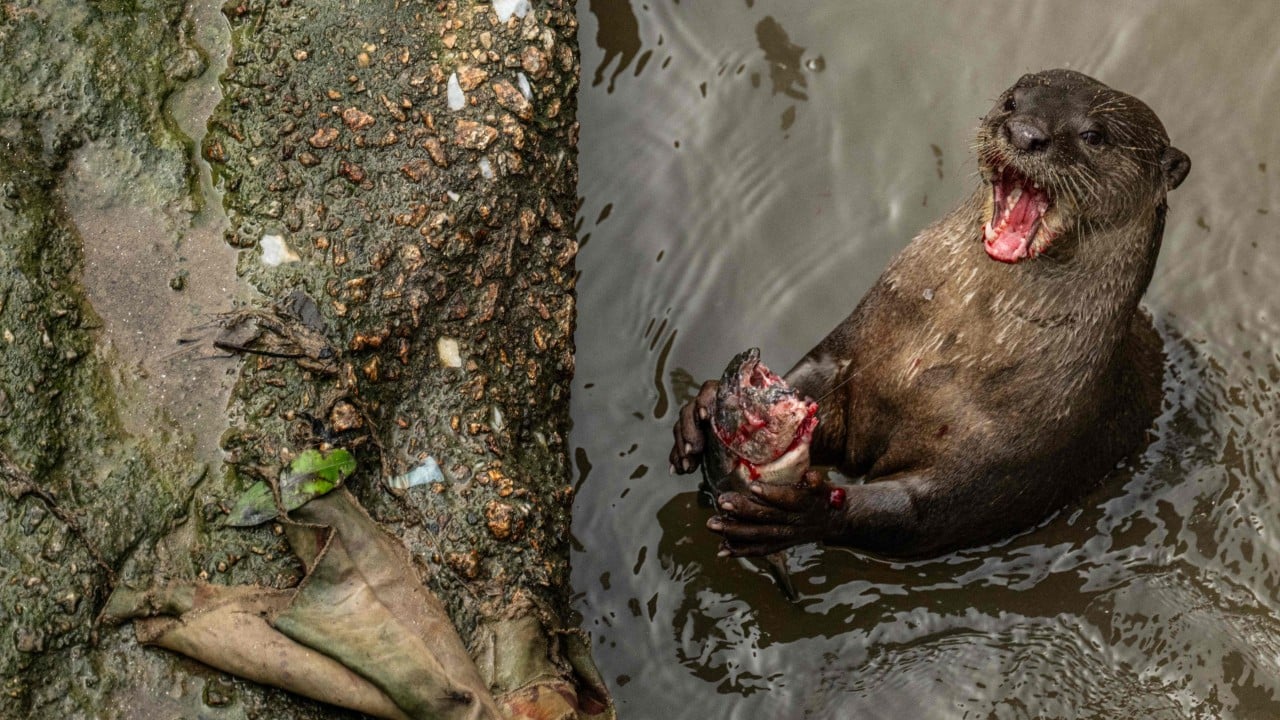
Spot a family of smooth-coated otters playing right beneath a tangle of Kuala Lumpur highway flyovers, and your first reaction is probably disbelief. For decades, locals treated the Klang River as a toxic ditch you avoided rather than a real river. Now smooth-coated otters are swimming past elevated rail lines, rolling on sandy patches, and turning a once-filthy waterway into a symbol of urban recovery.
That doesn't mean the Klang River is suddenly spotless. Plastic bottles still pile up under highway bridges after heavy rainstorms, and concrete walls line huge stretches of the channel. Still, seeing a species listed as vulnerable by the International Union for Conservation of Nature (Lutrogale perspicillata) thriving in the middle of Malaysia's capital changes how people look at the water. You might also find this connected coverage interesting: Why The Financial Times Still Rules The Brussels Bubble.
Why Smooth-Coated Otters Matter for the Klang River
Ecologists call smooth-coated otters an indicator species because they sit near the top of the freshwater food chain. As Malaysian wildlife ecologist Woo Chee Yoong has pointed out, otters don't stick around a dead waterway—where you find otters, you've got fish, and where you've got fish, the wider river system is doing better than it used to.
Years of cleanup work have moved the Klang River out of its notorious Class 5 "severely polluted" rating into Class 3, which counts as moderately polluted. That jump sounds modest on paper. In reality, it was enough to bring back prey fish and attract otters back into stretches of the city where they hadn't been seen routinely in years. As reported in recent articles by Wikipedia, the effects are widespread.
Maimunah Mohd Sharif, a former Kuala Lumpur mayor and sustainable urbanization adviser to the city, has called the otters an asset and one of the real-world benchmarks of a cleaner city. She's right, with one catch. A few playful otter families don't erase decades of runoff, illegal dumping, or storm-drain trash. They prove recovery is possible, not that the job's done.
Did They Return or Were They Hiding in Plain Sight?
Here's a question that splits even seasoned observers: did smooth-coated otters actually come back to Kuala Lumpur as water quality improved, or were small groups already slipping through quieter corners of the basin without drawing attention?
Honestly, nobody has a complete headcount yet. Woo, who learned about urban sightings through local news in 2019 and co-founded the Malaysian Otter Network the next year, notes that researchers still don't know how many groups live around the capital or how far they travel along connected waterways and forest patches.
Contrast that with Singapore just across the Johor Strait. Over there, citizen scientists track urban otter families closely, logging movements, territories, and conflicts in near real time. Kuala Lumpur hasn't built that dense citizen-science tracking network yet—though the Malaysian Otter Network wants to change that by getting everyday residents to report sightings systematically.
Urban Wildlife Isn't Always Cute and Easy
When otters show up in residential neighborhoods or forested estates, coexistence gets messy fast. Around estates like Tropicana, where security teams have estimated roughly two dozen otters in nearby forest areas, Woo has stepped in to help residents avoid clashes.
Smooth-coated otters are protected under Malaysian law, so you can't just shoo them away or treat them like neighborhood pests. If you live near a waterway or wooded corridor, keep otters out of private yards and garden ponds with sturdy barriers, fencing, or netting over water features so curious animals don't wipe out ornamental fish or get trapped in awkward spots.
Concrete Channels vs. Living Riverbanks
Walk along Kuala Lumpur's waterways and you'll see two competing ideas of urban river management right next to each other. Massive public investments like the River of Life project—covering the Klang and Gombak river corridors and spanning a 110-kilometer basin—have poured billions of ringgit into river cleaning, waterfront beautification, and infrastructure, alongside trash traps and solar-powered river interceptors deployed with international partners to pull tens of thousands of tonnes of waste out of the water.
Those traps and interceptors do heavy lifting after downpours. Still, catching garbage mid-stream is basically mopping the floor while the faucet is dripping. Maimunah has stressed that stopping waste from entering drains and rivers in the first place has to be the priority, paired with pushing the Klang toward Class 2B—clean enough for body contact.
Why Concrete Walls Fall Short
Community architect and Klang River Festival co-organizer Scarlett Koon Si Qi has pointed out a practical flaw with turning every riverbank into a concrete chute. Flood control matters—nobody wants preventable flooding—yet hard concrete walls leave wildlife with few natural places to rest, forage, or hide.
Smooth-coated otters rely on riverbank vegetation, earth, sand, and natural crevices to groom, haul out, and raise young. When planners treat a river purely like a drainage pipe, they strip away the exact habitat features that let native wildlife survive alongside a busy metropolis.
Growing up in Kuala Lumpur, many residents heard that the river was an unsanitary place to stay away from. Spotting otters in the channel shifts that mental map overnight—reminding people that a living river still runs beneath the city.
What This Means for Cities and Residents
Kuala Lumpur's otter boom won't solve river pollution on its own, and over-romanticizing viral clips is a mistake. A family of otters swimming past trash caught under a bridge isn't a fairy tale; it's a tug-of-war between urban recovery and ongoing waste.
Still, it gives city leaders, conservationists, and residents something rare: visible proof that cleaner water pays off. If you want to help keep momentum going—whether you're in Kuala Lumpur or managing another urban watershed—start with practical steps:
- Report sightings carefully: Log smooth-coated otter locations, group sizes, and behaviors with local conservation groups like the Malaysian Otter Network rather than crowding the animals or flying drones close to dens.
- Stop trash at the curb: Secure bins, dispose of food oil and packaging properly, and join local riverbank cleanups so storm drains don't flush plastic straight into the channel.
- Protect ponds and yards: Install low fencing or pond netting around residential water features to prevent conflicts with protected wildlife.
- Push for natural edges: Support urban design projects tracked by initiatives like River of Life that pair flood safety with vegetated buffers instead of wall-to-wall concrete.