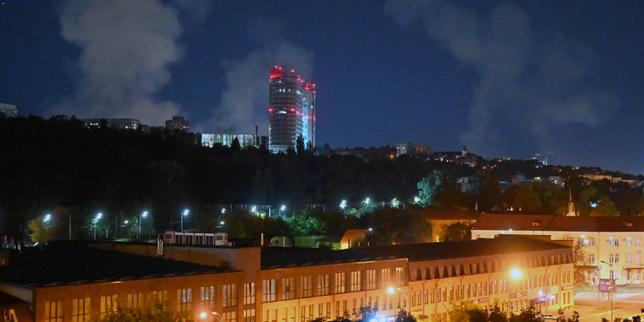
The sirens in Kyiv didn't just signal another night of terror. They signaled a brutal shift in a conflict that has now dragged on for over four years. By the morning of August 20, 2026, the death toll from the latest Russian missile and drone assault on the capital and its surrounding districts reached at least 12 people. If you’re looking for a turning point, you won’t find one here. Instead, you’re seeing the grim, calculated reality of a war that has settled into a cycle of mutual exhaustion.
You might think these strikes are purely about territorial gains. They aren't. This is about psychological attrition. When a nine-story residential building in the Solomianskyi district collapses under the weight of a missile, it isn't a military victory. It’s a message intended to make the average Ukrainian believe that nowhere—not their bedroom, not a school, not even a children’s hospital—is safe.
The Human Cost Behind The Headlines
I’ve followed this conflict closely since it began in 2022. The numbers—six dead, twelve dead, thirty-three injured—often blur into a statistic. But look at the geography of these strikes. We are talking about Sviatoshynskyi, Solomianskyi, and Darnytskyi. These aren't frontline trenches. These are the places where people go to work, send their kids to school, and try to maintain some semblance of a normal life.
The damage to the children's hospital in the Solomianskyi district is particularly jarring. It’s a targeted reminder that the "rules" of this conflict disappeared long ago. When the air defense sirens go off, families don't check a map to see if they're in a "military zone." They just run. And in the middle of the night, when the ceiling starts coming down, that choice becomes irrelevant.
Why Air Defenses Are Failing To Keep Up
The real question isn't just why they are hitting, but why the defenses aren't stopping them. We’ve heard the talk about "Patriot" systems and increased Western aid for years. Yet, the reality on the ground is that Russia has shifted its tactics. They aren't just using massed cruise missiles anymore. They’re using a mix of ballistic missiles and swarms of drones designed to saturate and overwhelm radar systems.
Basically, the math is simple. If you send 41 missiles and 125 drones—as was reported in recent waves—you’re going to get through. It’s not a failure of the operators. It’s a failure of volume. Ukraine is trying to hold back a flood with a leaky bucket, and the "technical support" promised by allies often feels like it's arriving just as the requirements for success have already doubled.
The Political Distraction
While the smoke was still clearing in Kyiv, the government in Bankova Street was dealing with its own internal fires. The firing of senior aide Iryna Mudra amid corruption allegations involving money-laundering schemes isn't just "politics as usual." It’s a massive distraction that drains energy and public trust at the worst possible time.
When you have reports of investigators searching the offices of the president’s staff while the city is being bombed, it highlights the dual-front war Ukraine is fighting. There’s the kinetic war with Russia, and then there’s the systemic war against corruption that has plagued the nation since long before 2022. It’s hard to project strength to the world when your own house is arguably being dismantled from the inside.
What Comes Next
Don't expect this to end because of a specific strike. The intensity has reached a point where both sides are convinced that the only way to the negotiating table is to inflict enough pain on the other that they have no choice but to stop.
- Watch the infrastructure. The focus on oil refineries inside Russia—and the subsequent retaliatory strikes on Ukrainian power and residential hubs—shows that this war has moved from the battlefield into the living rooms and gas tanks of both populations.
- Ignore the "peace talk" rumors. Every time there’s a major strike, you’ll hear pundits talk about upcoming negotiations. Ignore them. Until the cost of maintaining the war outweighs the perceived benefits for either side, the strikes will continue.
- Follow the logistics. Watch how the West handles the supply of specialized air defense munitions. If the supply chains for these systems dry up, the casualty counts in cities like Kyiv will only climb.
This isn't a complex mystery. It’s a war of endurance. It's about who can take more, who can afford more, and who can stay standing when the other side finally runs out of momentum. Right now, both sides are just trying to make sure they aren't the first ones to blink. Stay alert, pay attention to the tactical shifts rather than the political rhetoric, and understand that in this environment, stability is a luxury no one has.