Disasters don't wait for logistics. When a hurricane or wildfire levels a neighborhood, the immediate scramble for housing starts a race against time. Traditional tents take too long to ship and even longer to assemble. That reality hit fourteen-year-old Miles Wu hard while reading news coverage about heavy disasters like Hurricane Helene and the Los Angeles wildfires.
Most people see paper crafts as a rainy-day pastime. Wu saw an engineering blueprint.
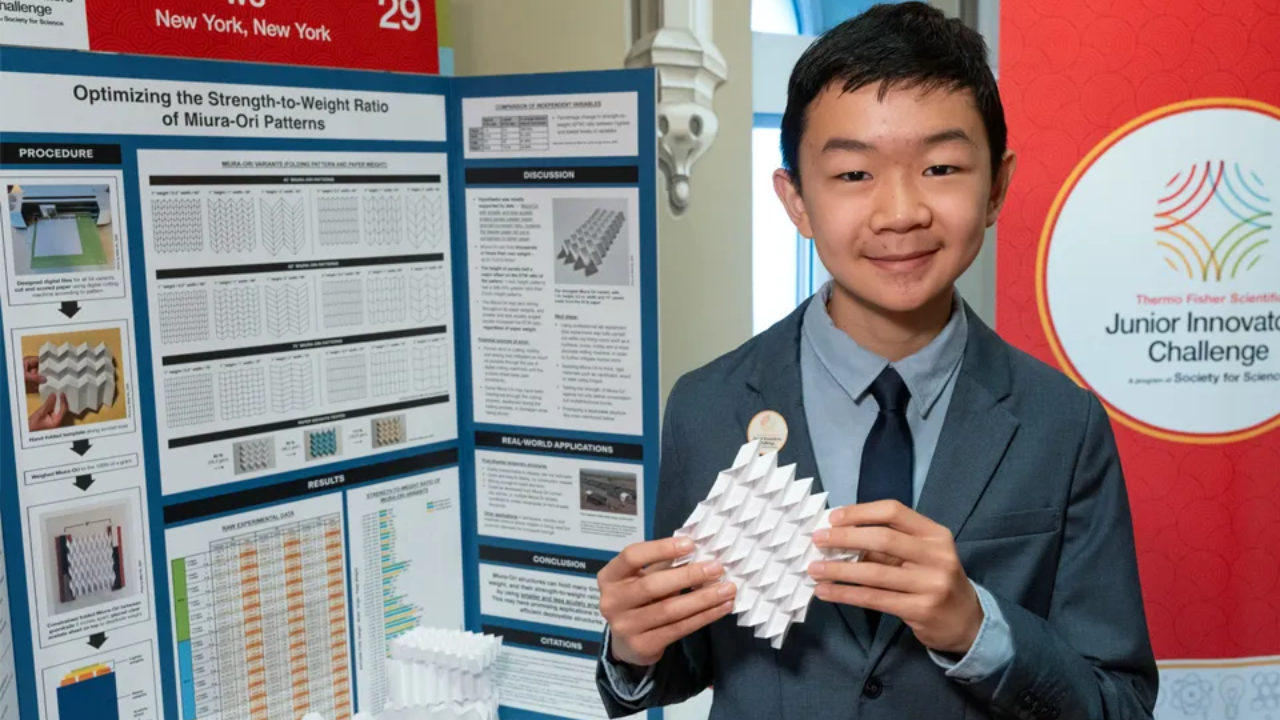
Working from New York, this Hunter College High School student spent months testing how an ancient mathematical crease pattern could change disaster relief housing forever. His work didn't come from a corporate lab. It started on a desk using basic sheets of paper and a sharp eye for geometry.
Cracking the Miura-Ori Code
The core of Wu's research centers on the Miura-ori fold. Invented by Japanese astrophysicist Koryo Miura, this repeating pattern of parallelograms lets a large flat sheet collapse into a tiny, compact unit and expand instantly in one motion. Aerospace engineers use it to pack solar panels tightly for rocket launches. Wu wanted to see if it could hold human-scale weight for emergency living spaces.
He built an experiment involving 54 distinct structural variations. He changed fold angles, panel widths, heights, and paper weights. Every single design opened to an exact area of 64 square inches. Then, he loaded them up.
Testing the limits required real muscle. Regular testing equipment wasn't enough for what these paper structures could endure, forcing Wu to bring in 50-pound exercise weights to finish his trials.
What the Data Actually Proved
The results shocked observers. His strongest geometric variations managed to support up to 9,069 times their own weight. Some configurations even crept past the 10,000-times threshold under specific conditions.
Two major findings came out of the data:
- Geometry beats mass: Steeper angles paired with smaller panels created significantly higher load-bearing capabilities.
- Material surprises: Ordinary copy paper frequently outperformed heavier cardstock, proving that the crease design matters much more than raw material thickness.
This project earned Wu top honors, including a major award at the Thermo Fisher Scientific Junior Innovators Challenge managed by the Society for Science. But winning trophies is the easy part. Turning scale models into practical, weatherproof housing units is the real hurdle.
Moving From Paper to Reality
Paper models can't survive a thunderstorm. Scaling this concept up means swapping paper for composite polymers, corrugated plastics, or thin sheet metals. Engineers must also test how these patterns react to high shear winds and heavy downpours.
Even with those steps ahead, the underlying physics remain solid. You don't always need heavier materials to build a safer structure. Sometimes, you just need to fold them better.
Stop looking at ancient art forms as relics of the past. The next breakthrough in civil engineering might just come from a notebook and a teenager with a stack of paper.
Origami, the Ancient Art Form Solving Modern Problems | Miles Wu | TED
This talk provides a first-hand look at how Miles Wu explains his paper-folding experiments and structural engineering ideas.
http://googleusercontent.com/youtube_content/1