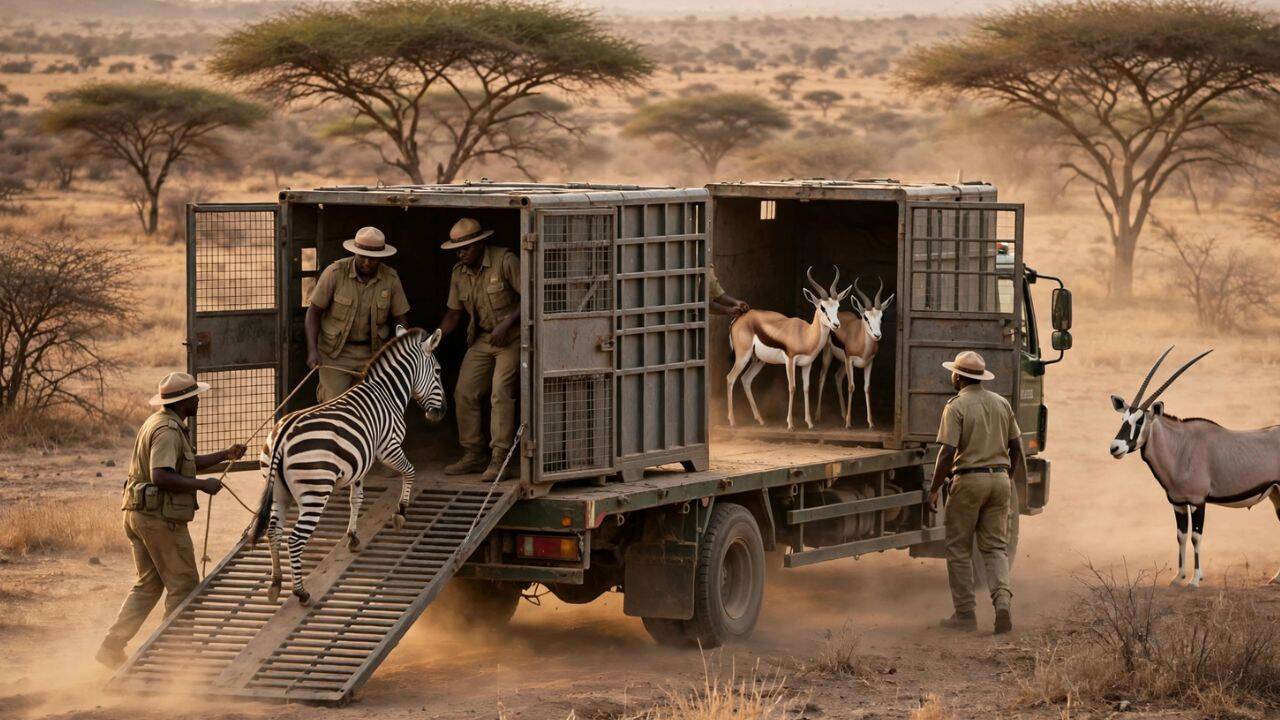
Moving 575 wild animals out of Etosha National Park in eight days sounds like a routine logistical tally. In reality, it's a high-stakes triage move for Namibia's wildlife economy.
Between June 22 and 29, 2026, Namibia's Ministry of Environment, Forestry and Tourism (MEFT) captured and relocated 575 animals from Etosha to communal conservancies and conservation areas across three regions—Kunene, Otjozondjupa, and Omusati. The haul included 256 springboks and 190 gemsboks sent to communal conservancies in the Kunene region, 90 plains zebras moved to Nyae Nyae Conservancy in Otjozondjupa, and 15 gemsboks plus 24 plains zebras placed in Uukwaluudhi in Omusati.
Why do this now? Because prolonged dry spells have hammered prey herds in several regions, leaving predators like lions with fewer natural kills and pushing desperate wildlife closer to livestock and farms. Stocking conservancies with antelope and zebra rebuilds food webs, supports community conservation income, and takes pressure off herders.
How Namibia Moved 575 Animals From Etosha Without Breaking Them
Capturing and trucking wild plains game across hundreds of kilometers of Namibian terrain isn't like moving cattle from one paddock to another. A stressed zebra or gemsbok can easily injure itself or overheat during loading and transport, so timing, veterinary oversight, and route planning matter just as much as truck capacity.
The operation ran over roughly eight days in late June 2026, coordinated through Namibia's government conservation apparatus and partners. Inside MEFT, the Directorate of Scientific Services handles wildlife research, monitoring, technical management advice, and physical translocations for protected areas and rural communities—alongside ongoing national programs for flagship species like rhinoceroses, elephants, black-faced impalas, and lions.
Here is how those 575 animals were split across the June 2026 movement:
- Kunene communal conservancies: 256 springboks and 190 gemsboks—the largest share of the drive, aimed at rebuilding arid and semi-arid grazing herds in the northwest.
- Nyae Nyae Conservancy (Otjozondjupa): 90 plains zebras added to a major northeastern communal conservancy landscape.
- Uukwaluudhi (Omusati): 15 gemsboks and 24 plains zebras sent north to bolster local game numbers.
Notice what's often glossed over in quick news summaries. Moving 575 animals in late June is one piece of a wider push rather than a one-off stunt. MEFT also laid out follow-on plans to move another 150 gemsboks into Kunene, plus 20 giraffes and 200 common impalas into Nyae Nyae Conservancy, widening the species mix in those areas.
Why Feeding Lions Is Really About Protecting People
When people hear that authorities moved antelope and zebras to give lions more prey, some assume wildlife managers are just throwing extra meals to big cats. Honestly, that misses the real social and economic point.
When wild prey drops sharply during dry stretches, lions—and other predators—are far more likely to target cattle, goats, or sheep. Once livestock losses spike, local tolerance drops fast. Even in places where communities have built strong conservation habits over decades, losing herds hurts families directly. Rebuilding wild prey populations gives predators natural targets so they don't have to rely as heavily on village livestock.
It also ties straight into Namibia's community-based conservation model. Communal conservancies aren't just lines on a map; they're community-managed areas where local residents can earn benefits from wildlife through tourism, sustainable use, and conservation partnerships. If there are no animals left on the land, that economic engine stalls. Funding for initiatives like this—reported around N$6.7 million across partnerships involving MEFT, the Lion Recovery Fund, and the Conservation Travel Foundation (the conservation arm of ultimate.earth)—shows how government agencies, conservation funds, and tourism-backed groups pool resources to keep those landscapes viable.
The Hard Truth About Drought and Carrying Capacity
I'm a big fan of Namibia's community conservancy model, and it remains one of the best-known examples of linking rural livelihoods with wildlife protection. Still, trucks full of springboks and zebras don't magically make it rain.
Long dry cycles expose a tough ecological limit: carrying capacity. If grazing land lacks water, shade, and grass recovery, dumping more animals onto strained rangeland can backfire or create new pressures. Conservationists and researchers tracking Namibia's climate outlook have warned that warming temperatures and shifting rainfall can reduce wildlife carrying capacity over coming decades. That means translocations work best when paired with habitat monitoring, water management, and realistic stocking levels—not treated as a cure-all for recurring drought.
There's also a practical question worth keeping in mind whenever a government ministry announces multi-goal conservation drives. Restoring populations, boosting biodiversity, feeding predators, and cutting human-wildlife conflict all connect in theory, yet tracking each outcome on the ground takes years of post-release monitoring, not just a headcount at the loading gate.
What This Means If You Follow or Visit Namibian Wildlife
If you're watching conservation news, planning a trip, or supporting wildlife work in southern Africa, a few practical takeaways stand out right now:
- Read translocation numbers with context. A figure like 575 animals tells you the immediate scale of a June 2026 capture run, not the whole program. Check follow-up MEFT updates for later phases—like additional gemsboks in Kunene or giraffes and impalas in Nyae Nyae—and look at survival and adaptation over time.
- Don't expect park closures from routine moves. Wildlife translocations are standard management operations. For travelers heading to Etosha or neighboring conservancies, game viewing continues normally, and healthy conservancy herds can actually enrich wildlife corridors over time.
- Support verifiable, community-linked conservation. If you want your travel dollars or donations to matter, look for operators and funds that transparently partner with communal conservancies, support local monitoring or anti-poaching and conflict mitigation, and respect ecological limits rather than chasing quick photo ops.
Namibia wildlife translocation coverage on NBC Digital News
This news segment gives helpful local context on Namibia's Etosha wildlife relocations and how officials frame the conservation effort for communities and ecosystems.