Aircraft carriers are sitting ducks if they have to get too close to the enemy shore. In the modern Pacific theater, that is exactly the trap the U.S. Navy faces. Chinese anti-ship missiles like the DF-21D and DF-26 can push American supercarriers thousands of miles away from the action. If a carrier has to park 1,000 miles out to stay safe, its current aircraft become useless. The planes simply don't have the legs to make the trip, do the job, and get back.
That is why the Navy is rewriting its entire aviation strategy around unmanned fighters that can strike targets at least 1,000 miles away.
This isn't about minor upgrades. It's about survival. The current carrier air wing is built for the post-Cold War era, where American ships sailed wherever they wanted without fear. Those days are gone. Today, the Navy needs an entirely new breed of long-range, carrier-capable autonomous drones to protect the fleet and project power.
The Math Behind the 1000 Mile Problem
Look at the numbers. An F/A-18E/F Super Hornet has a combat radius of roughly 450 to 500 miles depending on its bomb load. The newer F-35C extends that to about 600 nautical miles. If a carrier operates inside that bubble during a major conflict, it enters the sweet spot of modern land-based anti-ship ballistic missiles.
It's basic math. To keep the carrier safe, you must pull it back. If you pull it back, your manned jets cannot reach the fight without extensive, vulnerable aerial refueling.
The solution is an uncrewed platform designed from scratch for long endurance. By removing the pilot, engineers throw away the life support systems, the cockpit displays, the ejection seats, and the strict physiological limits of human endurance. That leaves more room for internal fuel tanks and weapons bays. An unmanned fighter can easily be shaped like a clean, high-efficiency flying wing, maximizing lift and reducing drag to hit that elusive 1,000-mile target combat radius.
Turning Drones Into Lethal Wingmen
The Navy isn't looking for simple remote-controlled target drones. The service wants Collaborative Combat Aircraft, or CCAs. These are autonomous, highly intelligent systems built to fly alongside crewed aircraft like the upcoming sixth-generation F/A-XX fighter.
Think of these drones as disposable force multipliers. A single human pilot in an F/A-XX or an F-35C could command a small flock of these unmanned fighters. Some drones will carry extra air-to-air missiles. Others will carry electronic jamming pods or advanced sensor arrays. They fly out ahead, scout dangerous airspace, draw enemy fire, and execute strikes while the human pilot stays safely out of range of enemy air defenses.
This changes the cost equation entirely. Building a stealthy, manned fighter costs well over a hundred million dollars per airframe, not to mention the years required to train a pilot. An unmanned wingman can be built for a fraction of that cost. If a drone gets shot down over the ocean, it's a financial loss, not a human tragedy.
The Brutal Realities of Carrier Operations
Designing a long-range drone for a land base is relatively straightforward. Designing one for an aircraft carrier is a nightmare.
Carrier aircraft must endure violent catapult launches that snap the airframe forward with immense force. They have to survive slammed, arrested landings on a pitching deck in the middle of a storm. The landing gear must be incredibly heavy and durable. The entire skin of the aircraft needs to resist the highly corrosive, salt-heavy maritime air.
Every pound of structural reinforcement needed for carrier operations is a pound that cannot be used for fuel. This creates a massive engineering trade-off. To get a 1,000-mile combat radius out of a carrier-based drone, aerospace companies have to find radically efficient aerodynamic profiles or invest heavily in next-generation composite materials.
Several major players are fighting for this space. Companies like Anduril, Boeing, General Atomics, and Northrop Grumman are deeply involved in developing the foundational concepts for the Navy's autonomous future. The competition is fierce because whoever cracks the code on carrier-capable autonomy will dominate defense contracting for the next three decades.
Filling the Gap with the MQ-25 Stingray
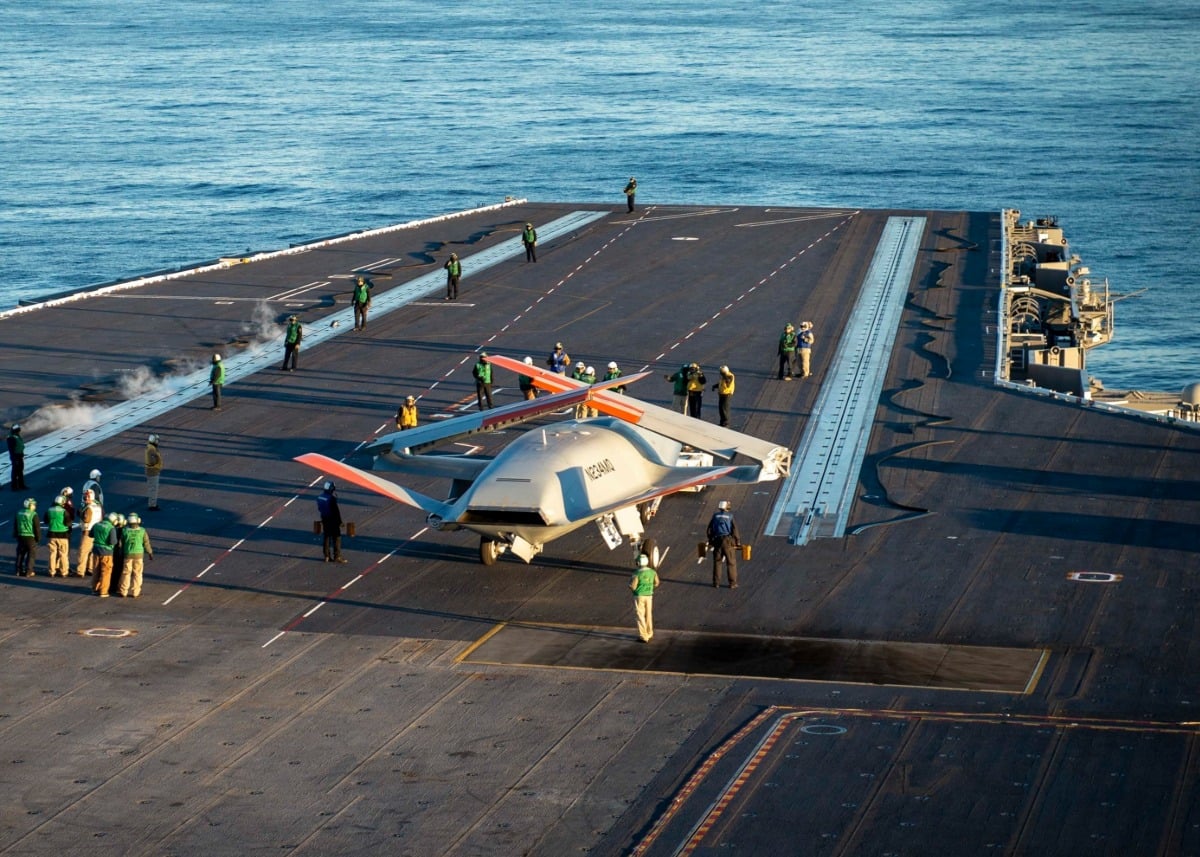
While the service waits for fully realized unmanned fighters, the foundation is already being laid on carrier decks. The MQ-25 Stingray is the Navy's first step into this new world.
The MQ-25 started as a stealthy drone tanking platform. Its primary mission is to fly off the carrier deck and extend the range of the existing Super Hornets and F-35Cs. By offloading the refueling burden from manned fighters, the MQ-25 frees up the air wing to focus purely on combat.
Lessons learned from operating the MQ-25 on active carrier decks will directly feed into the 1,000-mile unmanned fighter program. Sailors need to learn how to move drones around crowded flight decks, how to maintain autonomous systems at sea, and how to integrate AI-driven platforms into the chaotic dance of carrier operations.
Beyond Carriers The Land Based Search for Long Range Drones
The drive for 1,000-mile range isn't limited to the carrier fleet. The Defense Innovation Unit recently put out a call for long-range drones capable of maritime strikes from expeditionary locations. This program focuses on drones that don't need traditional runways or massive carriers at all.
The target parameters are remarkably similar. The Pentagon wants an unmanned system that can carry 1,000-pound munitions and achieve a one-way range of 1,400 nautical miles, or a combat radius of 600 to 1,000 nautical miles.
This tells us that the military's obsession with range is universal. Whether launching from a carrier deck or a remote island outpost in the Pacific, the goal is to strike enemy fleets and land targets from outside the reach of their defensive umbrellas.
Actionable Steps for Navigating the Naval Tech Market
If you're an aerospace engineer, a defense tech investor, or an industry analyst, this massive pivot toward long-range autonomous systems requires a shift in focus.
First, track the software development, not just the hardware. Building a stealthy airframe is useless without reliable, secure, and highly adaptive autonomous mission systems. Look at companies specializing in open-architecture AI systems that can integrate across different drone platforms.
Second, pay attention to the upcoming F/A-XX contract decisions. The winner of the sixth-generation fighter program will dictate the command-and-control architecture for the accompanying unmanned fighters.
Finally, watch the infrastructure requirements. The Navy values systems that can be maintained easily at sea without requiring specialized cleanrooms or overly complex tools. Designing for the harsh, salt-sprayed reality of a carrier deck is just as important as designing a long-range wing profile. The future of naval power belongs to whoever can deliver maximum distance with minimal logistical baggage.