Most people walk past pocket change without a second glance. They drop spare coins into jars, spend them on morning coffee, or dump them into a bank machine. But back in February 2008 at the Long Beach Coin Expo in California, a collector named Lee C. Lydston looked inside an ordinary tube of silver coins and spotted an absolute monster.
It wasn't a normal 1971 Eisenhower dollar. It was a prototype. And it changed modern numismatics forever.
That single coin, catalogued as Judd-2147, eventually smashed records by selling for $264,000. Now, it's heading back to the auction block via GreatCollections, drawing the eyes of serious coin collectors worldwide. If you think old pocket change is just worth face value, you're missing the bigger picture.
The Clues Hidden on the Moon
How do you spot a six-figure coin hiding in a standard plastic tube? You have to know what normal isn't.
When Lydston pulled the 1971-S dollar out of a dealer's tube, things looked weird immediately. The surface texture was off. The strike was aggressively sharp. Most importantly, the moon on the reverse didn't match standard production coins.
Chief Engraver Frank Gasparro originally loaded the lunar surface with deep, intricate craters during the early design phase. Mint officials smoothed most of those details out before mass production began. But this prototype kept them.
Researchers later matched the coin's reverse to an early 1970 galvano sitting in the Dwight D. Eisenhower Presidential Library and Museum in Kansas. Add in heavy die-polishing lines, rough letter edges, and the standard 40 per cent silver and 60 per cent copper composition, and you have an undeniable piece of trial history.
Surviving a Mint Order to Destroy
The United States Mint faced a massive engineering headache back in 1971. Bringing back a dollar coin after a 36-year hiatus meant dealing with a massive 38.5-millimetre planchet. Striking that much metal without cracking the dies or destroying the machinery took serious trial and error.
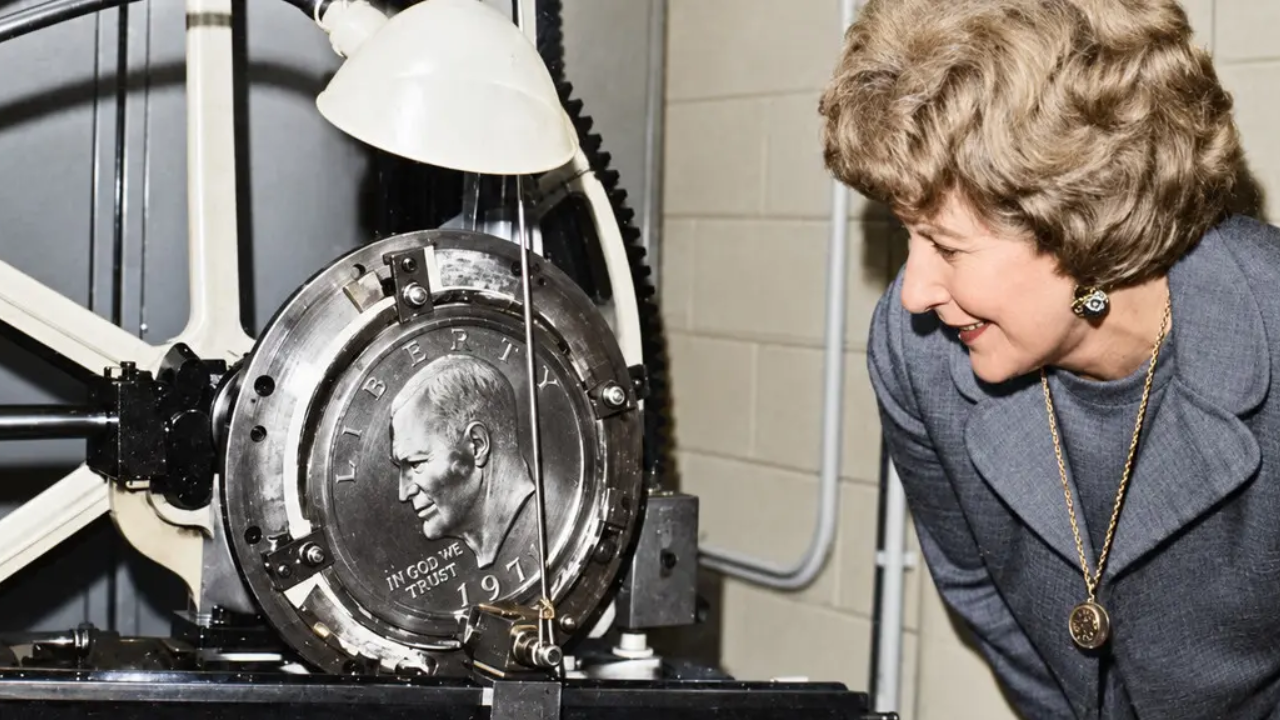
Mint Director Mary T. Brooks even invited reporters to the Philadelphia Mint on January 25, 1971, just to watch experimental trial strikes. Technicians churned out test pieces using experimental dies and silver blanks.
The official rule was simple: every single trial coin made during that demonstration had to be destroyed by the Trial Strike Committee.
They failed. Somehow, three prototype dollars slipped through the cracks.
The Mystery of the San Francisco Mintmark
All three known prototype dollars carry the "S" mintmark for San Francisco. Experts at Heritage Auctions suspect the Mint shipped experimental prototype dies to San Francisco to test equipment meant for silver collector coins.
How they escaped official custody remains a blank space in the history books. They ended up sealed inside standard Mint pliofilm wrappers—the blue packs collectors love. For 37 years, Lydston's coin sat completely unnoticed, traded away in ordinary lots as if it were just another common piece of silver.
Then lightning struck twice. Or rather, three times.
In 2010, an Alabama pawn shop yielded a second prototype. A collector named Charles Chatham picked it up for just ten bucks inside an original Blue Pack. It featured the same prototype reverse die as Lydston's coin, but paired with a completely different obverse die—giving away its identity through subtle lettering shifts in the word "LIBERTY."
A third specimen surfaced on eBay in 2013, spotted by another sharp-eyed hunter using the exact same die pairing as the original discovery piece.
Why This Coin Commands $264,000
Rarity drives the high-end coin market. In 1971 alone, the San Francisco Mint churned out more than 6.8 million uncirculated silver dollars and over 4 million silver proofs. Millions of these coins exist in standard collections today, worth little more than their silver weight or a modest collector premium.
Against that backdrop of millions, three prototypes stand alone.
When David Frohman acquired Lydston's discovery, it eventually crossed the auction block at Heritage Auctions in January 2022, commanding a staggering $264,000. Now, the exact same coin is back up for grabs with a PCGS grade of SP67 and a coveted green Certified Acceptance Corporation sticker. It remains the absolute finest known specimen of the three.
Check your old coin tubes, estate finds, and inherited collections. You probably won't find a six-figure prototype, but paying attention to the small details is the only way rare history finds a new home.