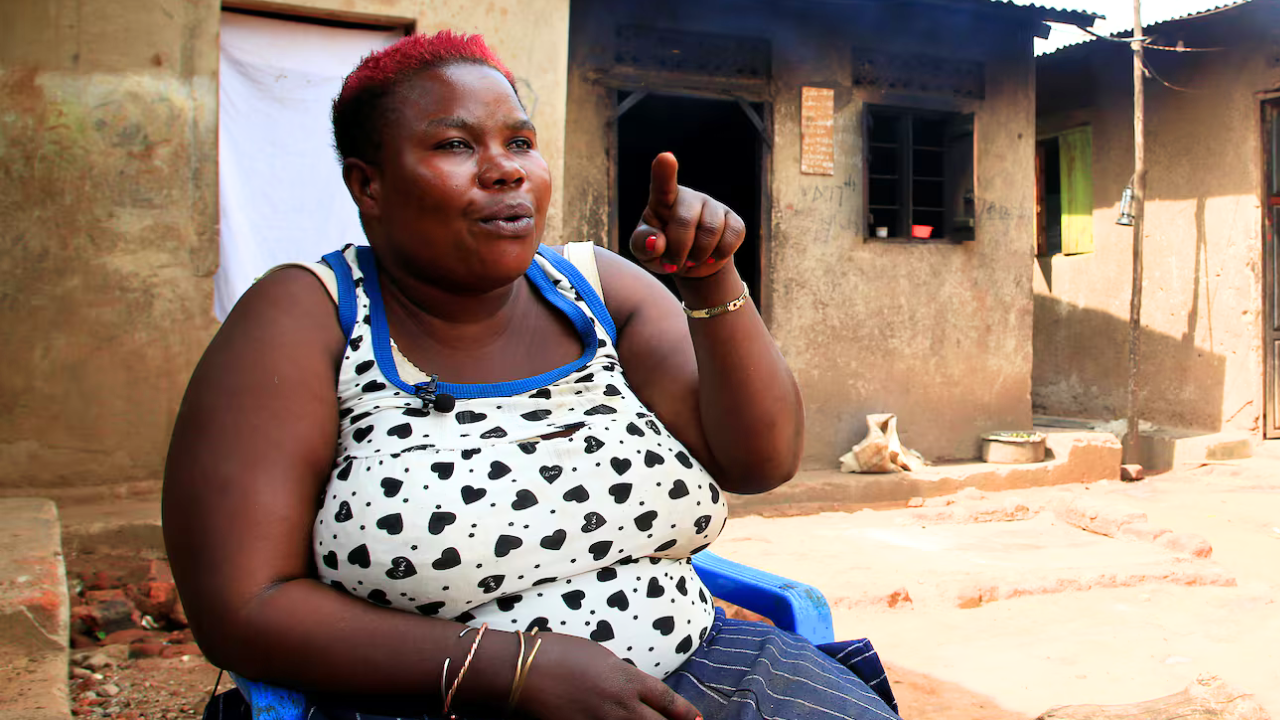
Imagine finding yourself responsible for 44 babies before you even hit your late thirties. It sounds like a made up medical myth or an internet hoax designed to farm clicks. But for Mariam Nabatanzi, a woman living in the village of Kasawo within Uganda's Mukono district, this wasn't a viral headline. It was her actual, grueling daily reality. Known locally as Maama Uganda, she holds the unofficial title of the world's most fertile woman. Yet the sensationalized internet stories completely gloss over the dark realities behind her massive family. People see the shocking numbers and think it is just a bizarre quirk of nature, but the real story is a messy mix of child exploitation, systemic medical failure, and jaw-dropping personal resilience.
The internet loves to treat her life as a lighthearted human-interest piece. You have probably seen the short videos or quick social media posts showing dozens of kids lined up outside brick homes. They frame it as a heartwarming tale of an extraordinary mother. That framing is completely wrong. When you peel back the layers, you don't find a whimsical medical anomaly. You find a story that should make you incredibly angry.
The Exploitation of a Child Bride
Let's look at how this actually started. Mariam didn't choose to build a mega-family. She never sat down and planned to break fertility records. Her childhood was stripped away from her before she could even understand what was happening. Born around 1980, her early life was defined by trauma. Her mother walked out on the family just three days after she was born. Later, her stepmother allegedly murdered her five older brothers by mixing crushed glass into their food while Mariam was away visiting a relative. She survived purely by chance.
Then came the final blow to her youth. When she was just 12 years old, her father sold her off into marriage. Her new husband was a 45-year-old man—more than three times her age. It was a textbook case of child marriage and severe exploitation.
By the time she turned 13, she gave birth to her first set of twins. Think about that for a second. While most young girls are navigating middle school, Mariam was enduring childbirth and learning to care for two newborns while dealing with an abusive, polygamous husband who routinely mistreated her. The sheer weight of adult responsibilities fell on her shoulders before her own body had even finished growing. She has publicly stated that she hasn't known true joy since the day she was born.
The Medical Reality of Hyperovulation
Why did she have so many kids so quickly? It wasn't because she was pregnant 44 separate times. The math works out quite differently. Over roughly 25 years of childbearing, Mariam experienced only 15 deliveries.
Her pregnancies were an almost unbroken chain of extreme multiple births:
- Six separate pairs of twins
- Four separate sets of triplets
- Three separate sets of quadruplets
- Only two single births
This happened because of an ultra-rare genetic condition called hyperovulation. In a typical menstrual cycle, a woman's ovaries release a single egg. If that egg gets fertilized, you get one baby. Mariam's body didn't work that way. Her ovaries were abnormally enlarged and genetically programmed to release multiple eggs during every single cycle. Whenever she became pregnant, her chances of carrying twins, triplets, or quadruplets shot through the roof.
Interestingly, she inherited this genetic trait directly from her father. He reportedly fathered 45 children with several different women, and his children frequently arrived in sets of twins, triplets, quadruplets, and even quintuplets. Her body carried that exact same genetic predisposition, pushing her reproductive system into overdrive.
How Medical Misinformation Locked Her In
One of the most frustrating aspects of Mariam's journey is that she actively tried to stop it. She didn't want a massive household. After her sixth delivery, she realized her body and her finances couldn't handle the exponential growth. She went to local doctors begging for help, looking for any way to halt the pregnancies.
The medical advice she received was shocking. Doctors told her that because her ovary count was so high, attempting to stop her fertility artificially could kill her. They claimed that backing up the unused eggs inside her body would lead to severe illness or early death.
This sounds completely absurd to anyone with access to modern Western medicine. But in rural Uganda, superstitious medical myths and patriarchal attitudes often dictate women's healthcare. Doctors kept telling her to keep going. By the time she was 23 years old, she had already given birth to 25 children. Again, she pleaded for a medical solution, and again, she was told that stopping would destroy her health.
She was essentially trapped by her own biology and the bad advice of the professionals she trusted. She kept getting pregnant because she thought it was the only way to stay alive. The endless cycle didn't end until 2016, following the birth of her final set of twins. During that delivery, one of the babies tragically died in childbirth. Following that final cesarean section, a gynecologist at Mulago National Specialised Hospital in Kampala finally intervened, performing a tubal ligation to permanently close her fallopian tubes. She was finally free from the threat of another pregnancy, but the damage was already done.
The Absolute Desertion of a Deadbeat Husband
If you think managing 44 kids with a supportive partner is impossible, try doing it completely alone. In 2015, Mariam's husband decided he was done. Terrified by the crushing financial burden and the sheer chaos of the household, he simply packed his things and abandoned the family.
But he didn't just walk out. He went out of his way to make their lives infinitely harder. Before he vanished, he sold off the very homestead where Mariam and the children were living, leaving them completely vulnerable. Out of the 44 children Mariam brought into the world, six passed away over the years, leaving her with 38 surviving children to feed, clothe, and educate entirely on her own.
Her husband's name is now a curse word in her home. He left her pregnant with that final, tragic set of twins and took whatever family resources were left. Mariam was forced to rely on her elderly grandmother for shelter. When her grandmother died, Mariam had to take on massive debts just to keep the roof over her children's heads. She spent years owing a massive balance on the property just to prevent her family from being thrown out onto the street.
The Brutal Mechanics of Daily Survival
How does a single mother actually manage a household of nearly 40 children? It requires a level of grit that most people cannot comprehend. They live in a handful of cramped, basic houses made of cement bricks and corrugated iron roofing, surrounded by rural coffee fields.
The living arrangements are a logistical puzzle:
- Most of the small bedrooms don't even have beds.
- A few rooms contain basic metal bunk beds, many of which are broken or structurally unsound.
- Up to a dozen children stack onto a single thin mattress on the floor.
- The youngest children sleep huddled together, sharing whatever blankets and space they can find.
Feeding this small army is an astronomical challenge. A typical day requires over 25 pounds of maize flour or cassava just to provide basic, starchy porridge to keep hunger pains away. Meat or fish are luxuries they almost never see.
To pay for this mountain of food and school fees, Mariam works constantly. She doesn't have the luxury of a single full-time job. Instead, she hustles across multiple informal industries. She mixes and sells local herbal medicines. She collects and resells scrap metal. She braids hair for women in the village. She even takes gig work decorating small local events or weddings when the opportunity pops up. Every single shilling she earns is immediately spent on her kids.
Despite the backbreaking poverty, Mariam has one non-negotiable rule. All of her children must get an education. Because she was robbed of her own schooling at age 12, she views education as the only real escape hatch for her kids. Her eldest son, Ivan, had to drop out of school to help support the younger siblings, but Mariam works herself to the bone to ensure the rest stay in the classroom. She wants them to become doctors, lawyers, and teachers. She wants them to have the life she was denied.
What This Story Represents
When you look at Mariam Nabatanzi, don't look at her as an internet curiosity or a freak fertility statistic. Her life is a living indictment of systemic global issues that persist today. It highlights the horrific impact of child marriage, where young girls are treated as property and reproductive vessels before they can even consent. It exposes the deep gaps in rural healthcare systems, where women are denied bodily autonomy and basic family planning because of myth and misinformation.
Most of all, it shows the failure of parental accountability, where a man can father dozens of children, ruin a family financially, walk away with zero legal consequences, and leave a woman to bear the entire weight of his choices.
Mariam's story isn't inspiring because of the number of children she had. It is inspiring because she refused to lie down and die when the world gave her every reason to quit. She is a survivor holding an entire generation together with nothing but raw willpower and odd jobs.
If you want to support vulnerable families or learn more about the ongoing fight against child marriage and reproductive injustice, look into grassroots organizations operating in East Africa. Groups like Girls Not Brides work directly on the ground to end forced early marriages, while local health initiatives focus on bringing accurate medical education and safe family planning resources to rural communities. Getting involved or donating to these causes helps ensure that the next generation of young girls won't have their childhoods stolen away.

:max_bytes(150000):strip_icc()/gettyimages-511520684-1-71d0a72cf50e4e4481cdc90bfc937f0a.jpg)