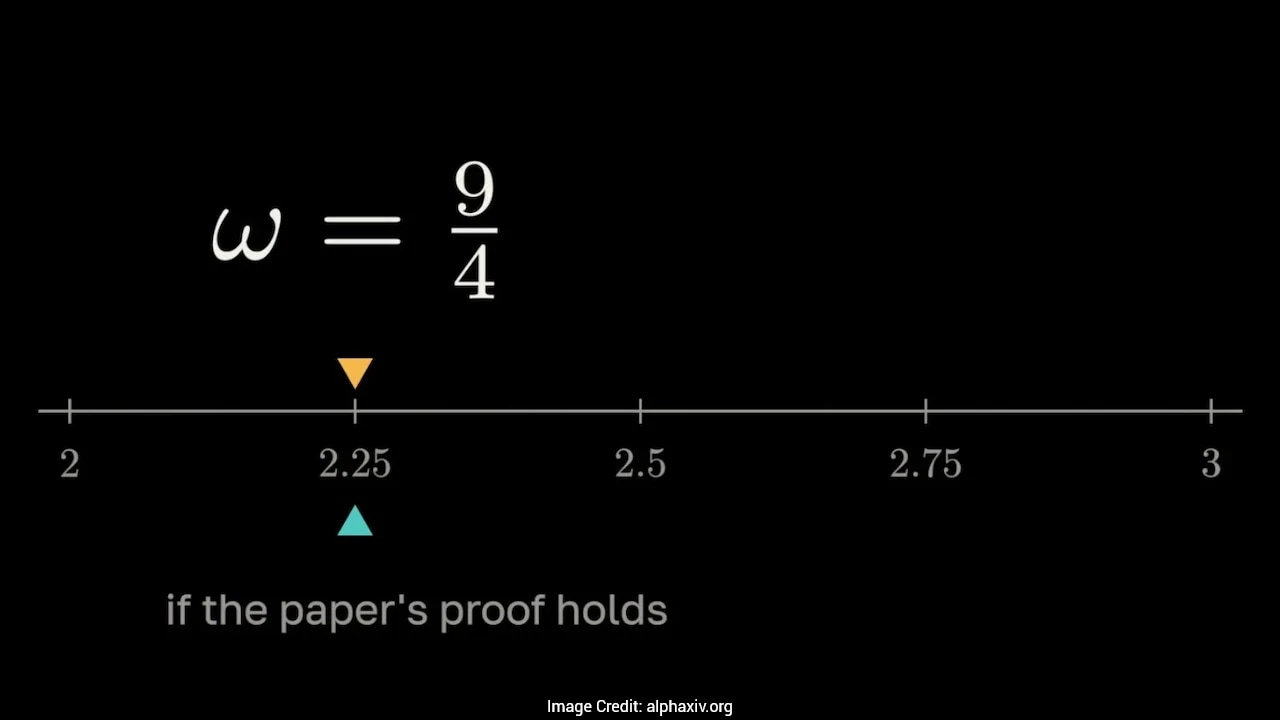
No, your GPUs aren't going to magically double in speed tomorrow morning. Still, if OpenAI's new proof holds up under peer scrutiny, it settles a 57-year argument about the theoretical speed limit of matrix multiplication—and puts the answer at 2.25 (or 9/4), not 2.
That number matters because matrix multiplication sits underneath almost everything in modern computing. Training frontier models, running inference, rendering graphics, solving physics simulations—it all boils down to multiplying grids of numbers fast. In November 2026, OpenAI dropped a 111-page preprint titled The Matrix Multiplication Exponent Is Nine-Fourths, following earlier work on upper bounds and a batch of math preprints.
Headlines love clean victories. Reality in theoretical computer science is much messier, and honestly, the most interesting part isn't even the headline number. It's what that number rules out—and why real hardware engineers still care about memory bandwidth more than asymptotic exponents.
Why This 57-Year Math Problem Exists in the First Place
When you learn matrix multiplication in school, multiplying two $n \times n$ matrices the standard way takes roughly $n^3$ operations. For a long time, people assumed cubic time was basically the natural cost of doing the work.
Then in 1969, Volker Strassen showed you could beat $n^3$ by splitting matrices into blocks and combining them cleverly, dropping the exponent below 3 to roughly 2.81. That kicked off a 57-year chase to find the true matrix multiplication exponent, written as $\omega$.
Mathematicians knew there had to be a floor somewhere. Since a product of two $n \times n$ matrices has $n^2$ entries, you can't avoid writing down the output, which put a trivial lower bound at $\omega \ge 2$. For decades, many hoped $\omega$ might actually equal 2. Over the years, researchers chipped away at the ceiling—pushing it down toward roughly 2.371—while the gap between 2 and the upper bound stayed stubbornly open.
OpenAI's claim pins both sides at 9/4, or 2.25. That means no algorithm in their formal model can beat $n^{2.25}$ in the exponent, closing the door on a near-quadratic breakthrough.
The Catch Nobody Mentions in the Hype Cycle
Whenever an AI lab claims a major theorem, two things happen right away. Half the internet acts like mathematics is over, and the other half yells that the proof hasn't been checked yet. Both reactions miss nuance.
First, the model of computation matters. OpenAI's result is framed around formal arithmetic circuits—where inputs are variables and gates add, subtract, multiply, or divide. As commentators in computer science have pointed out, real-world chips use floating-point formats like FP16, BF16, or low-bit quantization, memory hierarchies, and Word RAM models with their own quirks. A lower bound in an arithmetic circuit model isn't the same thing as a universal law across every conceivable hardware or number system.
Second, peer verification takes time. Automated checks like Lean can verify formal statements as encoded, which is helpful, yet human mathematicians still have to examine 111 pages of dense tensor and complexity arguments line by line. Even OpenAI has had to withdraw or revise AI-generated math manuscripts in 2026 after internal audits caught errors. Treating an unrefereed preprint as settled gospel before independent experts sign off is a classic mistake.
Third, asymptotic exponents don't equal practical speedups. Algorithms that chase exotic exponents often carry huge hidden constants or only kick in on absurdly massive matrices—so-called "galactic" algorithms. On actual GPUs, matrix multiplication is often bottlenecked by moving data between memory and compute cores, and simple tiled methods win because they map cleanly onto tensor cores.
What Changes If This Proof Holds Up
Assuming independent mathematicians confirm the result without fatal flaws, the impact is real, just not where most people expect it.
Closing Long-Running Theoretical Dead Ends
For decades, theorists chasing $\omega = 2$ had to keep asking whether a clever trick could push matrix multiplication right down to quadratic time. Pinning the exponent at 9/4 redraws the map. It tells researchers where the theoretical wall sits in that framework and shifts attention toward tight constants, structured matrices, and related complexity questions.
Ripple Effects Across Algorithms and Optimization
Matrix multiplication isn't an isolated parlor trick. It underpins graph algorithms, numerical linear algebra, and optimization. Better understanding of tensor structure and complexity bounds can spill into adjacent problems—like linear programming, Fourier transforms, and integer multiplication—where progress often comes from cross-pollinating ideas across subfields.
A Shift in How Frontier Research Gets Done
Even if you stay skeptical of hype, you can't ignore how fast labs are throwing reasoning models and proof assistants at open problems in 2026. AI systems can explore vast algebraic spaces and draft long arguments faster than a lone researcher working with chalk. That doesn't replace human insight—framing the right question, spotting subtle assumptions, and doing careful refereeing still require human judgment—but it changes the pace of exploration.
Common Misconceptions Worth Clearing Up
- "OpenAI solved P vs NP." No. Matrix multiplication complexity is a big deal in algorithms and computational complexity, yet proving a bound on $\omega$ does not resolve P versus NP.
- "LLM training costs will suddenly drop by half tomorrow." Not from this paper alone. Real-world training throughput depends heavily on kernel fusion, memory bandwidth, communication overhead across clusters, and low-precision hardware efficiency.
- "An AI proof means zero human work was involved." AI models build on decades of human-invented algebra, definitions, and theorems—and they still need human scrutiny to verify meaning and catch blind spots.
Practical Next Steps If You Work in AI or Math
If you're an engineer, researcher, or just someone trying to read past sensational headlines, don't stop at social media threads.
- Read the primary preprint and scope notes, not just summaries. Check what computational model is assumed and what exact theorem is claimed rather than relying on shorthand slogans.
- Watch for independent refereeing and community follow-ups from established complexity and tensor researchers over the coming weeks.
- Focus your engineering effort where real bottlenecks live—memory layout, batching, communication, and numerical stability—while keeping an eye on how formal methods and AI-assisted theorem proving evolve in your domain.