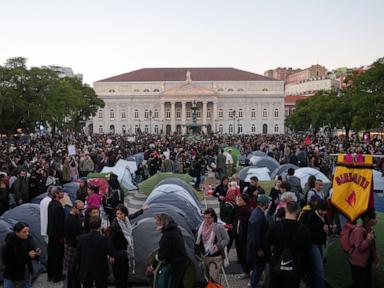
You can not walk through Lisbon right now without tripping over the reality of a fractured property market. Tents line public squares, rent prices outpace local wages by staggering margins, and the political friction inside the Portuguese parliament has reached a boiling point. Lawmakers are currently locking horns over government spending plans that critics argue ignore the root causes of the crisis.
People are furious. They are taking to the streets because the arithmetic simply does not work anymore. Meanwhile, you can find other events here: Why Gadi Eisenkot's Campaign Stop In Kibbutz Nir Oz Hits Different.
When your capital city becomes playground territory for foreign buyers utilizing golden visas and tax loopholes while locals earn minimum wage, something has to snap. The parliamentary debates happening right now in Lisbon are not just about numbers on a budget spreadsheet. They are a fierce ideological battle over who actually owns the country and who gets to live there.
The Reality Behind the Budget Battles
Let us look at what is actually driving these legislative showdowns. The government presents fiscal frameworks aimed at balancing national accounts, yet critics point out that these plans fail to inject enough capital into public housing stock or immediate rent stabilization. To understand the bigger picture, check out the recent article by BBC News.
If you are earning the national minimum wage, spending eighty percent of your monthly income on a tiny studio apartment is a mathematical trap. You cannot save. You cannot plan for the future. You are simply working to pay a landlord who might not even live in the country.
Opposition parties are clashing over spending allocations, arguing that tax incentives for foreign investors and digital nomads are pouring gasoline on a fire. The debate exposes a deep chasm between economic growth metrics on paper and the lived experience of citizens on the ground. Gross domestic product numbers might look fine to international financial institutions, but they mean nothing to a family facing eviction notices.
Why Golden Visas and Tourism Broke the Market
For years, Portugal positioned itself as the premier sun-drenched sanctuary for remote workers and retirees. Real estate became the primary engine of economic recovery following past financial downturns. That strategy worked too well.
Foreign capital flooded in. Luxury renovations replaced traditional housing blocks. Short-term vacation rentals swallowed up neighborhoods that used to house multi-generational families.
The market adapted to high-net-worth individuals rather than local earners. When supply is diverted toward lucrative tourist rentals and luxury developments, domestic inventory shrinks. Prices skyrocket. Basic economics dictates that locals get priced out of their own neighborhoods.
While recent legislative tweaks have attempted to curb some of the most aggressive golden visa loopholes, the damage is deeply entrenched. The political debate in parliament often stalls because powerful economic interests benefit from maintaining high property valuations. Lawmakers argue over incremental tax adjustments while the baseline cost of living continues to climb out of reach.
What Real Reform Looks Like
Solving this requires more than symbolic gestures or temporary rent caps that landlords find ways to bypass.
First, public investment must shift toward large-scale social housing construction. Portugal lags far behind the European average in public housing stock. Until the state actively builds and maintains affordable options, the private market holds all the leverage.
Second, tax structures need a complete overhaul to penalize speculative hoarding. Properties left vacant for the sake of capital appreciation should face heavy municipal penalties.
Third, local employment policies must catch up with European living costs. Economic resilience cannot rely solely on tourism and real estate speculation. It requires diversification into sectors that pay competitive local wages.
The protests in the streets are a warning sign. When citizens can no longer afford shelter in the cities where they work, the social contract breaks down. The politicians currently debating spending plans inside parliament need to realize that technical budget adjustments will not quiet the crowds. Real structural change is the only path forward.