Ancient stone walls are supposed to keep the chaos out. But last weekend, that illusion shattered completely in the heart of Rome.
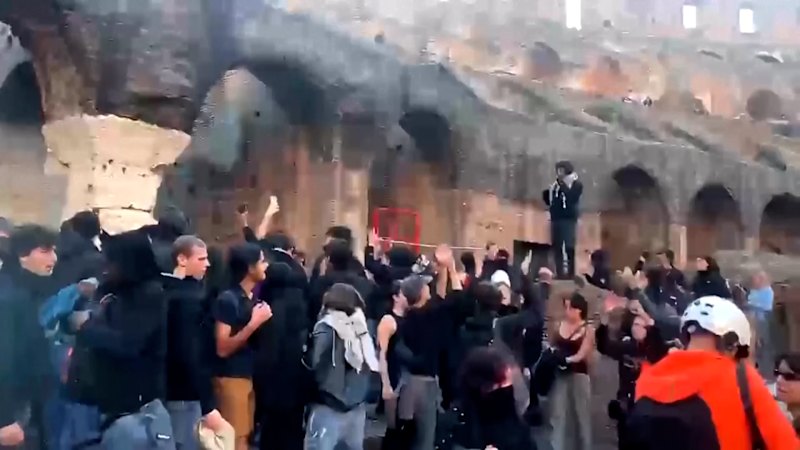
A faction of demonstrators broke through security perimeters at the Flavian Amphitheatre during massive nationwide anti-government and anti-war rallies. They waved banners, chanted slogans, and turned a symbol of imperial endurance into a stage for modern political fury. Prime Minister Giorgia Meloni’s administration faces an explosive public backlash, and the breach of one of the world's most heavily guarded heritage sites proves that ordinary security measures are failing to contain widespread social anger.
Let's look at what actually happened, why it matters, and how Italy got to this boiling point.
What Went Down at the Colosseum
The incident didn't happen in a vacuum. Thousands had poured into Italian streets across Rome, Milan, Turin, Florence, and Bologna. They were marching over soaring living costs, government policies under Meloni, and ongoing conflicts in the Middle East.
Amid the massive marches, a smaller splinter group broke away from the main crowd along Via Cavour. They made a beeline for the Colosseum, bypassed secured entry points, and poured into the interior areas where tourists normally walk.
Security staff acted quickly, pushing the crowd back out before things escalated into structural damage or prolonged occupation. But the psychological impact was massive. If a mob can punch through the perimeter of a globally famous monument like the Colosseum, security infrastructure across European cultural sites has a serious vulnerability problem.
The Broader Unrest Sweeping Italy
The Colosseum breach wasn't an isolated stunt. It was the sharp tip of a much larger spear.
Across major Italian cities, tensions boiled over into violent street clashes. In Rome and Turin, police deployed water cannons and tear gas after protesters hurled bottles at government buildings and law enforcement lines. In Florence, marchers attempted to smash through a police blockade near the Santa Trìnita bridge, meeting batons and rigid defense lines.
The numbers released by the Department of Public Security paint a stark picture of the scale of the crackdown:
- Nine people arrested nationwide during the day's events.
- 87 formally reported to law enforcement authorities.
- 371 individuals brought into police stations for background checks, including 110 minors and 69 foreign nationals.
Long before the marches even kicked off, Italian police had already detained 43 young people in Rome after routine checks uncovered balaclavas, heavy gloves, and masks. Investigators have also set their sights on digital organizers, including 30-year-old Youssef Siher, who allegedly administers social media channels for the Movimento 17 Ottobre, facing active suspicion of inciting crime.
Why Are Italians So Angry Right Now?
You can't understand the storming of the Colosseum without looking at the economic and political pressure cooker driving it.
Inflation has battered households. The cost of basic goods, housing, and energy has climbed past what many working-class families and students can comfortably absorb. When you combine economic desperation with intense polarization over foreign policy, rearmament spending, and the war in Gaza, you get a powder keg.
Students and young adults have taken the brunt of the frustration. Many feel left behind by traditional political channels, leading them to direct action, street occupations, and direct clashes with police.
Prime Minister Meloni responded by publicly praising law enforcement agencies, thanking Interior Minister Matteo Piantedosi and local security chiefs for holding the line. Her stance is firm: the right to peaceful protest must coexist with the safety of ordinary citizens in their own cities. Yet, the hardline response risks fueling a vicious cycle where police crackdowns only draw out larger, angrier crowds next weekend.
What Happens Next
Governments don't easily forget when national landmarks get breached. Expect Italy's security apparatus to tighten further, especially around major tourist zones and government corridors. Additional troop deployments, stricter digital surveillance of protest groups on apps like Telegram, and pre-emptive detentions are almost guaranteed.
If you're traveling to Rome or any major Italian hub anytime soon, keep your eyes open. Foreign governments, including India's embassy in Italy, have already issued advisories urging their citizens to stay clear of large crowds and demonstrations.
The anger in the streets isn't cooling down. The Colosseum has survived fires, earthquakes, and the fall of an empire, but modern political friction is testing its boundaries in ways the ancient Romans never anticipated.