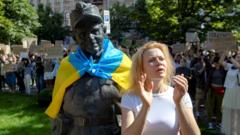
Volodymyr Zelensky just made his biggest political gamble since the 2022 invasion. By firing his highly popular, tech-savvy 35-year-old defence minister, Mykhailo Fedorov, the Ukrainian president sparked a firestorm he clearly did not anticipate. This was not just another routine wartime cabinet shuffle. It instantly triggered widespread protests in Ukraine's cities against Zelensky's removal of defence minister, exposing raw political fractures in a country fighting for its survival.
People are angry. They are taking to the streets during a war, defying security risks to make their voices heard. For a president who has enjoyed almost unchallenged domestic authority since the full-scale invasion began, this public backlash marks a dangerous turning point. It shows that the Ukrainian public's patience with top-down, non-transparent decisions is wearing thin, even under the shadow of Russian missiles.
Street anger and political rebellion in Kyiv
On Thursday, thousands of demonstrators gathered outside the president's office in Kyiv. The mood was tense. They carried signs demanding that Fedorov remain in office, chanting "Fe-do-rov!" and "Shame!" Many of these protesters are directly involved in Ukraine's massive volunteer and defence technology sectors. They feel personally betrayed by the decision.
"This is what happens when you take people's hope away from them," said Ksana Nechyporenko, a demonstrator working in Ukraine's drone industry.
This is not a fringe movement. The anger is deeply felt. Fedorov, who previously served as the minister for digital transformation, was widely seen as a modernizer. He cut through red tape to build Ukraine’s formidable "Army of Drones" from scratch. To everyday citizens and frontline soldiers, he represented efficiency, transparency, and a break from the Soviet-style bureaucracy that still plagues parts of the state apparatus.
Sacking him after just six months in the job feels like a step backward to many Ukrainians. It suggests that the old political guard is reasserting control.
The political fallout was immediate. Pavlo Yelizarov, a renowned drone unit commander and the deputy leader of the Air Force, resigned in protest. He wrote publicly that the decision to oust Fedorov would do "a great evil for the country's defence capability". When top military officers start resigning over political decisions, you know you have a crisis.
Why a tech reformer became public enemy number one inside the ministry
Fedorov’s rise was rapid. His fall was even faster. He was appointed in January 2026 with a mandate to clean up the notoriously corrupt procurement processes and speed up supply chains. He did exactly that. He bypassed traditional military channels to work directly with private tech startups, domestic drone manufacturers, and international partners.
But in doing so, he made powerful enemies.
Ukraine's wartime defence budget is massive. Millions of dollars flow through these systems daily. For decades, certain networks of middlemen, military bureaucrats, and corrupt actors have profited from these opaque procurement structures. Fedorov’s push for digital tracking and open bidding threatened these deep-seated interests. Multiple sources close to the parliament and defence industry have openly stated that Fedorov had become an obstacle to interests seeking to skim profits from the state's military spending.
Instead of backing his reformer, Zelensky chose to cut him loose. The president's office claimed the decision was about a lack of progress on a highly sensitive draft and mobilisation system, but few on the streets buy that explanation.
The public break with General Syrskyi
We cannot ignore the friction at the top of the military hierarchy. Fedorov’s fast-moving, data-first approach clashed directly with the traditionalist stance of General Oleksandr Syrskyi, the commander-in-chief of Ukraine's armed forces.
Fedorov did not hold back after his dismissal. In a press conference on Thursday, he openly criticized the military command.
"Decisions are made based on loyalty, not data," Fedorov told reporters, accusing parts of the military hierarchy of active sabotage. "There is sabotage of changes. There are constant lies, including about me."
Zelensky reportedly told members of his own party that the relationship between Fedorov and General Syrskyi had completely broken down. They were simply not on speaking terms. When forced to choose between his top battlefield general and his reformist defence minister, Zelensky chose the general. It is an understandable instinct during a war, but the political cost is proving to be incredibly high.
A parliamentary crisis Zelensky did not see coming
The protests on the streets are being mirrored inside Ukraine's parliament, the Verkhovna Rada. Zelensky’s Servant of the People party has typically operated as a rubber stamp for wartime presidential decisions. Not this time.
Several MPs from the president’s own faction have warned that there are currently not enough votes to approve Zelensky's handpicked candidate to replace Fedorov. The internal rebellion is so severe that prominent lawmaker Mykyta Poturaiev resigned in protest.
This is a massive blow to Zelensky’s domestic authority. He is now locked in urgent talks with his chief of staff to find a way out of this political dead-end.
The timing of this crisis could not be worse. It coincided with Russian missile strikes on Kyiv and the farewell visit of outgoing British Prime Minister Keir Starmer. While Zelensky was trying to project an image of absolute strength and continuity to his international allies, his own capital was filled with citizens chanting against his leadership.
Where does Ukraine go from here
To resolve this crisis, the presidential administration needs to take immediate, transparent steps. The public will not accept another backroom political deal.
First, Zelensky needs to publicly guarantee that the tech-focused reforms pioneered by Fedorov will not be dismantled. The "Army of Drones" program must remain independent and free from the old-school bureaucratic meddling of the defence ministry.
Second, the president must address the allegations of corruption in procurement head-on. If the public believes Fedorov was fired because he was stopping corrupt officials from stealing wartime funds, domestic trust in the government will completely collapse.
The coming days will show whether Zelensky can listen to his people and adapt, or if he will double down on a decision that has alienated his most vital supporters: the reformers, the tech innovators, and the soldiers fighting on the front lines.