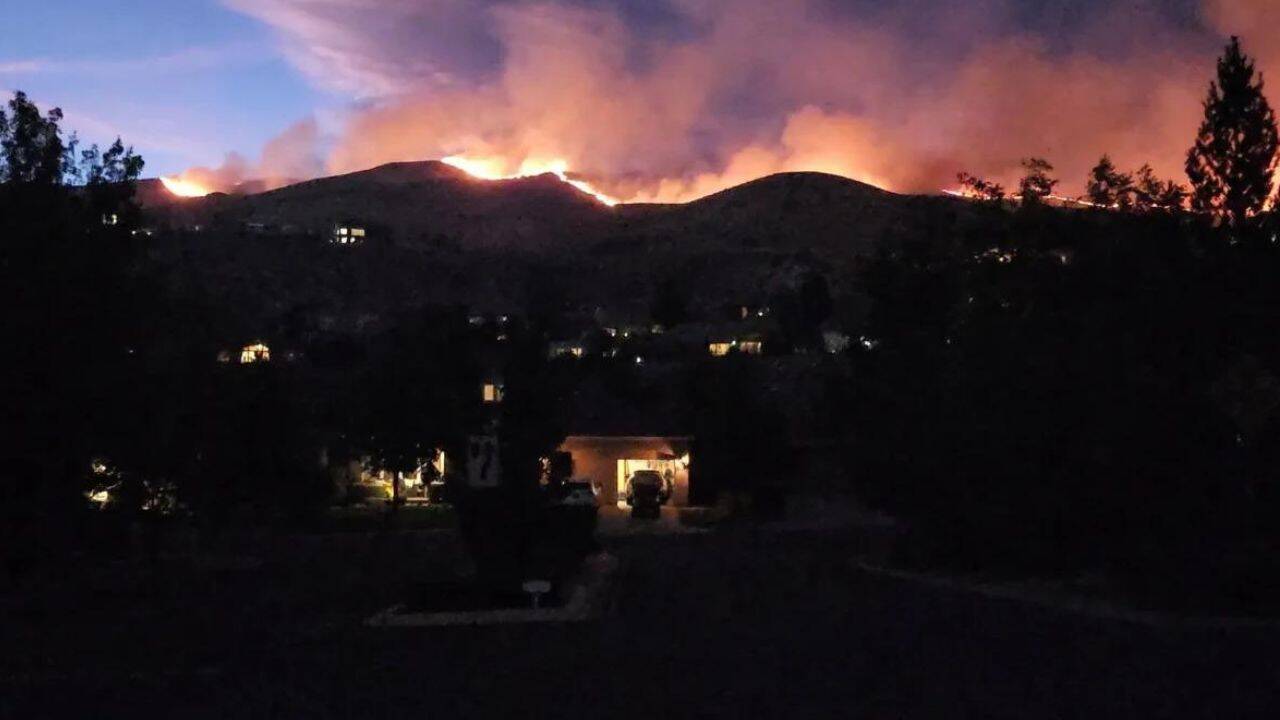
When a wildfire moves fast enough to jump over active fire trucks, normal safety timelines evaporate. That is what happened on the edge of Reno, Nevada, when the human-caused Hawk Fire exploded across Peavine Peak.
If you are trying to understand how a weekend blaze in the Humboldt–Toiyabe National Forest forced roughly 90,000 people under evacuation orders or warnings, you have to look at the combination of erratic winds, dry foothills, and a blaze that refused to follow standard containment patterns. Meanwhile, you can explore related events here: Inside Imran Khan's Recent Adiala Jail Health Check And Why Everyone Is Arguing About It.
The Anatomy of a Fast-Moving Emergency
The fire started on a Saturday and ballooned to cover over 20 square miles of rugged terrain near the California state line. Washoe County Sheriff Darin Balaam pointed out just how chaotic conditions became once the sun went down and the winds shifted. Crews couldn't safely reach hotspots because the flames were changing directions and outpacing response vehicles.
With 42,000 residents placed under strict "GO NOW" orders and another 45,000 kept on warning status, local infrastructure stretched to its breaking point. The "GO NOW" zone pushed right up to the edge of the University of Nevada campus, where many of the 20,000 undergraduate students had just finished moving into housing for the new term. To understand the full picture, we recommend the excellent report by NPR.
Why Tracking Apps Failed Families
Real-time safety relies on accurate data, but this fire exposed major gaps in everyday emergency tracking. Local resident Cari Kieffer found out her family home was compromised only after seeing a social media video of the destruction. The tracking application her family used was lagging significantly behind the actual fire front. They thought firefighters had successfully buffered their neighborhood, only to realize later that everything they owned was gone, leaving behind little more than a scorched backyard basketball hoop.
Stories like that explain why emergency officials stopped sugarcoating the threat. Authorities warned evacuees to plan on staying away from their properties for several days. Shifting winds create unpredictable surges, meaning a house that looks safe in the morning can be engulfed by afternoon gusts.
State Response and Logistics
Nevada Governor Joe Lombardo stepped in by declaring a state of emergency for Washoe County. The response mobilization brought in the Nevada National Guard, which dispatched two helicopter crews for aerial water drops and roughly 60 troops to assist law enforcement with securing abandoned neighborhoods against looting.
Around 800 total fire personnel converged on the lines. Power outages initially knocked electricity out for 60,000 customers, though crews managed to trim that number down to about 10,000 by Sunday. Major transit arteries like US Route 395 saw major closures, choking off normal escape and supply routes.
For displaced residents, logistics became an immediate hurdle. The Reno-Sparks Convention Center opened its doors as an emergency shelter, but with a catch: no pets were allowed inside the main facility. Families had to split up, dropping small and large animals off at separate designated animal shelters before finding a place to sleep. Local Reno casinos stepped up by offering discounted hotel rooms for the displaced, softening the blow of a sudden evacuation.
What Triggers These Rapid Spreads
Investigators confirmed the Hawk Fire was human-caused, though they kept specific details under wraps while the investigation remained active. That detail stings for a region already exhausted by an active fire season. Nevada logged 15 new fires on a single Saturday, highlighting how fragile the landscape is during dry summer months.
When authorities tell you to leave an evacuation warning zone, don't wait for mandatory orders to materialize. Pack your animals, grab essential documents, and assume the roads will clog up the moment the wind changes direction.