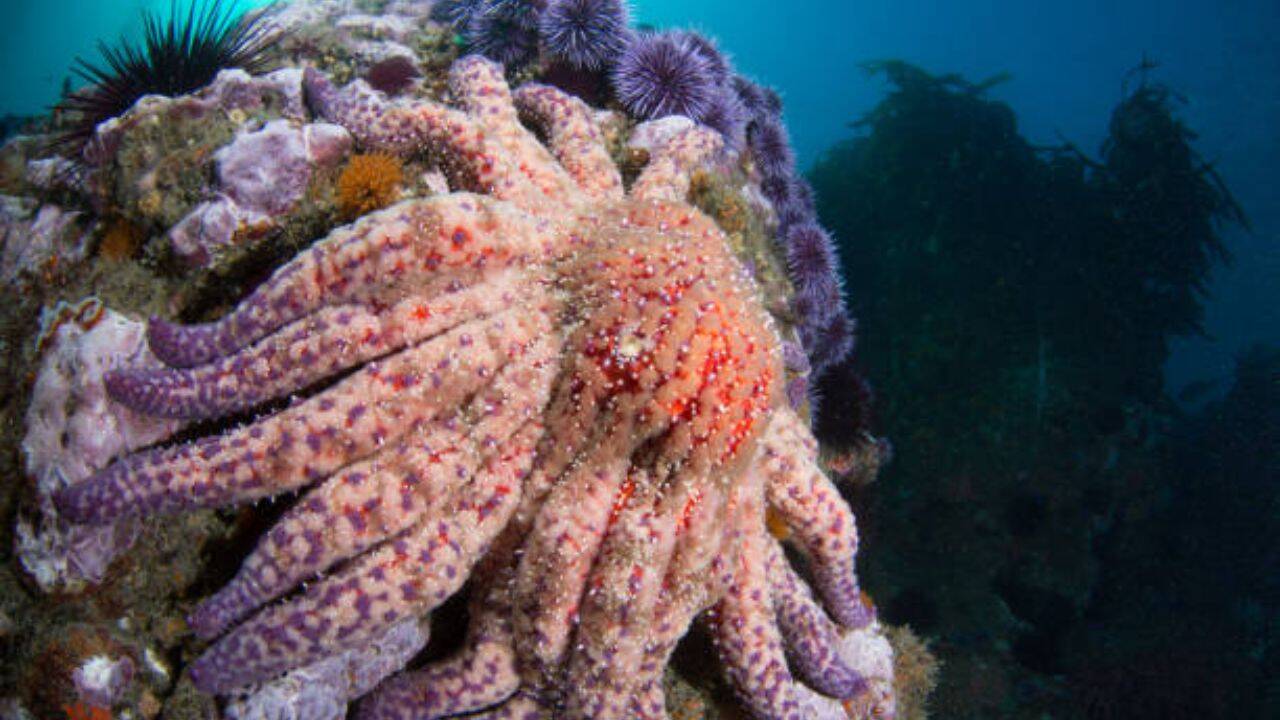
For ten years, divers along the West Coast searched in vain for a creature many feared was gone forever. Known scientifically as Pycnopodia helianthoides, the sunflower sea star earned a mythical reputation. People started calling them the "seasquatch" of the sea. When a devastating marine heatwave collided with a massive sea star wasting epidemic back in 2013, over 99 percent of these multi-armed giants vanished from California waters.
That sudden absence triggered an ecological collapse. Without their primary predator to keep them in check, hungry purple sea urchins exploded in population. They mowed down the state's lush bull kelp forests, wiping out over 90 percent of vital underwater habitats.
Then marine researchers stumbled on something shocking. While monitoring underwater sites along the Sonoma County coast, scientists from Sonoma State University's Hughes Lab spotted a lone adult sunflower sea star. A week later, they returned and found juveniles—tiny, silver-dollar-sized stars clinging to the same rock.
That initial discovery blew open a much larger door. Researchers launched a collaborative diving blitz nicknamed "Pycnopalooza," bringing together twenty-five scientific divers from academic institutions, tribal communities, and environmental agencies. They found eighteen live sunflower sea stars. It's the largest and southernmost wild population documented in California since the wasting disease tore through the Pacific.
What Makes Sunflower Sea Stars So Important
If you've never seen a healthy sunflower sea star in the wild, you might not realize how massive and aggressive they are. They can grow up to three feet wide, sport up to twenty-four arms, and move across the ocean floor at a surprising speed.
They aren't passive bottom-feeders. They are apex invertebrate predators. An adult star hunts down purple sea urchins, using an overwhelming grip of tube feet to reel its prey in and consume it whole.
When the stars died off, the balance broke. Urchins created barren underwater deserts, stripping away the habitat that commercial fisheries, rockfish, abalone, and migrating gray whales rely on. Kelp forests also act as massive natural carbon sinks, making their survival crucial for fighting climate change. Finding a surviving breeding colony changes the timeline for coastal restoration.
Decoding Natural Resistance to Sea Star Wasting Disease
The discovery isn't just a feel-good story about spotting a rare animal. It gives scientists a direct line to genetic gold.
Researchers at the University of California, Merced, are analyzing genetic tissue samples collected during the Pycnopalooza surveys. They want to know why these specific eighteen stars survived an epidemic that wiped out billions of their peers.
Did these particular stars possess unique genetic traits that make them immune to the pathogen? Recent studies have identified Vibrio pectenicida as a primary bacterial culprit behind the wasting syndrome, worsened by warm ocean temperatures. Understanding how this Sonoma County colony handles disease stress lets conservation labs breed resilient generations. Facilities like the Sunflower Star Laboratory in Moss Landing are already working on captive-rearing programs. Having wild, naturally adapted survivors helps calibrate those breeding lines.
How Indigenous Partnerships Drive Modern Conservation
This discovery highlights a broader shift in how marine conservation happens on the Pacific coast. The Kashia Band of Pomo Indians worked directly alongside university researchers and state sanctuaries during the Pycnopalooza expeditions.
Ecologists note that restoring these waters requires long-term tribal land and sea stewardship combined with modern marine biology. For local Indigenous communities, seeing the return of the sunflower sea star represents a vital piece of ecological healing.
Long-term monitoring programs made this find possible. Without consistent, boots-on-the-ground ecological tracking by academic labs, this pocket of life would have gone unnoticed.
What Happens Next for California Kelp Forests
Finding eighteen sea stars won't instantly rebuild thousands of acres of lost kelp. Purple urchins still blanket vast stretches of the coast.
Yet, the discovery provides a blueprint for targeted restoration. Scientists plan to use environmental DNA sampling to track other hidden pockets of sea stars along the coast without relying entirely on luck or scuba divers. By pairing lab-bred disease-resistant stars with naturally resilient wild populations, marine biologists have a realistic framework to push back against urchin barrens.
Support local marine sanctuary monitoring programs, back regional kelp restoration initiatives, and pay attention to how scientific diving teams track nearshore biodiversity.