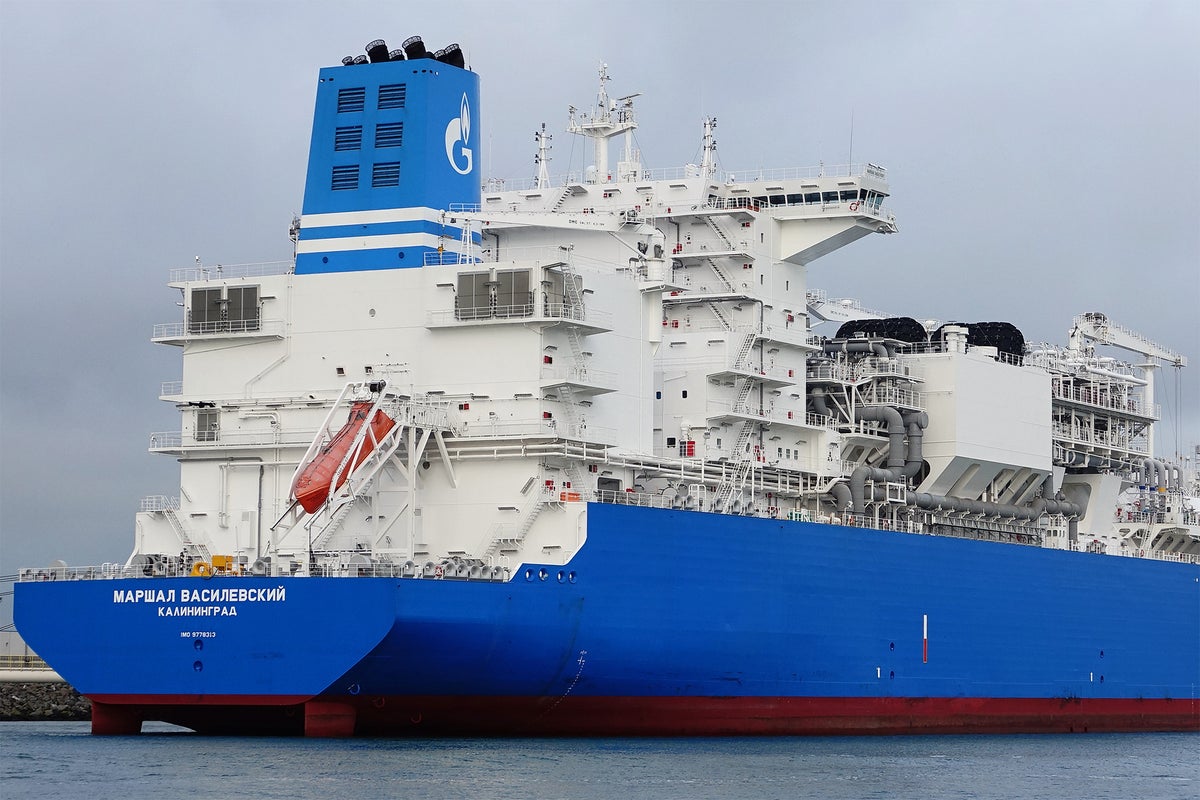
Commercial shipping isn't supposed to look like a war zone. Yet, Estonian surveillance aircraft recently captured stunning photos that prove Moscow is throwing out the old maritime rulebook. A massive, Russian-flagged civilian liquefied natural gas carrier called the Marshal Vasilevskiy was spotted sailing through the Baltic Sea with military-grade heavy machine guns mounted openly on its bridge roof.
This isn't an anti-piracy measure. There are no pirates in the Gulf of Finland. Instead, it's a cold, calculated message from the Kremlin to NATO. Moscow is showing the world that it will use force to protect its state-owned energy assets, even if it means turning civilian merchant crews into combatants.
What the Estonian Border Guard Found
The photos, captured by the Estonian Police and Border Guard Service, reveal two heavily fortified firing positions built right onto the corners of the vessel's bridge wings. Wooden pallets and sandbags surround the setups, protecting the gunners from incoming fire.
Inside those makeshift bunkers sit Soviet-designed 12.7mm Kord heavy machine guns. These aren't small arms. They're heavy infantry weapons capable of ripping through light vehicles, small watercraft, and low-flying helicopters at a range of up to two kilometers.
The Marshal Vasilevskiy is a 288-meter monster owned by Gazprom Flot LLC, a subsidiary of Russia's state energy giant. It serves as a floating storage and regasification unit, making it one of the most critical links in Russia's energy network. When the Estonians photographed it, the ship was making a routine run past Estonia’s western islands toward the port of Bolshoi Bor.
The Real Reasons Behind the Weapons
Maritime security analysts are calling this unprecedented. Armed guards frequently ride commercial vessels through the Western Indian Ocean or the Gulf of Guinea to deter pirates, but bringing military hardware into the highly monitored waters of northern Europe is a completely different story.
Intelligence officers in the region believe the guns serve two distinct purposes, split right down the middle.
First, they're a defense against Ukrainian maritime drones. Ukraine has successfully opened a new front in its drone war, striking deep into Russian territory. Earlier this year, Ukrainian uncrewed surface vessels managed to target and hit the St. Petersburg oil terminal and the Kronstadt naval base. Even more shocking to Moscow was an explosion aboard the Russian LNG carrier Arctic Metagaz in the Mediterranean Sea, which Russia blames on a Ukrainian drone cell operating out of Libya. The Kord machine guns give the crew a fighting chance to detonate a fast-moving explosive boat before it strikes the hull.
Second, the weapons send a blunt warning to European and NATO authorities. Western nations have steadily increased their sanctions packages, targeting Russia's energy infrastructure and its unflagging shadow fleet. By mounting heavy weapons on a legitimate, Russian-flagged ship, the Kremlin is warning Western navies not to try boarding, detaining, or inspecting its cargo. Defense analysts note that if a NATO boarding team tried to approach the ship, the presence of these guns means the situation could turn bloody instantly.
The Mystery of the Crew
A massive ship carrying super-cooled, highly volatile liquefied natural gas is basically a floating bomb. Operating heavy machine guns next to thousands of tons of flammable gas requires intense specialized training. Regular merchant mariners don't have those skills.
Investigative journalists reviewing the ship's manifests from recent months found something highly unusual. Alongside the normal crew, the manifest listed over twenty "passengers" who have been living aboard the vessel since last year. When researchers cross-referenced those names against leaked Russian databases, the truth came out. Nearly two dozen of these individuals have direct ties to Russian military structures, including the Federal Security Service, or FSB.
Russia isn't just bolting guns to the deck. It's deploying active security personnel to sail on commercial routes, effectively turning a civilian energy vessel into a hybrid military auxiliary ship.
A NATO Lake and a Stressed Kremlin
Ever since Finland and Sweden joined NATO, the Baltic Sea has essentially become an internal alliance lake. This reality has deeply rattled Moscow. Russian maritime trade relies heavily on the narrow lanes running out of St. Petersburg and past the Baltic states.
Vladimir Putin's maritime advisor, Nikolai Patrushev, publicly stressed that Russia cannot allow a blockade of its key maritime routes. He insisted that the Russian fleet must maintain total combat readiness to counter a full spectrum of threats in both the Baltic and Black Seas.
The Marshal Vasilevskiy is uniquely vital because it ensures the survival of Kaliningrad, the heavily militarized Russian exclave sandwiched between Poland and Lithuania. If Lithuania cuts off the overland pipelines that feed gas to Kaliningrad, this ship is Russia's only way to keep the lights on in that strategic military stronghold. Moscow’s anxiety over losing access to Kaliningrad explains why they're willing to take such an aggressive risk.
The Dangerous New Normal at Sea
This development pushes the high seas into dangerous, lawless territory. The UK, Canada, and Australia have already slapped sanctions on the Marshal Vasilevskiy, while the European Union has blacklisted its owner, Gazprom Flot. However, because the ship flies a sovereign Russian flag and carefully avoids entering Western territorial waters, it operates in a legal gray zone.
Estonian Navy officials admit they've stopped trying to intercept or detain problematic Russian ships in international waters unless there's an immediate, catastrophic danger. The risk of triggering a major military escalation with a nuclear power is simply too high.
But carrying boxes of live ammunition on an LNG tanker introduces terrifying structural risks. A single stray spark or an accidental discharge during a drill could trigger a catastrophic explosion, destroying the ship and causing an environmental nightmare in the middle of a crowded European waterway.
The arming of the Marshal Vasilevskiy proves that the lines between civilian commerce and military operations have completely blurred. For anyone operating in the Baltic Sea, the maritime environment just became a lot more volatile.
What Happens Next
Security teams and regional governments need to adapt to this hybrid threat immediately. The days of treating Russian merchant ships as purely commercial entities are over.
If you are involved in maritime logistics, port security, or regional defense planning in Northern Europe, you should expect to see more of this behavior. Take these three steps to handle the shifting reality in the Baltic.
- Update threat assessment protocols to classify state-owned Russian energy vessels as potentially armed hybrid platforms rather than standard civilian traffic.
- Increase aerial and satellite surveillance tracking on Gazprom-operated fleets to monitor for new weapon installations or unusual passenger manifests.
- Establish clear rules of engagement for coast guards and naval patrols encountering these vessels to avoid accidental escalations in international waters.