If you thought the Russian Navy was safe inside its heavily defended home ports, high-resolution orbital photos just shattered that idea.
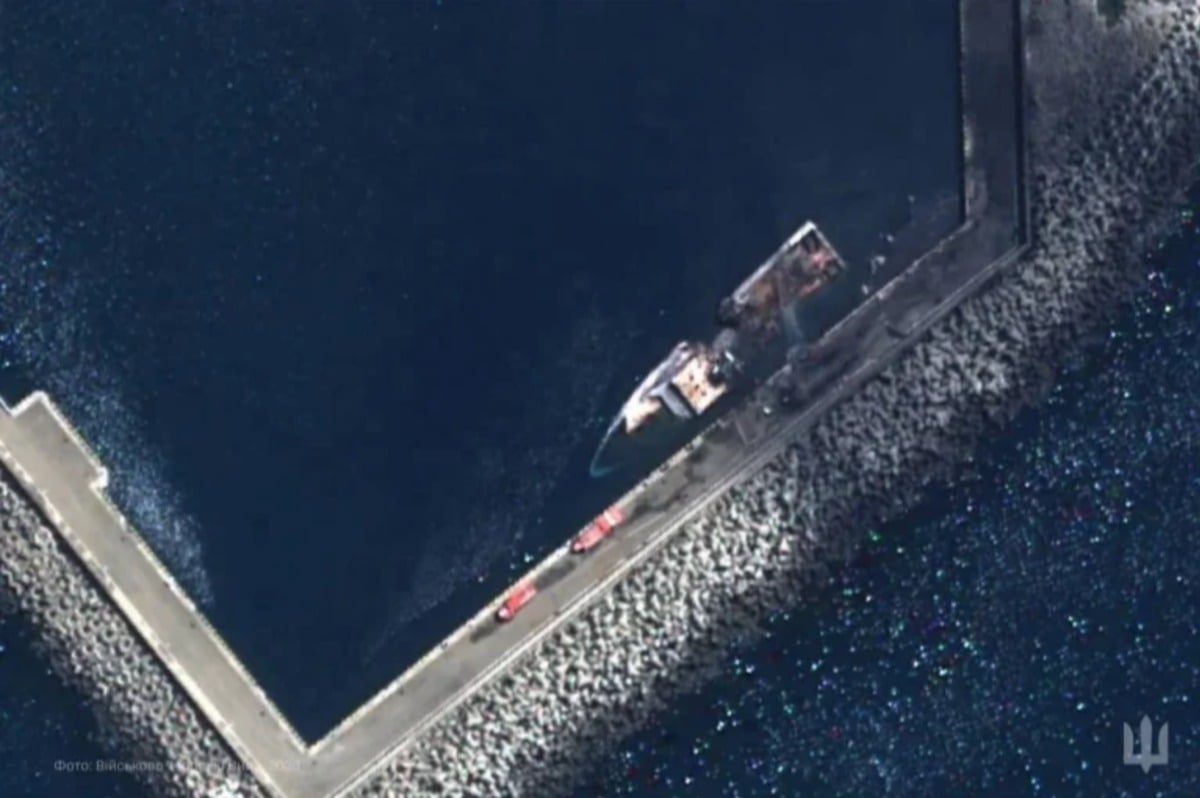
Fresh satellite imagery shows a Russian patrol ship destroyed near Novorossiysk, sitting half-sunk at its berth with black burn marks scoring the concrete dock around it. The vessel, identified as the FSB border guard ship Izumrud, met its end after a direct hit by a Ukrainian uncrewed surface vessel. Ukrainian naval forces released the space-based photo to verify the strike after initially claiming the hit.
For months, military observers watched Moscow pull its major surface combatants out of Crimea and tuck them into the Krasnodar Krai coastline. Novorossiysk was supposed to be the fortress beyond Ukraine's reach. This strike proves it isn't.
The Strike on a Russian Patrol Ship Near Novorossiysk Explained
Ukraine's Navy targeted the Izumrud using a Sargan-3000 sea drone. This isn't the older, widely publicized Magura V5 or Sea Baby model you've probably read about before. The Sargan-3000 represents a newer iteration of Ukraine's naval drone arsenal, built specifically to slip past harbor booms, electronic jamming arrays, and shore-based lookouts.
The attack hit the Izumrud while it was moored right against the pier wall. That detail matters. Striking a moving ship in open waters is hard, but striking a vessel docked deep inside a protected port facility requires penetrating layers of physical barriers, net guards, and port patrols.
Satellite photos captured shortly after the strike show the vessel listing heavily to its side, partly underwater, with clear structural devastation across its deck. Dockside scorch marks line the concrete quay, proving an aggressive secondary fire took hold following the impact. Ukrainian military sources reported casualties and injuries among the onboard FSB crew, though Russian state media remains silent on the exact count.
Why the Izumrud Was a Prime Target
The Izumrud wasn't just any routine coastal cutter. Launched in 2014, it was a Project 22460 Rubin-class (also known as the Okhotnik-class) border guard vessel operated by the FSB's Coast Guard branch.
Measuring 62.5 meters in length with a displacement between 630 and 750 tonnes, the ship came equipped with a stern flight deck capable of operating lightweight reconnaissance helicopters or surveillance drones. It carried automated gun mounts and high-grade optic sensors designed specifically for maritime surveillance, interdiction, and coastal patrol.
There's historical karma at play here, too. Back on November 25, 2018, the Izumrud was one of the primary Russian vessels that rammed, opened fire on, and captured three Ukrainian Navy ships attempting to pass through the Kerch Strait. Ukrainian sailors remember that incident vividly. Taking out this specific hull carries immense symbolic weight alongside its tactical value.
Beyond history, losing an FSB patrol asset directly weakens Russia's ability to watch its own coastal approaches. The FSB Coast Guard handles port security, checks commercial shipping traffic, and monitors for incoming sea drones. When you destroy the guard dog inside the yard, the entire perimeter becomes vulnerable.
Satellite Proof Cuts Through Fog of War Claims
In modern conflict, claims fly around constantly. Kyiv announces a hit; Moscow denies it or claims all drones were intercepted; observers are left guessing. Space imagery changes that dynamic instantly.
Commercial and military satellites passing over southern Russia picked up the damage pattern before official Russian channels could frame the event. You can't easily hide a 200-foot warship lying on its side, smoking against a public naval berth.
Space-based verification matters for three core reasons:
- It validates official military announcements with hard physical evidence that neither side can spin.
- It shows exact structural damage, helping defense analysts evaluate how effective specific payload designs actually are against steel hulls.
- It forces adversary planners to accept that their base security has failed, creating internal tension and distrust in dockyard defense systems.
When a satellite photo shows a hull half-submerged and quay walls blackened, the debate ends. The ship is out of commission, likely permanently.
Novorossiysk Is No Longer a Safe Harbor
When Ukrainian strikes made Sevastopol too risky for valuable Russian warships, the Kremlin ordered a massive migration eastward. Dozens of frigates, landing ships, and submarines relocated to Novorossiysk and Taman.
For a time, the move worked. The added distance gave Russian commanders a buffer zone. But Ukraine's defense industry kept expanding the range, payload, and autonomy of its drone fleet.
By hitting a Russian patrol ship destroyed near Novorossiysk while tied to its pier, Ukraine sent a clear message to Russia's Black Sea command: moving east only bought temporary time.
If a fast drone can navigate into Novorossiysk, penetrate harbor entry defenses, and sink an FSB patrol ship at berth, every major vessel docked nearby is living on borrowed time. Submarines loading missiles, landing crafts taking on supply loads, and frigates refueling all face the same overhead threat.
How Ukraine's Sea Drone Doctrine Keeps Adapting
Early in the war, many Western analysts doubted that uncrewed motorboats could alter the balance of naval power. Conventional wisdom held that warship guns and helicopters would easily pick off slow-moving surface drones long before they got close.
Ukraine proved that assumption wrong by changing tactics faster than conventional navies can update manuals.
They don't send single drones anymore. They launch coordinated swarm strikes that combine low-profile surface craft with aerial distraction drones. Some drones carry heavy high-explosive warheads; others carry thermal sensors or electronic countermeasures to blind port radars. The Sargan-3000 strike on the Izumrud shows this doctrine maturing further, proving that even hardened port facilities in mainland Russia offer zero guarantee of safety.
Navies around the globe are watching this closely. The ratio of investment to damage is radically skewed in favor of the attacker. A sea drone costing tens of thousands of dollars can destroy or permanently disable a warship that takes years and tens of millions of dollars to build.
What to Watch Next
If you're tracking naval developments in the region, keep an eye on these immediate shifts:
- Further Fleet Displacement: Watch for Russian naval assets moving even further away from the frontline, possibly towards ports in Abkhazia or deeper into eastern inland waterways.
- Harbor Defense Upgrades: Expect Russia to install heavy net booms, floating barges, and automated gun turrets across the narrow entry channels of Novorossiysk.
- Escalation in Azov Waters: As Russian warships pull back, Ukraine will likely push more drone operations into the Sea of Azov to disrupt military cargo movements and shadow fleet traffic.
- Increased Satellite Scrutiny: Western intelligence and open-source intelligence analysts will continue using high-resolution orbital passes to track hull movements and verify claims within hours.
Russia's retreat across the Black Sea hasn't stopped the losses. Until Moscow finds a reliable countermeasure to low-profile maritime drones, even their most secure ports will remain dangerous places to park a warship.