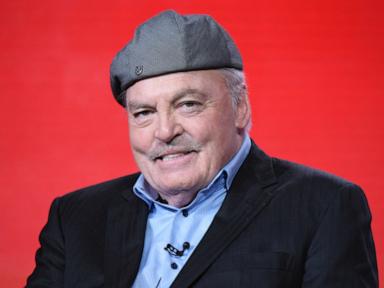
When people hear the name Stacy Keach, they instantly picture a trench coat, a fedora, and a snarling, hard-boiled private eye chewing on a toothpick. Mickey Spillane’s Mike Hammer made Keach a household name across television screens in the 1980s. But reducing Keach to a single television detective does a massive disservice to an actor who possessed one of the most formidable classical ranges of his generation. Before he ever lit up network television, he commanded Shakespearean stages with a raw, terrifying intensity that left critics searching for superlatives.
Keach passed away at the age of 85 at his family home in Magdalenka, Poland, following a long battle with heart failure. His wife, Małgosia Tomassi, confirmed his passing, closing the chapter on a staggering six-decade career. While the obituaries rightly lead with his iconic turn as Hammer, the real story of Stacy Keach is about an artist who constantly blurred the lines between high art and gritty pulp fiction, refusing to be boxed into any single category.
The Classical Roots Nobody Talks About
Most television viewers who tuned in weekly to watch Mickey Spillane's Mike Hammer had no idea they were watching a Juilliard-trained classical titan. Keach didn't just stumble into acting; he studied it meticulously at the London Academy of Music and Dramatic Art before taking New York theater by storm.
In the late 1960s and 1970s, his stage work was legendary. He played Hamlet, Macbeth, and King Lear with a muscularity and psychological depth that shocked traditionalists. When he took on the title role in Joseph Papp’s production of Macbeth alongside James Earl Jones, or when he portrayed Buffalo Bill in Arthur Kopit's Indians, he didn't recite lines—he inhabited them. Theater critics regularly noted that Keach possessed a rare instrument: a gravelly, commanding voice paired with a physical presence that could fill the back row of a massive auditorium without ever losing an ounce of intimacy.
Yet, Keach never suffered from the snobbery that often plagues classically trained stage actors. He loved genre work. He understood that a pulpy detective story or a western could carry just as much emotional truth as Elizabethan drama if played with absolute conviction.
Finding Truth in the Grit
If his stage work proved his pedigree, his film choices proved his daring. Look at John Huston’s 1972 masterpiece Fat City. Keach played Tully Keenan, a washed-up, punch-drunk boxer in Stockton, California. It's a devastating, quiet performance of quiet desperation and shattered American dreams. Keach gained weight, slouched, and drained all the movie-star swagger out of his frame.
He didn't play Tully as a cliché; he played him with a crushing vulnerability. It remains one of the finest and most underrated cinematic performances of the 1970s. When you watch Fat City, you realize why Mike Hammer worked so well a decade later. Keach understood broken men. He knew how to project toughness while letting the audience see the cracks underneath.
That specific blend of menace and weariness made him the definitive Mike Hammer when the character returned to television in the 1980s. While other actors played private eyes as plastic heroes, Keach made Hammer feel dangerous, obsessive, and deeply human.
A Career That Refused to Slow Down
A lesser actor might have faded away after a defining television hit, but Keach simply reinvented himself across generations. Younger audiences discovered him through entirely different channels. He lent his unmistakable, authoritative baritone to countless documentaries, historical series, and voiceover projects.
On television, he shifted effortlessly from gritty dramas to mainstream comedies. He played Ken Titus on the Fox sitcom Titus, turning a gruff, obnoxious patriarch into a surprisingly lovable figure through sheer comic timing. He spent time behind bars in Prison Break as the enigmatic Warden Henry Pope, brought gravitas to guest spots on Blue Bloods, and kept working well into his eighties—appearing alongside George Clooney in the film Jay Kelly.
Keach survived personal struggles, career turbulence, and the fickle nature of Hollywood longevity simply because he was too talented to ignore. He worked constantly because directors trusted him, writers loved what he brought to their dialogue, and audiences always believed him.
Take a look back at his filmography today. Skip the endless rerun episodes of Hammer for a moment and throw on Fat City. Listen to an audio recording of his Shakespearean monologues. You will find an artist who treated every single role—whether high tragedy or low-budget television—with total, unwavering dedication. That is why Stacy Keach leaves behind a legacy that stretches far beyond a fedora and a trench coat.