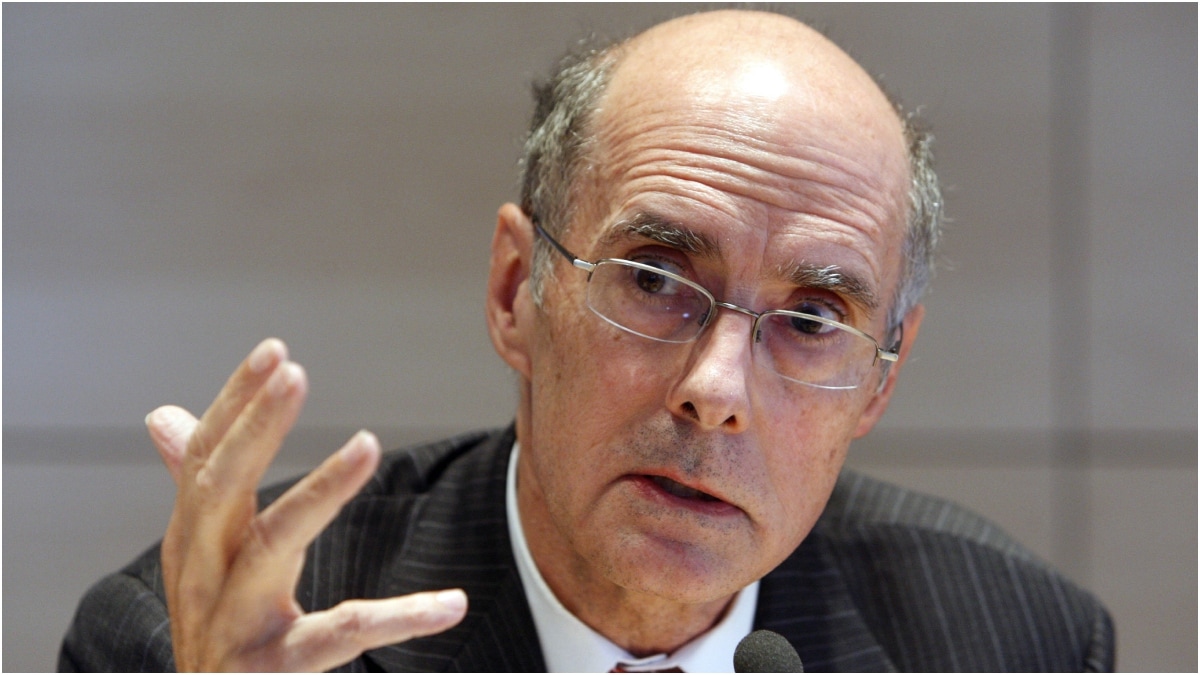
Strobe Talbott died on November 26, 2026, at age 80. Most headlines will remember him as Bill Clinton's longtime Oxford roommate, a Russia specialist, or a former head of the Brookings Institution. That framing misses half the story. For India, Talbott was the man who helped turn a nuclear shockwave into a real geopolitical opening.
In May 1998, India detonated nuclear devices at Pokhran and caught Washington off guard. Automatic sanctions hit under U.S. law, and relations between the world's two largest democracies froze into bitter frustration. Then came the marathon talks between Talbott and Jaswant Singh, who served as India's principal interlocutor and later as external affairs minister. Over roughly two years, the two men held 14 rounds of discussions across multiple cities and continents. You might also find this connected article useful: Why Zelensky Finds Trump’s Warmth Toward Putin So Hard To Swallow.
Honestly, if you read standard obituaries, you might think Talbott simply walked into those rooms and talked India into backing down. He didn't. India didn't sign the Comprehensive Nuclear-Test-Ban Treaty during those talks, nor did New Delhi surrender its nuclear deterrent. Yet something shifted anyway. A relationship defined by mutual suspicion slowly gained enough trust to survive the 1999 Kargil conflict and set up President Bill Clinton's landmark March 2000 visit to India.
http://googleusercontent.com/lmdx_content/ZkTjwDhktQpIqovuPjZLAlVHnIyXrcCZgaQqlZrGrALHsQmrQGUEaKrYqbNpGHoORNfkCavRNvcEGpethbJWYOntJyjQLzCDKxMuHznFaIZkStDCihyPieDjnKAnGpTlvrJYKYAmyLNHqBgkoJdvLeQYWmyhJU193273 As extensively documented in recent coverage by The New York Times, the implications are widespread.
How Pokhran Triggered a Diplomatic Reset
When India tested nuclear devices in May 1998, Washington didn't treat it as a mere regional headache. Officials in the Clinton administration saw a direct challenge to the global non-proliferation regime they had spent years trying to lock in. Under the Glenn Amendment, mandatory sanctions kicked in—curtailing financial assistance, defense sales, certain lending, and sensitive technology transfers. Pakistan conducted its own tests soon after, raising fears of a dangerous South Asian arms race.
Here is what many observers get wrong about that moment. Sanctions weren't just a punishment; they were a wall. Washington wanted clear commitments on signing the Comprehensive Nuclear-Test-Ban Treaty, capping fissile material production, restraining missile programs, and tightening export controls. New Delhi pushed back hard. Indian leaders argued that Washington's non-proliferation rules locked in a two-tier nuclear world while leaving India exposed to security threats from both China and Pakistan.
Putting Talbott across the table from Jaswant Singh changed the tone without erasing the deadlock. Talbott wasn't a South Asia specialist by background; he came out of journalism and post-Soviet diplomacy. Still, he brought a reporter's habit of listening for motive and context rather than reading strictly off a talking-points sheet. Keeping Singh's book Defending India on his desk was a small gesture, yet it signaled that Washington had to take India's strategic worldview seriously instead of lecturing New Delhi.
What the Talbott and Singh Talks Actually Achieved
Diplomacy gets judged too often by treaties signed on the spot. By that narrow yardstick, the 14 meetings between Talbott and Singh fell short of Washington's original checklist. India refused to sign the test ban treaty or walk back its nuclear status. Talbott himself later wrote in Engaging India that Singh came closer to achieving his objectives in those negotiations than Talbott did to achieving his own.
Still, calling the talks a failure would be lazy analysis. Over months of grueling sessions—punctuated by frank arguments, private exchanges, and personal dinners—the two sides built something rare in U.S.-India history. They built predictability. Washington began to see that India's security anxieties weren't a rhetorical pose, and New Delhi saw a senior American official willing to argue through every detail rather than walk away.
You can see the payoff in two concrete turning points:
- Partial sanctions relief in late 1998: By November 1998, as India maintained a voluntary moratorium on further nuclear testing, the Clinton administration eased several banking and financial restrictions under the sanctions regime.
- The 1999 Kargil crisis: When Pakistani forces crossed the Line of Control in Kargil, Washington did not fall back on reflexive "evenhandedness". The Clinton administration pressed Islamabad to pull its forces back, a stance that reshaped how many Indian policymakers viewed American reliability.
Those shifts didn't erase every friction point. Remaining sanctions weren't lifted until September 2001 under George W. Bush, and the landmark U.S.-India civil nuclear agreement took years more—announced in 2005 and finalized in 2008. Yet without the groundwork laid between 1998 and 2000, Bill Clinton's March 2000 trip to India would have been far harder to imagine, let alone carry off.
Why a Reporter's Instincts Shaped His Foreign Policy
Before becoming Deputy Secretary of State in 1994, Talbott spent more than two decades at Time, rising from Eastern Europe correspondent to Washington bureau chief and foreign affairs columnist. His career began early and loudly when he translated and edited Nikita Khrushchev's memoirs, Khrushchev Remembers, published in 1970 while he was still in his twenties.
Moving from press row to the State Department brings obvious awkwardness. Suddenly the people who once treated you as a confidant or chronicler are negotiating high-stakes policy with you across a table. Talbott had to reassure former sources that past conversations wouldn't be abused, while adapting to the slower, heavier machinery of government.
That background cuts both ways in hindsight. Critics and historians have long debated the Clinton administration's post-Cold War Russia policy, including how optimistic Washington was about Boris Yeltsin's Russia and how NATO expansion unfolded. Even Clinton noted upon Talbott's passing that Vladimir Putin later took Russia in a sharply different direction. Talbott himself was no pushover on authoritarianism; he warned Clinton in 2000 about Putin's outlook and the return of fear inside the Kremlin, and his later writing—including The Russia Hand and Our Founders' Warning—returned often to democratic strain and autocratic ambition.
In South Asia, though, his journalist's curiosity proved genuinely useful. Foreign policy breaks down when officials treat rivals or estranged partners as caricatures. Talbott understood that sustained dialogue can change the political weather even when immediate concessions aren't on the table.
Practical Next Steps If You Are Studying This Era
If you want to go past surface-level news coverage and understand how U.S.-India relations actually shifted after 1998, don't start with modern punditry. Start with the primary records and firsthand accounts:
- Read Engaging India: Diplomacy, Democracy, and the Bomb by Strobe Talbott: Look closely at how he describes the pacing of the 14 meetings with Jaswant Singh and why incremental trust mattered when treaty demands stalled.
- Compare the U.S. and Indian strategic framing around May 1998: Contrast Washington's non-proliferation priorities and Glenn Amendment sanctions against New Delhi's arguments over regional deterrence and perceived nuclear double standards.
- Trace the timeline from Pokhran-II to the civil nuclear deal: Map how 1998 sanctions, the 1999 Kargil conflict, Clinton's March 2000 visit, the September 2001 sanctions lift, and the 2005–2008 civil nuclear framework connected over a decade.