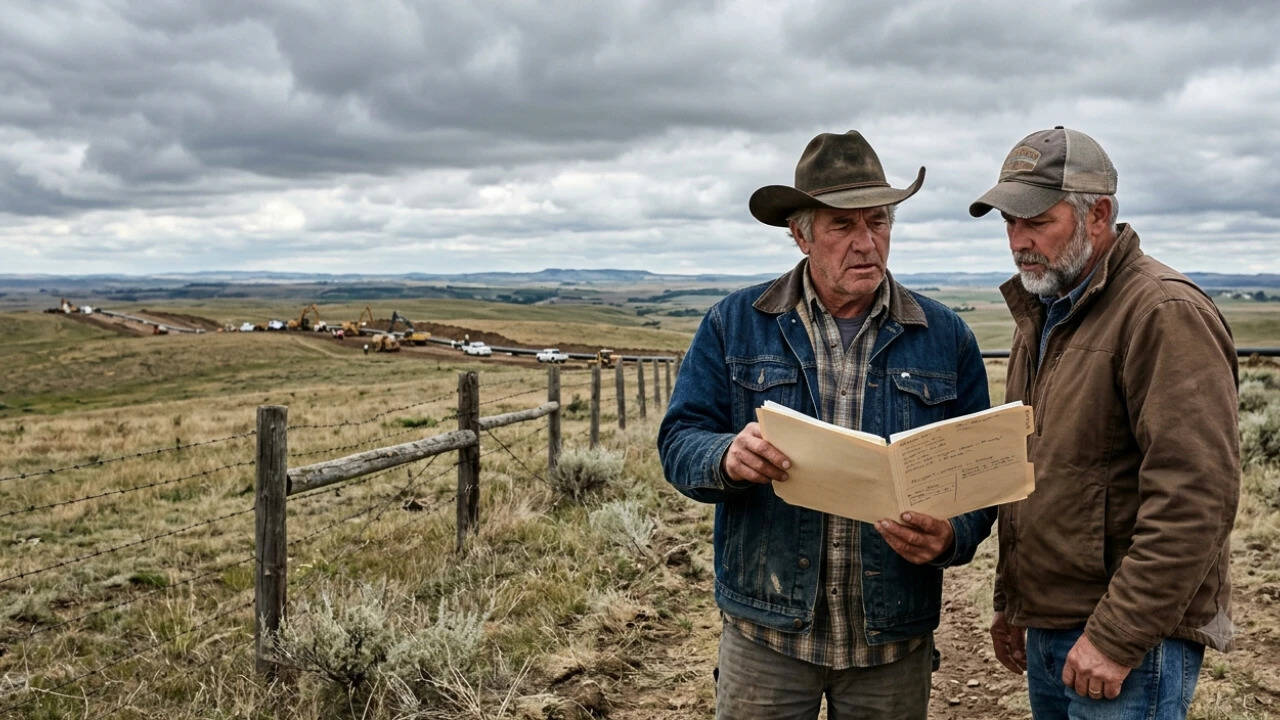
When a private energy corporation knocks on your door with federal eminent domain papers, you don't just hand over your family's ranchland. North Dakota rancher Leonard Hoffmann and his neighbors learned this the hard way back in 2018 when WBI Energy Transmission wanted an easement for a natural gas pipeline. The company offered roughly half of what the property was actually worth. Refusing to roll over, the landowners fought back in court, eventually settling the property value and winning a crucial $383,375.76 in attorney fees and litigation costs.
Then the rug got pulled out from under them.
In March 2025, the Eighth Circuit Court of Appeals reversed the lower court's ruling. The judges decided that because WBI exercised federal eminent domain authority under the Natural Gas Act, federal law—not North Dakota state law—governed the dispute, wiping out the ranchers' legal fee reimbursement entirely. Now, the battle has landed before the United States Supreme Court, raising a massive constitutional question about property rights, corporate power, and who should foot the bill when ordinary citizens are forced to defend their land.
The Real Cost of Defending Private Property
Eminent domain sounds terrifying because it is. Under the Fifth Amendment, the government can take private property for public use as long as it pays just compensation. But when Congress delegates that awesome power to private for-profit pipeline companies under statutes like the Natural Gas Act, the power dynamics shift dramatically.
Private companies aren't government agencies. They're corporations with bottom lines. When WBI Energy approached North Dakota landowners, the initial lowball offer forced farmers and ranchers into a corner. If you accept a fraction of your land's value, you lose. If you hire lawyers and fight back to secure fair market value, you face crushing legal bills that can easily eclipse the value of the disputed land itself.
Winning a legal fee award of over $383,000 felt like a rare victory for property rights. It proved that landowners could stand up to corporate heavyweights without going bankrupt in the process. When the Eighth Circuit overturned that award, it sent a chilling message to rural communities across America. If you fight a pipeline and win on the land value, you might still lose financially because your legal expenses aren't covered.
State Law Versus Federal Power
The legal battle before the Supreme Court boils down to a fundamental clash of jurisdictions. The core question is whether compensation standards for private pipeline condemnations should be dictated by state property laws or federal rules.
The Institute for Justice, representing Hoffmann and the other ranchers, argues that the Natural Gas Act doesn't explicitly replace state compensation laws with a federal standard. Property rights have historically been a matter of state law. If Congress wanted to wipe out state-level rules regarding legal fee recovery during private condemnations, it should have written that intention explicitly into the statute.
Furthermore, the ranchers point out that the Eighth Circuit's decision puts it directly at odds with four other federal appeals courts—the Third, Fifth, Sixth, and Eleventh Circuits—which have previously allowed state compensation laws to govern private condemnations under federal statutes. That kind of legal inconsistency cries out for Supreme Court intervention.
On the other side, WBI Energy Transmission and the federal government argue that delegating federal eminent domain powers means the same federal standards apply as if the federal government itself were taking the land. Under strict federal constitutional interpretations, attorney fees generally aren't recoverable unless Congress explicitly authorizes them. The pipeline company maintains that allowing different state laws to govern land acquisitions would create a chaotic patchwork system instead of a uniform federal pipeline network.
What's Really at Stake for Landowners
This case isn't just a boring legal technicality for constitutional scholars. It has massive real-world consequences for anyone who owns rural property in the path of energy infrastructure projects.
If the Supreme Court sides with the pipeline company, private corporations will hold an enormous tactical advantage in easement negotiations. Landowners will know that even if they prove in court that a company's initial offer was insultingly low, they will have to pay their own attorneys out of pocket. That financial barrier will stop countless farmers and ranchers from challenging unfair offers, effectively subsidizing corporate land acquisition at the expense of private property rights.
When you look at how modern energy projects expand across the American landscape, the scales are already tipped heavily toward corporate interests. Pipeline companies have deep pockets, battalions of lawyers, and the backing of federal certificates. Individual landowners have family heritage, local land, and whatever personal savings they can scrape together.
Moving Forward
The Supreme Court's handling of this dispute will determine whether private companies can use federal delegation as a shield against paying the true cost of litigation. Property rights advocates are watching closely to see if the justices will preserve traditional state protections or prioritize federal uniformity for energy developers.
If you own land near planned utility corridors or energy routes, keep a close eye on how this ruling shakes out. It redefines the financial risk of standing your ground against corporate condemnation. Review your state property laws, understand your rights under eminent domain, and never assume that a corporate offer is the final word on what your land is worth.