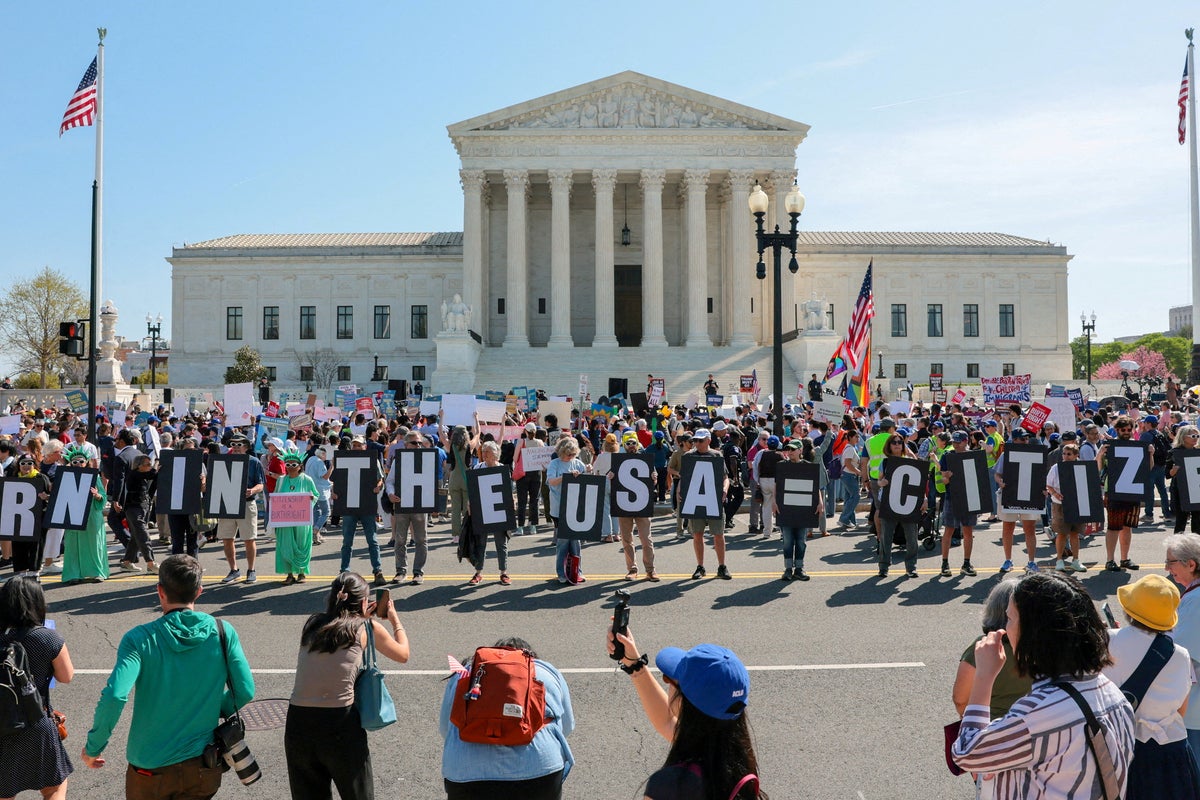
Donald Trump just found out the hard way that you can't erase a century and a half of American history with a single stroke of a pen.
In a massive blow to the administration's immigration strategy, the Supreme Court struck down Executive Order 14160, the sweepingly ambitious directive aiming to end automatic birthright citizenship for the children of undocumented immigrants and temporary visa holders. The high court didn't just tweak the edges here. They completely dismantled the president's day-one executive order, sending a fierce, 6-3 message that the executive branch doesn't get to rewrite the Constitution on its own.
If you've been following the headlines, you know Trump has blasted the decision on Truth Social, calling it "too bad for our country" and demanding that Congress pick up where he left off. But this case, formally known as Trump v. Barbara, is a lot deeper than just another political squabble. It fundamentally tested what it means to be an American, and the ripple effects are going to shake up the entire political landscape leading into the midterms.
The 14th Amendment Isn't Up for Executive Reinterpretation
Let's look at what actually went down in the courtroom. The whole fight boils down to the first section of the Fourteenth Amendment, which was ratified back in 1868 right after the Civil War. The text seems straightforward enough. It says that all persons born or naturalized in the United States, and "subject to the jurisdiction thereof," are citizens.
For over 150 years, the legal consensus has been crystal clear: if you are born on U.S. soil, you're a citizen. Period. The only real exceptions are the children of foreign diplomats or invading foreign armies.
But U.S. Solicitor General John Sauer tried a bold legal pivot during oral arguments. He argued that the phrase "subject to the jurisdiction thereof" required a deeper political allegiance to the country. According to the administration's logic, if your parents are only here on a tourist visa, a student visa, or without legal status, they haven't committed to the U.S. long-term, so their kids shouldn't get automatic passports.
Chief Justice John Roberts wasn't buying it. Writing for the majority, Roberts directly slammed the administration's legal gymnastics.
"Citizenship, then and now, was the right to have rights—to freely participate in our political community," Roberts wrote. "The Framers of the Fourteenth Amendment extended that promise to 'every free-born person in this land.' We keep that promise today."
The ruling effectively keeps the 1898 precedent of United States v. Wong Kim Ark fully intact. In that historic case, the court ruled that a child born in San Francisco to Chinese parents—who were legally barred from ever becoming citizens themselves—was an American citizen at birth. Roberts and the majority made it clear that the rule hasn't changed.
The Surprising Math Behind the Fractured Court
The final vote count tells an fascinating story about the current makeup of the court. While the overall ruling to kill the executive order was 6-3, the justices actually split 5-4 on the deeper constitutional question.
Chief Justice Roberts anchored the majority, joined by the court's three liberals—Sonia Sotomayor, Elena Kagan, and Ketanji Brown Jackson—along with Trump-appointed conservative Amy Coney Barrett. They ruled that the executive order was flat-out unconstitutional under the 14th Amendment.
Brett Kavanaugh, another Trump appointee, provided the crucial sixth vote to kill the order, but he took a different route. Kavanaugh argued that while the president didn't violate the 14th Amendment itself, the order directly violated federal statutory law. He noted that Congress could theoretically pass limits, but because they haven't, the president couldn't just bypass them.
On the losing side, Justices Clarence Thomas, Neil Gorsuch, and Samuel Alito filed blistering dissents. Thomas claimed the majority's historical analysis was completely wrong, arguing the 14th Amendment was explicitly designed to protect freed slaves, not to grant blanket citizenship to the children of temporary visitors or what he called "birth tourists." Alito chimed in too, writing that upholding birthright citizenship keeps a "powerful incentive" alive for people to enter the country unlawfully.
The infighting got personal. Justice Jackson openly called out Thomas in her concurring opinion, noting the irony that Thomas—long an advocate for a "colorblind" view of the Constitution—was suddenly arguing the Citizenship Clause should be viewed as a narrow, race-conscious historical remedy.
Real Stakes and Immediate Impact
This wasn't some dry, academic debate over legal philosophy. The practical stakes of Trump's order were staggeringly high.
Had the order stood, it would have blocked citizenship documentation for an estimated 250,000 babies born in the United States every single year. According to legal briefs submitted by immigration policy experts, that policy would have created a stateless class of roughly 5 million children by 2045.
Think about the sheer administrative nightmare that would've unleashed. Hospitals would have been forced to act as de facto immigration checkpoints, checking the visa and residency status of every laboring mother before filling out a birth certificate application.
The policy also highlighted glaring contradictions within the administration itself. Several high-profile figures close to Trump, including Secretary of State Marco Rubio and FBI Director Kash Patel, are themselves the children of immigrants who built their lives in America through the mechanism of birthright citizenship.
What Happens Next
Don't expect the immigration battle to cool down just because Trump lost this round. The administration actually won several other massive immigration victories at the high court this week, including rulings that let immigration agents quickly turn away asylum seekers and allowed the termination of Temporary Protected Status (TPS) for over 1.3 million people from countries like Haiti and Syria.
Because the court left a tiny window open regarding what Congress can do by law, the battlefield is moving straight to Capitol Hill. Trump is already putting immense pressure on congressional Republicans to draft legislation targeting birthright citizenship immediately.
If you want to track where this goes next, keep your eyes on these two fronts:
- The Legislative Pipeline: Watch for House Republicans to introduce a bill attempting to redefine the Immigration and Nationality Act's citizenship rules. It faces a brick wall in the Senate, but it will be a major campaign talking point.
- State-Level Pushback: Look out for conservative states trying to pass localized restrictions on state-issued benefits or birth certificates for children of non-citizens, setting up the next wave of federal lawsuits.