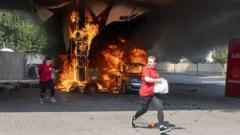
Air raid sirens don't sound nearly as distant in Moscow or Saratov as they used to. When hundreds of long-range drones cross sovereign borders to slam into oil refineries, strategic airbases, and massive retail fulfillment centers, the illusion of safety inside Russia shatters entirely. Kyiv isn't just defending its own trenches anymore. They've shifted the math of this war directly onto Russian soil, and the psychological impact is mounting faster than Moscow's air defense can intercept it.
The Strategic Shift From Defense to Deep Strikes
For a long time, the public narrative assumed the conflict would stay confined strictly to eastern and southern Ukrainian towns. That template is dead. Recent massive overnight waves involving hundreds of aerial drones have targeted critical Russian logistics and energy infrastructure hundreds of miles past the front lines.
Look at what happened in Saratov and Engels. These aren't sleepy border hamlets. Engels hosts strategic military bombers, while Saratov houses a major oil processing refinery. When Ukrainian long-range systems strike these coordinates, they disrupt the fuel supply chains keeping the Russian military machine lubricated.
Moscow's defense ministry routinely claims they intercept massive numbers of incoming threats—sometimes citing figures upward of 600 drones in a single night. Even if those interception metrics are accurate, the sheer volume tells a different story. Slippage happens. Fires break out. Refineries shut down, and civilian areas hundreds of miles deep face sudden explosions.
Why Commercial Hubs Are Now Targets
The strategy isn't limited strictly to oil and military hardware. Kyiv has systematically targeted key economic linchpins, including distribution hubs belonging to Wildberries, Russia's massive e-commerce giant often styled as the local equivalent of Amazon.
Why strike a retail warehouse? Because modern war relies as much on consumer stability and economic morale as it does on artillery shells. By repeatedly hitting these logistical jugulars across regions like Samara, Vladimir, and beyond, Ukrainian strategists aim to make the true cost of the invasion visible to ordinary citizens who thought they could ignore a conflict happening miles away.
- Economic Friction: Disrupting supply chains forces businesses to reroute and inflate operational costs.
- Psychological Pressure: Bringing smoke and fire to major industrial centers erodes public detachment from the front lines.
- Resource Strain: Forcing Moscow to scatter air defense batteries across thousands of miles thins out protection for high-value military assets.
The Human Toll and the Escalation Loop
Wars are fought by states, but they are bled by people. The intensification of deep strikes brings inevitable tragedy. Residential blocks in Engels and regions like Udmurtia and Belgorod have absorbed the destructive fallout of falling debris and direct impacts, leading to civilian casualties that feed an escalating cycle of retaliation.
Meanwhile, Russian forces continue hammering Ukrainian population centers with brutal glide bombs and overnight missile barrages, targeting cities like Zaporizhzhia and Kharkiv. President Volodymyr Zelenskyy keeps pushing Western partners for accelerated deliveries of advanced air defense systems, arguing that every delayed interceptor means another destroyed home.
The baseline reality has shifted permanently. As long as the conflict grinds forward, the fire across Russian regions proves that distance no longer guarantees immunity.
Russia Launches Massive Missile & Drone Attack On Ukraine, Kharkiv And Chernihiv Hit | WATCH
This video report outlines the simultaneous heavy aerial bombardments and drone campaigns hitting urban and infrastructure targets across the region.
http://googleusercontent.com/youtube_content/1