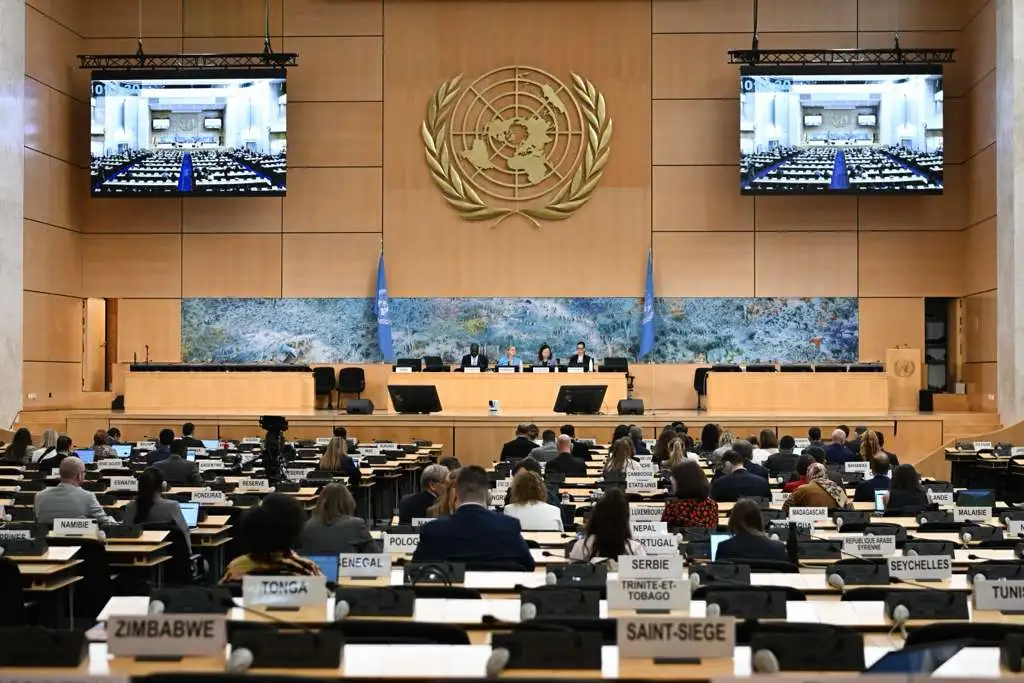
An empty chair sits in the Palais des Nations in Geneva, and it belongs to the United States. For the second consecutive year, Washington has completely shut out its scheduled United Nations human rights evaluation. No other nation in the history of the UN has ever pulled off a double no-show for this mandatory peer review. Even authoritarian governments that routinely jail dissidents at home manage to send a delegation to sit through the Universal Periodic Review (UPR) process.
The Trump administration's total cold shoulder toward the UN Human Rights Council isn't just diplomatic theater. It represents a massive breakdown in international accountability that leaves vulnerable populations without a final safety net. If you think Geneva bureaucracy has no bearing on daily life at home, consider what happens when the global superpower decides the rules simply don't apply to it.
What Is the Universal Periodic Review and Why Did Washington Walk?
Every single UN member state is supposed to step up to the plate every four to five years. The Universal Periodic Review evaluates domestic human rights records through peer examination. Member nations grill each other on everything from prison conditions to free speech.
The U.S. was originally booked for its evaluation in November 2025. When Washington skipped that date, council organizers gave the government a full-year cushion, rescheduling the session for November 2026. That grace period ran out, and the chair remained empty.
State Department officials haven't minced words about why they're absent. Washington accuses the council of deep-seated anti-U.S. and anti-Israel bias, arguing the agency has lost all credibility and fails to address actual tyrants. A spokesperson made it clear that the administration refuses to be lectured on human rights by council members like China, Venezuela, or Sudan.
There is undeniable truth to the critique that the UN Human Rights Council frequently includes member states with horrific domestic records. But walking away creates a vacuum with messy consequences.
The Dangerous Precedent of the Empty Chair
Diplomatic insiders in Geneva are genuinely spooked. Eric Tistounet, a visiting professor at the Geneva Graduate Institute and former secretary of the council, put it bluntly: when the global superpower refuses to show up or explain its absence, the entire architecture of international law starts to wobble.
Think about the signal this sends to other governments. If the U.S. can blow off its peer review without facing immediate penalties, what stops other powerful nations from ditching the process whenever domestic policies face uncomfortable scrutiny?
Civil rights groups are furious. Jamil Dakwar of the American Civil Liberties Union pointed out that domestic advocacy groups submitted nearly two hundred detailed briefs covering everything from aggressive migrant deportations to racial disparities and abortion restrictions. Those reports point to unprecedented friction points in American civil liberties. By refusing to engage, Washington avoids answering direct questions from other nations about the death penalty, reproductive healthcare access, and harsh border enforcement measures.
What Happens When Accountability Disappears?
International bodies lack heavy-handed enforcement tools. They rely heavily on peer pressure, public exposure, and voluntary compliance. When a country simply ghost-writes its own exit from the conversation, international law has few ways to force compliance.
The UN council recently voted to delay tricky decisions on how to handle the ongoing U.S. boycott until early next year. Officials are terrified that holding a review in total absence of the defendant state could set a bad precedent, yet letting Washington ghost the process entirely rewards stonewalling.
For American citizens who find domestic legal avenues exhausted, international petition mechanisms often serve as a vital last resort. Cutting off that avenue doesn't project strength. It signals a government that would rather duck hard questions than defend its record in the open.
Stop treating international human rights mechanisms as optional PR exercises. Demand transparency from your representatives, support local watchdog groups tracking domestic civil liberties, and pay attention when your government decides to turn off the lights and walk away from the table.