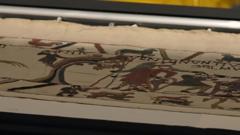
The British Museum just pulled off a historical heist in reverse. In the dead of night on Friday, July 10, 2026, a heavily guarded convoy slipped across the English Channel under absolute secrecy. Inside a climate-controlled case, protected by a specialized shock-absorbing cradle, lay 70 meters of fragile, 950-year-old linen fabric. For the first time in nearly a millennium, the famous Bayeux embroidery is back on British soil.
If you tried getting tickets recently, you already know the public went absolutely feral for it. The first batch of a hundred thousand tickets sold out in less than twenty-four hours, creating online queues that lasted nine agonizing hours. People are treating this like a rock concert. Honestly, they should. It is the cultural event of the century.
But beyond the ticket frenzy and the diplomatic handshaking between London and Paris, there is a much bigger story here. This isn't just about looking at some old stitches through thick glass. This loan represents a fragile political truce, a staggering feat of modern engineering, and a chance to look directly at the propaganda that shaped the English-speaking world.
Moving the fragile Bayeux embroidery across the channel
Let's talk about the sheer terror of moving a 230-foot-long piece of eleventh-century fabric. The French government turned down British requests to borrow the artifact twice in the past. They had damn good reasons. Linen and wool thread do not like to travel. They hate humidity changes. They hate vibration. They face a constant threat from moths, mold, and basic physical stress.
To make this happen, teams of conservators spent months conducting rigorous structural studies. They literally ran empty trial runs across the Channel to track every bump, shudder, and thermal dip. When the real transport happened, the artifact was folded accordion-style inside its container. The police escort from Folkestone to London looked like a security detail for a nuclear warhead.
Why go through all this stress now? The opportunity only opened up because the museum in Normandy that usually houses the artifact closed down for a massive, multi-year renovation. Instead of locking the historic cloth away in a dark vault during construction, French President Emmanuel Macron and British Prime Minister Keir Starmer hashed out a high-stakes cultural trade.
It wasn't a free favor. The British Museum had to offer up some of its own crown jewels in exchange. In return for the linen masterpiece, Britain is shipping the iconic Sutton Hoo treasures and the legendary Lewis Chessmen over to France for a temporary stay. It is a massive, stressful logistical dance, and if a single piece of thread snaps, the diplomatic fallout will be brutal.
What most people get wrong about this medieval masterpiece
First off, let's clear up the single biggest misconception. Everyone calls it a woven hanging, but it isn't. It is an embroidery. The entire 70-meter narrative was stitched by hand using wool yarn on a plain linen backing. Woven hangings involve complex looms where the design is built directly into the structure of the fabric. This artwork is essentially the world's most elaborate, blood-soaked comic strip, created with a needle and thread.
The second myth is that this is a purely French creation celebrating an English defeat. The historical reality is far messier and much more interesting. While it tells the story of William the Conqueror invading England in 1066, historians generally agree that Anglo-Saxon needleworkers in Canterbury, England, actually made it.
Think about the psychological weight of that. The very people who were conquered, whose lands were seized, and whose society was completely dismantled were forced to stitch the victory lap of their oppressor. When you look closely at the borders of the main scenes, you can spot subtle hints of rebellion. Amid the depictions of standard medieval life and fables, there are raunchy figures, scavenger scenes, and dead bodies that seem to critique the raw violence of the Norman invaders.
It is an incredible piece of political spin. It was commissioned by Bishop Odo, William’s half-brother, to justify a brutal, bloody coup. It frames William’s invasion not as an unprovoked land grab, but as a holy crusade sanctioned by God to punish King Harold for breaking a sacred oath. We are looking at an eleventh-century press release masquerading as fine art.
The details you will miss if you don't look closely
When the exhibition opens to the public on September 10, 2026, the British Museum is doing something unprecedented. For the first time in its history, the entire length of the embroidery will be displayed completely flat and in one continuous line inside a custom-engineered glass showcase. In France, it is kept in a curved display that forces you to walk in circles. Seeing it stretched out straight will give an entirely new perspective on the pacing of the story.
You need to know what to look for, or you will miss the best parts. The artwork features more than 620 people, 737 animals, and 58 distinct scenes. It isn't a sanitized, elegant royal portrait. It is gritty, violent, and deeply weird.
Look at the battle scenes near the end. You will see detailed depictions of soldiers stripping chainmail coats off decapitated corpses. You will see horses flipping upside down in mid-air during the chaotic clash at Hastings.
Then there is the famous death of King Harold. Everyone learns in school that he took an arrow straight to the eye. Look closely at that specific scene. There is a man pulling an arrow from his helmet, but right next to him is another soldier getting hacked down by a Norman knight. Over the centuries, restorations and restitched threads have made it incredibly ambiguous as to who is actually Harold and how he died. You can stand there and decide for yourself.
How to actually get into the exhibition
If you don't have tickets yet, do not panic. Yes, the initial release for dates between September and December 2026 evaporated instantly. But the museum is releasing tickets in distinct phases.
The next major ticket drop happens in October 2026, which will open up dates for the winter and spring of 2027. Another release follows in January 2027 for the final block of dates leading up to the closing on July 11, 2027.
Here is what you need to do right now. Sign up for the British Museum’s official newsletter immediately. Do not rely on social media announcements because by the time you see a tweet, the digital queue will already be thousands of people deep.
Keep in mind that tickets use a tiered pricing structure ranging from £25 to £33 depending on peak hours. If you have kids, take advantage of the rules: under-16s get in totally free when accompanied by an adult, and the museum is carving out dedicated weekly slots specifically for school groups.
If you want a quieter experience, target the late-night slots. The gallery stays open until 21:00 from Thursday through Saturday. Most tourists clog up the morning and early afternoon slots, leaving the evening hours slightly more breathable.
This artwork survived ten centuries of fires, revolutions, Nazi treasure hunters, and ravenous mice. It is a miracle it exists at all. Set your calendar reminders for the October ticket drop, get your spot in line, and go see the foundation of medieval history laid out flat before it heads back across the Channel for good.