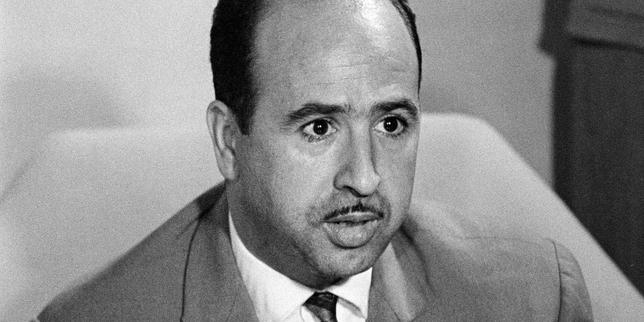
History rarely gets written in straight lines. In Algeria, the official narrative surrounding the war of independence still carries sharp edges, unresolved silences, and political exclusions. Look closely at how the state honors its founding fathers, and you'll spot glaring omissions. Few figures illustrate this national amnesia and selective memory better than Krim Belkacem.
Known widely as the "Lion of the Djebel," Belkacem was a revolutionary of the very first hour. He didn't just join the fight; he helped architect the armed struggle from the rugged mountains of Kabylie long before the historic outbreak of November 1, 1954. He commanded troops, structured the clandestine networks, and ultimately led the Algerian delegation that signed the historic Évian Accords in March 1962. That treaty brought the ceasefire, ending over seven grueling years of colonial conflict and clearing the path to national sovereignty.
Yet, decades after independence, his place in the nation’s Pantheon remains fragile, contested, and incomplete.
From Architect of Freedom to State Pariah
To understand why Belkacem's rehabilitation feels perpetually stuck in neutral, you have to look at how post-independence power structures took shape in Algiers. Revolutions often devour their own children, and Algeria’s liberation struggle was no exception. Following independence in 1962, fierce internal power struggles pitted former maquisard commanders against one another.
Belkacem found himself increasingly sidelined by the rising authoritarian apparatus led by Houari Boumédiène and Ahmed Ben Bella. Opposed to the mounting military dictatorship and the sidelining of civilian political voices who had built the revolution, Belkacem went into opposition. That choice sealed his fate within the corridors of official power.
Condemned to death in absentia by a regime that preferred compliance to critical dissent, he lived out his final years in exile. On October 18, 1970, his life was cut short in a hotel room in Frankfurt, Germany, where he was strangled. Though his remains were eventually repatriated in 1984 and placed in the Martyrs' Square at El Alia cemetery in Algiers, physical burial didn't translate into genuine political rehabilitation.
The Politics of Selective Memory
Today, official commemorations acknowledge his monumental role only in careful, measured doses. Streets bear his name, and state-sanctioned biographies pay lip service to his military exploits. But a deeper look reveals a persistent reluctance to fully embrace his political legacy.
Why does this hesitation persist?
Official histories in Algiers have long favored a monolithic, consensus-driven narrative of the revolution that minimizes internal ideological battles, assassinations, and post-independence purges. Embracing Krim Belkacem fully means confronting uncomfortable truths about how power was seized and consolidated after 1962. It requires acknowledging that the architects of independence didn't all share the same vision for a democratic, pluralistic Algeria.
When you whitewash the complex political disagreements of figures like Belkacem and Abane Ramdane, you strip the revolution of its human depth. You turn living strategists into flat marble statues.
Cultural Resistance and Grassroots Demand
Official foot-dragging hasn't stopped ordinary citizens, historians, and family members from keeping his memory alive. Civil society groups, cultural associations in Kabylie, and public intellectuals regularly push for a transparent reevaluation of his contributions. Artistic works, such as biographical films and documentary projects, attempt to bridge the gap left by school textbooks that gloss over his tragic downfall.
Families of historical figures have repeatedly called for genuine institutional recognition that goes beyond hollow anniversary speeches. They want access to archives, open academic debate, and an honest reckoning with political assassinations that bloodied the dawn of the young republic.
History isn't just a tool to legitimize whoever holds power today. It belongs to the people who lived it, suffered for it, and built the nation from the ashes. Until Algeria can look at Krim Belkacem's entire trajectory—from the snowy peaks of the Djebel to his lonely end in Frankfurt—without political filters, that rehabilitation will remain half-finished.