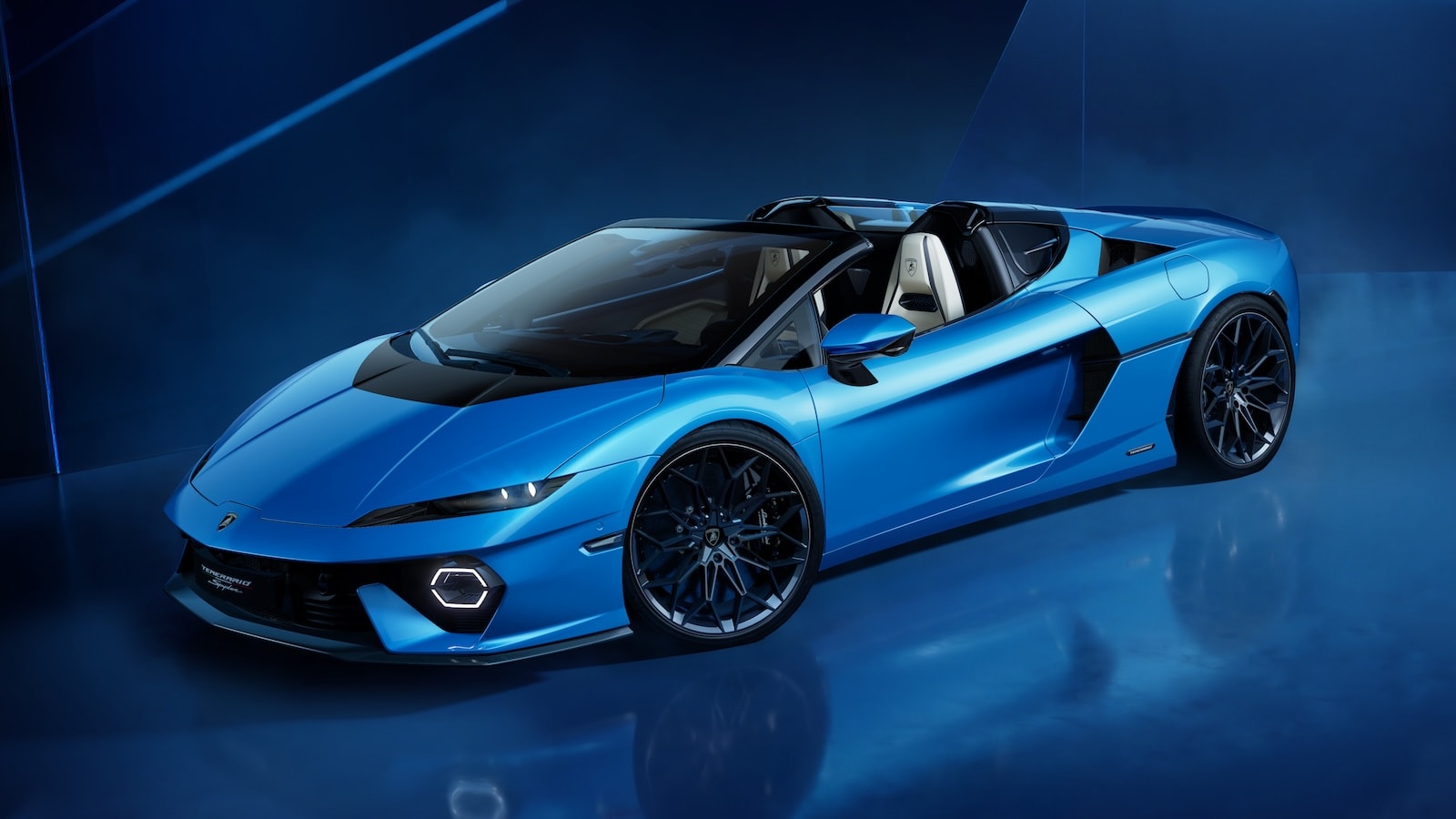
Drop-top Lamborghinis have always asked you to compromise. You either wrestled with removable panels in a garage, watched a soft roof balloon at high speed, or lived with less cabin quietness than a fixed-roof car. Now the Temerario Spyder flips that script with the first retractable hardtop in Lamborghini's history.
Unveiled across Sant'Agata Bolognese and Los Angeles to mark 50 years of open-air production cars since the 1976 Silhouette, the Spyder pairs a folding hardtop with the coupe's 4.0-liter twin-turbo V8 plug-in hybrid architecture. Combined output hits 920 CV (907 hp). Claimed 0 to 100 km/h takes 2.8 seconds, and top speed reaches 343 km/h.
If you're shopping in the mid-engine hybrid supercar space, this matters immediately. Rivals like the Ferrari 296 GTS and McLaren Artura Spider already offered folding hardtops, leaving Lamborghini looking stubbornly old-school. Honestly, waiting until the Temerario generation to bring a power-folding hardtop to a Spyder feels long overdue.
How the Retractable Hardtop Works Without Ruining Balance
Most news recaps stop at "first folding hardtop" and move on. That misses why engineers chose a vertically stowed roof driven by ten electric actuators instead of a classic electro-hydraulic setup.
Hydraulic pumps, hoses, and fluid add weight and maintenance complexity. By using ten electric actuators to stow the roof vertically, Lamborghini keeps the packaging tighter and claims the car's center of gravity drops by 3 mm (0.1 in) with the roof lowered, without throwing off weight distribution. You can also operate the roof at speeds up to 31 mph.
There's a neat detail most casual readers skip too. A separately operated rear window lets you drop the glass with the roof closed to pull in extra engine note, or raise it with the roof open to cut wind buffeting. That kind of small cabin control is what you actually notice on a chilly morning canyon run.
Why a 10,000 RPM V8 Makes the Open Roof Worth It
Numbers on a spec sheet don't tell you how a car feels at 8,500 rpm. The Temerario's flat-plane hot-vee V8 uses titanium connecting rods and a short-stroke layout to rev past 10,000 rpm—wild territory for a twin-turbo engine. Pair that combustion scream with three axial-flux electric motors, and throttle response is instant.
Some early critics of the coupe noted that turbocharging and hybrid hardware mute everyday acoustic drama compared with older naturally aspirated engines. Fair point. Dropping the roof—especially if you tick the box for the optional Akrapovič titanium exhaust, which sheds 11.4 kg (12% lighter than the standard system)—directly answers that complaint. As Autoblog pointed out in its first look, pairing an open rear window, a folding roof, and a 10,000-rpm V8 leaves the cabin stereo fighting for relevance.
What about electric-only driving? In Citta mode, the car can run on electric power alone with up to 190 hp. That's handy for sneaking out of a quiet neighborhood at dawn without waking everyone up. Just don't buy a 920-CV Lamborghini expecting long-range EV commuting; the 3.8 kWh battery is there to back up performance and short city stints.
Chassis Rigidity, Weight Tradeoffs, and What Buyers Miss
Any time you chop the roof off a supercar, physics pushes back. Extra reinforcement is needed to keep the body from flexing over rough pavement, and extra hardware adds mass.
Lamborghini built the Spyder on an all-aluminum spaceframe and reports gains over the Huracán Spyder—including 6% higher static torsional rigidity, 9% higher dynamic bending stiffness, and 6% higher dynamic torsional rigidity—while cutting structural components by 50% and heat-input welds by 80% compared with the Huracán EVO Spyder. Even with those gains, Lamborghini hasn't published the exact weight penalty of the Spyder yet, and as The Supercar Blog notes, pricing hasn't been locked in either.
Here's a mistake I see buyers make all the time with open-top exotics: they obsess over a tenth of a second in straight-line acceleration while ignoring how much richer the driving experience feels with open air and better sound. Still, let's be honest about the tradeoff. Adding folding roof hardware and electric actuators doesn't make mass vanish. On tight tracks, a coupe usually holds a slight edge in agility and predictability.
If you want to shave weight back down, Autocar India highlights that carbon-fiber body and cabin components plus optional carbon-fiber wheels trim up to 22 kg. Meanwhile, Lamborghini's Ad Personam program spans roughly 400 exterior shades along with bespoke trim and plaques. That customization freedom is huge if you want something distinct, though option lists on Italian exotics can inflate the bill fast.
Practical Next Steps If You're Eyeing One
- Check official homologation and allocation timing first: The Temerario Spyder is still moving through approval stages, so confirm exact delivery windows and regional pricing with an authorized dealer rather than relying on rumor.
- Decide how you actually drive: If most of your miles are weekend backroads and coastal highways, the folding hardtop and rear window setup make a strong case over the coupe. If you chase lap times every month, compare the coupe and lightweight options carefully.
- Prioritize sound and weight options over flashy trim: Look closely at the optional titanium exhaust and carbon wheels before spending extra on purely cosmetic upgrades.
- Review full specs on the source page: Visit the official Lamborghini Temerario Spyder page to verify current technical figures and availability updates as type approval wraps up.