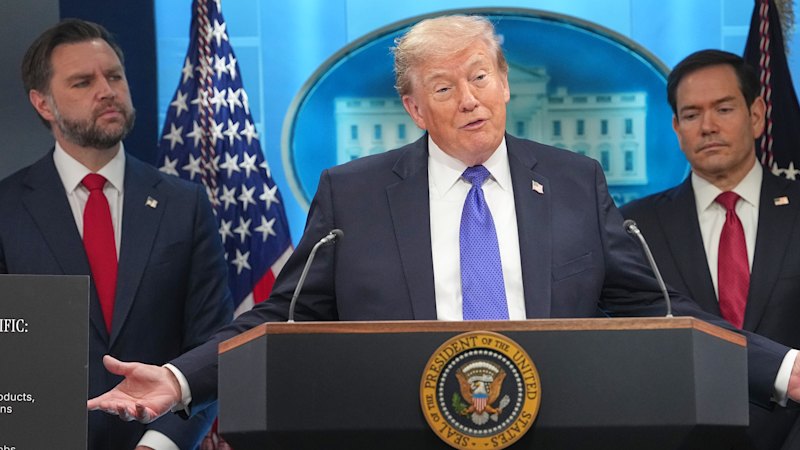
You can't command the laws of physics and international data sovereignty with a press conference threat. Donald Trump recently dropped a bombshell at a White House press briefing, declaring that his administration plans to slap a "tremendous tax" or an outright ban on American technology firms building artificial intelligence data centres overseas.
Unsurprisingly, the announcement caught his own staff completely off guard. When a leader dictates industrial policy on the fly without running it past the National Economic Council or the Treasury, markets notice. Big tech companies like Microsoft, Alphabet, Meta, and Amazon are already sinking hundreds of billions of dollars into global infrastructure. They aren't building abroad just for fun. They do it because they are legally forced to, or because the domestic power grid simply can't handle the load.
The Local Backlash Nobody Wants to Talk About
Here is the core contradiction driving this entire mess. American voters despise data centres in their own backyards. Recent polling shows massive public resistance, with a huge percentage of voters actively opposing the construction of massive AI server farms within ten miles of their homes. Local ballot measures and municipal blocks have spiked nationwide, shutting down billions of dollars in domestic projects.
Governors across the country are slamming the brakes on permits because these facilities guzzle water and drain local electricity grids. So what happens when tech giants try to build at home? They face endless lawsuits, zoning fights, and community protests. When they look abroad to escape the domestic gridlock, the White House threatens to penalize them for leaving. It is a classic double bind. You cannot block infrastructure at home while simultaneously criminalizing companies for building it where they are actually allowed to plug in.
Why Global Hyperscalers Need Foreign Soil
The idea that American firms can simply hoard all their computing power inside US borders misunderstands how the internet actually functions. Foreign jurisdictions enforce strict data localization laws. The European Union and various Asian economies demand that their citizens' data remain within specific geographic boundaries.
If Google wants to serve enterprise cloud customers in Europe or maintain low-latency connections across global markets, it has to build regional hubs like the ones it operates in Finland. If US regulations forbid American firms from building these foreign facilities, local foreign competitors will happily step in to fill the vacuum. You don't secure American technological dominance by forcing your own champions to abandon international markets. You just hand those markets to foreign rivals on a silver platter.
Energy Realities Trump's Plan Ignores
Building an AI data centre requires gigawatts of continuous power. Parts of the United States are staring down genuine grid capacity shortages. Utilities are already struggling to keep up with industrial demand, electric vehicles, and residential growth.
When executives look at West Virginia or rural Texas, they aren't just looking for cheap land. They are hunting for available clean energy and willing municipal partners. Until the US fixes its painfully slow electrical interconnection queues and speeds up power generation permitting, overseas expansion isn't an optional luxury for tech companies. It is an absolute operational necessity.
Threatening corporations with sudden tax penalties might make for a punchy headline, but it does nothing to solve the physical constraints of the AI boom. Until policymakers fix the local energy crisis and reform domestic zoning laws, American tech giants will keep looking across oceans—penalties or no penalties.