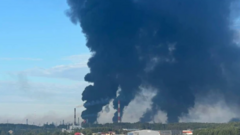
When long-range drones strike targets more than a thousand kilometers from a front line, military math shifts entirely. President Volodymyr Zelenskyy recently confirmed that Ukrainian long-range strikes successfully hit two major oil-processing facilities deep inside Russian territory: the Slavneft-Yanos refinery in Yaroslavl and the Bashneft-Novoil facility in Bashkortostan.
Distance used to be Russia's ultimate shield. Not anymore.
These aren't random tactical skirmishes near the border. Kyiv is systematically dismantling the financial engine powering the Kremlin's military machine. Let's look at what's actually happening on the ground, why these specific targets matter, and how this strategy alters the trajectory of the conflict.
The Anatomy of Long-Range Deep Strikes
Geography dictates strategy. The Slavneft-Yanos plant in Yaroslavl sits roughly 700 kilometers from the Ukrainian border, while the Bashneft-Novoil refinery in Bashkortostan lies over 1,300 kilometers away. Hitting targets at that range requires sophisticated guidance, massive payload optimization, and the ability to evade dense layers of air defense systems.
Regional authorities in Yaroslavl reported dealing with what they termed the largest drone assault since the war began. Russian defense officials claimed massive interception numbers across multiple regions, yet verified footage told a very different story. Thick plumes of black smoke, raging fires, and structural damage proved that air defenses failed to protect critical national infrastructure.
When you strike a facility like Slavneft-Yanos—which ranks among Russia's top five largest oil-processing plants—you aren't just creating a local emergency. You are disrupting the supply of petrol, jet fuel, and industrial lubricants that keep both the Russian economy and its military logistics functioning.
Striking the Kremlin's Wallet
Why focus so heavily on oil refineries instead of purely military targets like barracks or ammunition depots? The answer comes down to economics.
Russia's war effort runs on petrodollars. By targeting major refineries, Ukraine aims to choke off the state revenue used to fund troop deployments, equipment manufacturing, and missile purchases.
Consider the scale. Slavneft-Yanos alone processes nearly 15 million tonnes of crude oil annually. When facilities of this magnitude are forced to halt operations, repair work takes months. Specialized western components required to fix advanced refinery units are heavily restricted under international sanctions.
Independent economic analysts and intelligence assessments point to a compounding effect. Each successful strike reduces domestic fuel availability, forces regional rationing, and pushes up inflation within Russia. It shifts the economic burden of the war inward, forcing Moscow to choose between supplying its civilian population or fueling its front-line units.
The Strategic Realities of Asymmetric Warfare
Air defense is a numbers game, and Russia is losing the math. You cannot place a Pantsir missile system next to every single industrial asset, pipeline, and storage tank across eleven time zones.
Kyiv's domestic drone program has evolved into a high-precision, cost-effective counterweight to Russia's massive stockpile of ballistic and cruise missiles. While building and launching long-range drones costs a fraction of what Russia spends on intercepting them, the economic damage inflicted per successful hit is exponentially higher.
Moscow routinely counters these attacks by emphasizing its own strikes on Ukrainian energy grids and urban centers. Yet, the psychological impact of war arriving on the doorstep of citizens deep inside Russia—far away from the border regions—introduces a domestic political pressure point that state media struggles to spin away.
What Happens Next
The campaign against Russian energy infrastructure is accelerating, not slowing down. As long as the conflict continues, expect more long-range operations targeting distant fuel depots, pumping stations, and processing plants.
Distance no longer equals safety. The economic cost of the war is catching up to the aggressor, and every smoke plume rising over an industrial heartland proves that modern warfare respects no borders.